Dane Mitchell’s artistic journey began not with a defined career plan, but with a community of artists making work for one another in the late 1990s, when opportunities were scarce and self-made. Since then, his practice has expanded across Aotearoa, Australia, and beyond, shaped by influential mentors, international networks, and his current role in Naarm Melbourne as an artist and academic. Central to his work is Archive of Dust, an ongoing project since 2001, where dust becomes both material and metaphor, revealing the quiet histories, absences, and institutional structures that accumulate around us. The exhibition is on until 20 December at Two Rooms, Tāmaki Makaurau Auckland. We spoke with the artist about his practice and the stories and questions that continue to shape his work.
Cover image: Photo by Sam Hartnett
_____
What inspired you to pursue a career in art, and how has your journey as an artist evolved over the years?
I never thought about making art as a career per se. When I graduated in the late 90s there weren’t many opportunities for young artists, and most opportunities we made for one another. They certainly had no relationship to money, or the idea of what a career might entail. We made art for each other, and I guess eventually other people became interested in whatever we could find a way to make without much space, few resources or external support.
I think the work and connections of the generation above me — artists like Julian Dashper seeking to connect to broader networks, curators like Robert Leonard bringing international guests through Artspace Aotearoa, as well as international curators like Tobias Berger and Brian Butler living in New Zealand who opened up opportunities internationally for people like myself, and others like Simon Denny, Kate Newby and many, many others. I’m grateful for all of the opportunities that came my way back then.
Things continue to evolve. I’m now living in Naarm Melbourne where I hold a permanent academic position at the University of Melbourne at the VCA. I run the Honours Programme, which is a huge privilege. I’m busy working in my studio and exhibiting in Aotearoa, Australia and further afield, Bangkok and Seoul most recently.
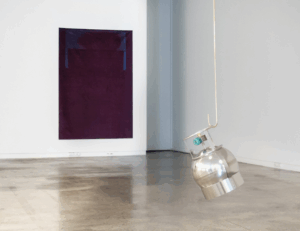
Archive of Dust, Room 18, Installation image
Archive of Dust has been an ongoing project since 2001. What continues to draw you back to dust as both a material and a conceptual subject after nearly 25 years of collecting it?
Dust is the great inevitability. Dust contains all and everything, settling almost everywhere. It is a resident of every crevice and country and is made up of all things, both synthetic and natural. Occurring as a byproduct of all activity, it marks and attacks those zones and objects that appear inactive, defunct, resting. Dust is a distinct paradox in the world of institutionalised history — something I’m really interested in — and serves as a record of all who come to visit art in its multifarious homes. The project is an active archive, and so there is an inevitability that it does go on, and on. There is no limit to the amount of dust I might accumulate.
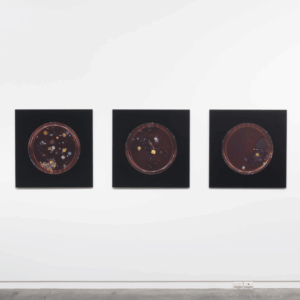
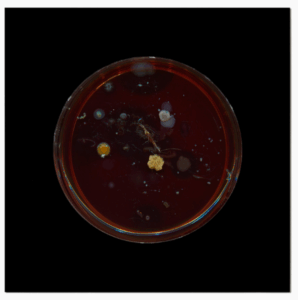
Archive of Dust, Room 18, Installation image
Can you share any interesting stories about events that have occurred while collecting dust from the museums?
I love collecting dust from museums with scant security. That allows me to run my fingers along the tops of frames, across plinths and cabinets containing objects, to then drop it in a resealable low-density polyethylene bag. I think the most elegiac dust I have is from the National Museum of Brazil. I collected dust from there in the early 2000s, and in 2018 the museum was destroyed by a fire. The only two things to survive the fire were a meteorite (given its ability to withstand the temperatures of the fire) and the dust in my archive.
Why did you focus on room 18 at the British Museum for your latest exhibition?
I focussed on collecting dust from Room 18 at the British Museum, as it is the current resting place of the Parthenon Marbles. These are hot objects — the potential of heat in the museum is another interest of mine — in that they were looted from Athens and are at the centre of current debates around repatriation. This location hopefully generates critical dialogue about contested cultural objects, institutional ‘stewardship’, and the material traces of public engagement with heritage. The project’s interrogation of dust as both destroyer and archivist might offer a perspective on how museums preserve and present contested artefacts — and how presence produces an absence, and absence produces a presence. Focussing on Room 18 allows the Archive of Dust in this instance to sit at the intersection of art-making, museology, microbiology, and cultural heritage studies.
Your work has been shown internationally in very different contexts, from Venice Biennale to regional galleries. How does location affect the way audiences engage with your installations?
I don’t really like the word audience. Maybe viewer is better. Or sniffer. Audience suggests passive reception to me, and in many respects, it is each of our responsibility to be active when we’re engaging with or in something. I don’t know. Audiences are mysterious. What do they want? What do they know?
Dane Mitchell Archive of Dust, Room 18 Two Rooms, Tāmaki Makaurau Auckland
15 November – 20 December 2025