The medieval and Renaissance informed paintings of Sophie Greig were a standout at the 2025 Aotearoa Art Fair. Curator and art writer Becky Hemus selected Greig to show in Horizons, the emerging artist section of the Fair. Greig credits the Fair as being “transformative to her practice”, providing the opportunity to introduce her work to a wider audience and engaged collectors.
Our conversation with Greig takes place as her work is presented at Ivan Anthony, as part of the group exhibition PROVENANCE III. Drawing inspiration from inherited stories, folklore, and literature, Greig’s work explores the spaces between polarities, where tension and meaning take shape.
_____
What inspired you to pursue a career in art, and how has your journey as an artist evolved over the years?
I’ve been incredibly lucky to come from a family of immensely talented artists. My mother and sister are amazing, and seeing their work and practices, along with their constant support and camaraderie, has always been my biggest inspiration. It’s the main reason I’ve kept painting.
The biggest evolution in my practice came from taking a year off from painting to focus on my BA. With little time to paint, I removed the pressure and just drew. That made drawing a huge part of my practice; my works have since become more like drawing-painting hybrids.
Your work often draws from myth, folklore, and ancestral narratives. What role does storytelling, especially inherited or ancient stories, play in your creative process?
It’s definitely where the artwork comes from—less by intention and more because I can’t really help it. It’s just how my brain works and what I keep returning to. I think there’s a sense-making, or rather an emotional sense-making, to storytelling that isn’t rational. That’s all I’m really looking to achieve with any painting. In that way, the stories I’ve inherited about my family feel the same to me as those from folklore and literature; each one feels like a tool for understanding and making sense of it all.
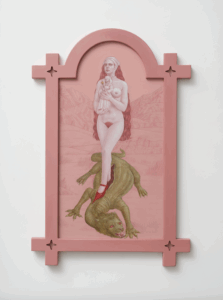
Image credit: Sophie Greig, Navity, 2025. Courtesy of the artist and Ivan Anthony.
You seem interested in dualities: life and death, sacred and profane, beauty and grotesque. What attracts you to exploring these kinds of tensions, and how do they find form in your painting?
I think the gaps between polarities, the tension between them, is where the best art comes from. It’s the juicy bit—trying to figure out how to reconcile the extremes inherent to being alive. The literary critic Fredric Jameson said stories could be understood “as the imaginary resolution of a real contradiction,” and that’s very much how I see my own artwork functioning, too.
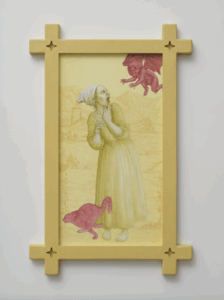
Image credit: Sophie Greig, Conception, 2025. Courtesy of the artist and Ivan Anthony.
Are there any daily rituals, materials, or even texts you return to that help ground your practice or keep the creative flow going when things feel stuck?
I’m constantly returning to my big, fat coffee table books on Flemish Primitive painters like Jan van Eyck and Rogier van der Weyden, and Northern Renaissance art in general. I also love to search for a random term and collect images like a magpie from archives like JSTOR and the Public Domain Review. Most of my paintings are Frankensteined together from the various images and stories I’ve collected.
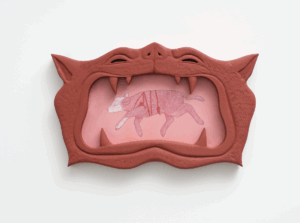
Image credit: Sophie Greig, Madigan Squeeze, 2025. Courtesy of the artist and Ivan Anthony.
How do you imagine yourself, your practice, to look in 10 years?
I hope I’m lucky enough to just keep painting — to have more time, more space, and more skill.