Curator Kenneth Brummel on ‘Pop to Present’ at Auckland Art Gallery
To coincide with Pop to Present: American Art from the Virginia Museum of Fine Arts, a landmark exhibition presented at Auckland Art Gallery Toi o Tāmaki, Aotearoa Art Fair spoke with curator Kenneth Brummel about the ideas, provocations and curatorial decisions shaping this expansive survey of post-1945 American art. Opening with an iconic 1948 drip painting by Jackson Pollock and closing with a poignant sculptural assemblage by the Alabama-based artist Thornton Dial, this presentation of 52 compelling works from the world-renowned Virginia Museum of Fine Arts offers a comprehensive overview of the principal themes and styles shaping American art since 1945. In this Q&A, Brummel reflects on questions of representation, politics and popular culture, and on how this major international exhibition resonates within an Aotearoa New Zealand context.
About Kenneth Brummel: Formerly Curator, International Art, at Auckland Art Gallery Toi o Tāmaki, Brummel now works at the Indianapolis Museum of Art at Newfields, where he oversees the European Art collection of approximately 1,000 works, including the renowned Clowes Collection, which includes a notable early self-portrait by Rembrandt. He will also lead forthcoming gallery reinstallation emphasising inclusive storytelling, global connections, and accessibility.
___
The exhibition includes 28 works by women and African American and Indigenous artists in Pop to Present. How did you and the international curators from the Virginia Museum of Fine Arts, approach questions of representation and diversity in your curatorial selections?
Alexis Assam and Dr. Sarah Powers, the co-curators of Pop to Present: American Art from the Virginia Museum of Fine Arts, created a checklist that reflects their organization’s collecting history and practices. In 1985, Sydney and Frances Lewis, who ran a mail-order catalogue business called Best Brands, donated high-quality examples of Abstract Expressionism, Post-Painterly Abstraction, Pop, Minimalism and other post-World War II movements to the VMFA, transforming the profile of that institution’s collection of recent American art. Building upon the Lewis’s progressive vision and generosity, curators since the 1990s have been actively diversifying the VMFA’s holdings of post-1945 American art with targeted acquisitions of works by Black, Latinx, Indigenous and women artists. Working closely with Alexis and Sarah, exhibition designer Scott Everson and I selected works from the checklist that fit in the Gallery’s special exhibition spaces and supported the exhibition’s aim to tell an inclusive story of American art by putting diverse artistic voices in conversation with canonical figures.
An excellent example of this is the early work by Kehinde Wiley Williem van Heythuysen which is a stunning portrait of an African American man dressed in a tracksuit and Timberland boots, in the style of the old masters. What themes or conversations do you think Wiley’s Williem van Heythuysen opens up for viewers?
Wiley’s Willem van Heythuysen (2005) raises questions about Black excellence, Black beauty, the visibility of Black bodies in the Western canon, the notion of Black aesthetics, and the representational politics of Blackness and queerness in the United States of America.
Jackson Pollock’s drip painting opens the exhibition. Can you talk about that curatorial choice and how it sets the tone?
When reviewing the checklist for the exhibition, I was struck by the superficial formal similarities between Pollock’s Number 15, 1948 (1948) and Thornton Dial’s Foundation of the World (A Dream of My Mother) (2014). To me, Dial’s polychromatic sculptural assemblage was a three-dimensional version of Pollock’s skein of white, red, yellow and blue pigments. As I wanted to honor the Virginia curators’ vision of putting diverse artistic voices in conversation with canonical figures, I asked Scott if we could center the Pollock on the opening sightline of the exhibition and place the Dial on the sightline one sees when looking through the show’s exit. To make the formal comparison we are staging between these two works explicit for the viewer, we painted the wall behind the Dial a matte black, as this is the same colour as the paper support of the Pollock. Opening the exhibition with the Pollock also made sense, as it is the earliest work in the checklist. It is, moreover, an instantly recognisable work that challenged the status quo, which is a major theme of the exhibition.
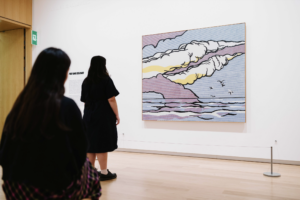
Pop art is famously known for drawing inspiration from popular culture, mass media and everyday consumer goods, but do you think works like Gullscape by Roy Lichtenstein are purely a cynical representation of American Capitalism?
All of the Pop works on display in the exhibition are critical of post-World War II American society. Lichtenstein’s Gullscape (1964), I would argue, is not a cynical painting;it is a realist painting, as its transformation of clouds into a fighter plane’s exhaust trails underlines the fact the US Army was waging a war in Vietnam in 1964, the date of the painting’s manufacture. It is a subtle political point that directs the viewer’s attention to an aspect of US society.
One of the most famous works in the exhibition is Triple Elvis by Andy Warhol. What did Warhol base this image off? You have talked about this work being highly eroticised and possibly homoerotic. Can you explain?
The three likenesses of the King of Rock and Roll in Warhol’s Triple Elvis (1963) are based on a publicity still of a 1960 Western entitled Flaming Star. What makes these depictions of Elvis erotic are his stiff and erect, upright posture, his hostile, penetrating gaze, his phallic revolver, and his double holster, whose strategic placement directs the viewer’s attention to the putative source of his masculine prowess. Such a charged representation yields visual pleasure for all viewers, heterosexual men included.
Was there a work that you would have liked to have included but you weren’t able to show?
I would have wanted to include Claes Oldenburg’s Clothspin Ten Foot (1974) in the exhibition. Unfortunately, the sculpture is too tall for our special exhibition spaces.
What’s an interesting story behind one of the artworks that people would never guess just by looking at it?
Duane Hanson’s hyperrealistic Hard Hat Construction Worker (1970) was so popular with the labour movement in North America, it was exhibited in the Labor Study Center of the AFL-CIO (American Federation of Labor and Congress of Industrial Organizations) in Washington, DC, in 1975, and reproduced on the cover of a Canadian union’s members’ magazine the same year.
What do you hope visitors will take away from experiencing this exhibition?
My hope is that visitors will leave the exhibition with the understanding that America is great when diverse voices are included in the United States’ art-historical narratives.
Pop to Present: American Art from the Virginia Museum of Fine Arts runs at Auckland Art Gallery Toi o Tāmaki until 15 March 2026.