Holly Anderson approaches painting as a way of thinking through vision, using it to translate fleeting optical experiences into structured, perceptual encounters. Drawing on geometry, pattern, and fragmentation, her work navigates the space between realism and abstraction, where images shift and destabilise as the viewer moves.
Ahead of her presentation with N.Smith Gallery at Aotearoa Art Fair 2026, we spoke with Holly about working through optical anomalies, encourgaing discovery and the hidden processes to her practice.
What got you into painting, and what’s kept you doing it?
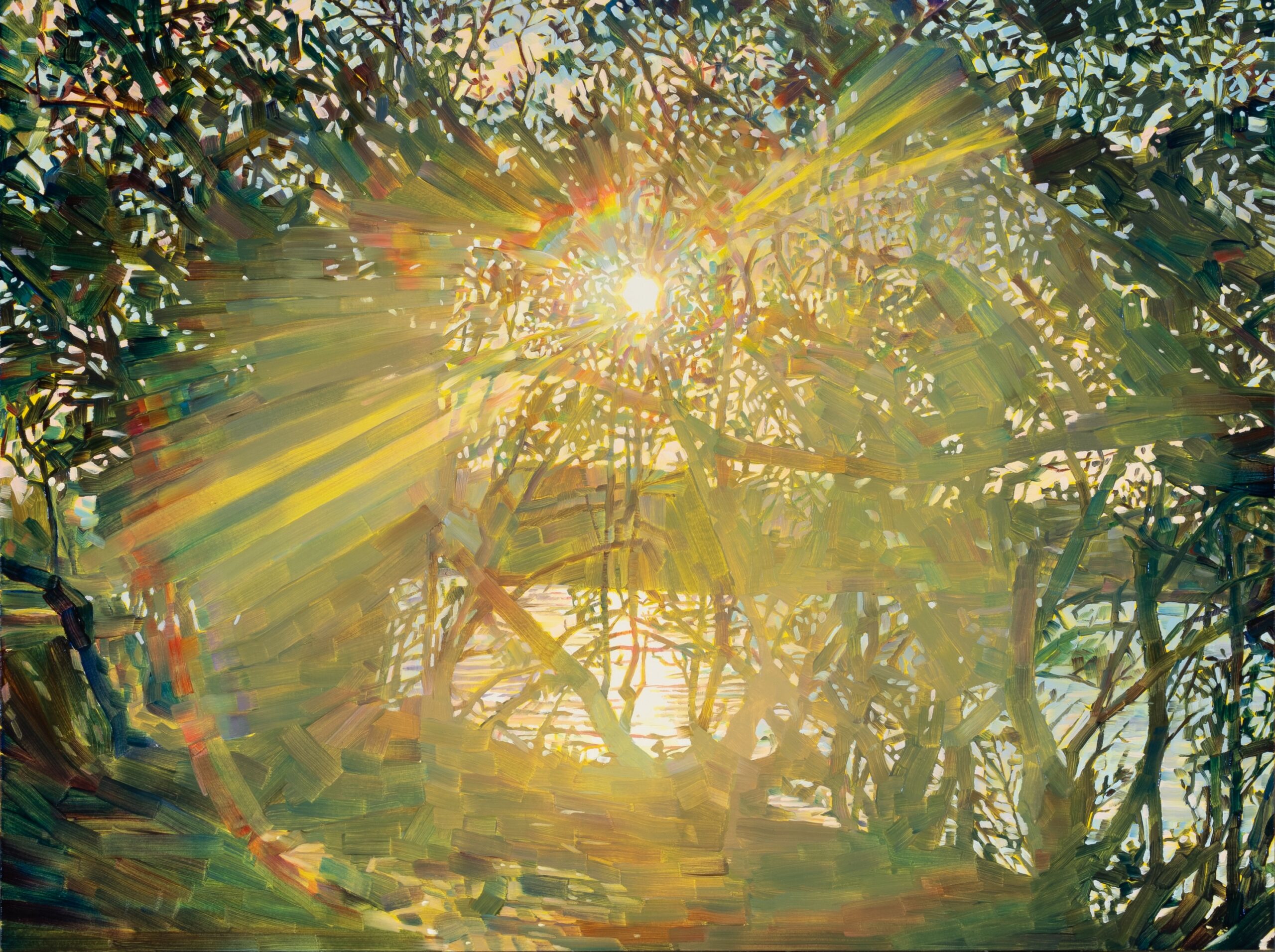
In painting I found a really useful language for articulating connections I see between things in the world. A lot of people in my family make paintings, so that visual language was always around and seemed very straight forward and pressure free. I liked that it had very specific conventions that make it useful for analysing certain ‘problems’ I encountered in everyday looking. Problems like, what did it really look like to accidentally catch the sun in my eye while I was out for a walk, or what did it look like when I confused that shadow on the water’s surface with a reflection. Painting is a great tool for me to use to think about vision and how that perceptual tool works. I’m able to work through a lot of optical anomalies I experience as spatial anomalies in painting. You can’t photograph everything, like how it looks to squint into bright sunlight; the way your eyelashes get in the way, or the image is softened by tears or infiltrated by dark afterimages. Analysing these optical experiences in painting helps me think about how I access the world. It teaches me to recognise the specificity and limitations of my perception as a part of myself.
It’s not necessarily fun per se, but immensely satisfying to transmute an inner experience of the world onto another object outside of yourself. To be able to show that bodily experience to other people and have it be understood.
Holly Anderson, Gold, 2026
Your work sits between figuration and abstraction, but the structure often comes from grids and geometry. Do those systems come first, or do they emerge out of what you’re observing?
It’s sort of both. I always like to have an underlying geometric structure to the images I make, so I often notice things around me that have a very obvious geometric structure, like a stripy curtain or a swimming pool with gridded tiles. I can tell from looking at them what it would be like to build them in the studio with painted marks. In some other paintings though, like those of trees in a forest, the underlying structure is more hidden from everyday looking, more complicated, and by painting them I get to draw out that structure by building the surface of the image with individuated block-like marks, finding the structure as I go.
There are a few reasons why I’m interested in these geometric structures in painting. Firstly, I find that areas of dense pattern can have a disorienting effect on the viewer’s eye that feel a lot like encountering bright sunlight out in the world. It’s hard to understand things like depth and perspective, for example, when you accidentally catch a blast of sunlight to your peripheral vision. Dense patterns can have a similar effect on our eye’s ability to interpret depth. Secondly, I consider my paintings altogether as part of a wider investigation and I like that all of my works are unified with these same underlying geometric structures. It emphasises the style of the eye’s seeing, the optical qualities, over the pictorial content or subject matter of the painting.
Holly Anderson, Pool (the secret garden), 2025
You use flatness and fragmentation while still holding onto realism. What are you trying to keep from the original scene, and what are you willing to lose?
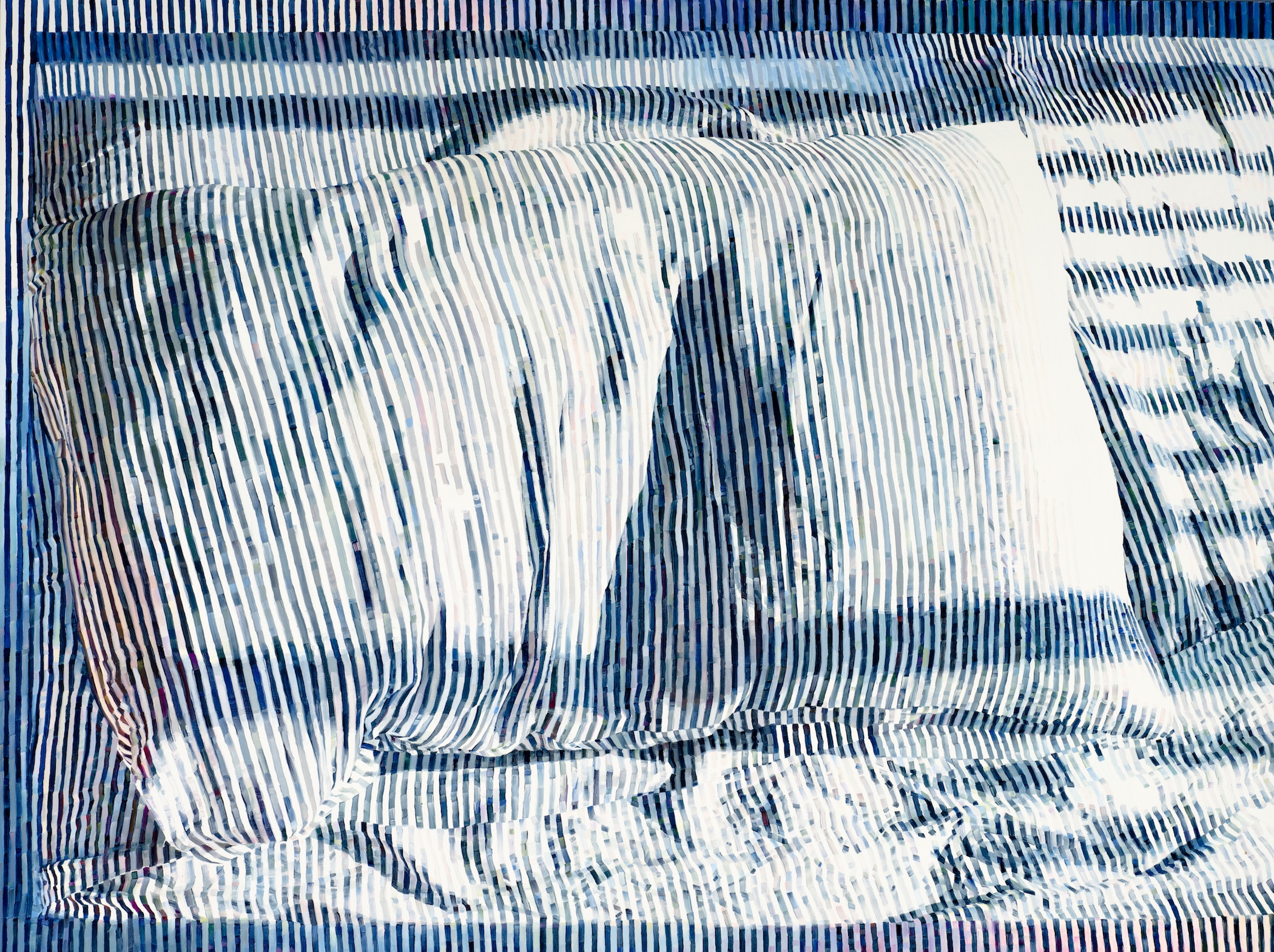
I like to retain a sense of realism to create an interesting experience of discovery for the viewer as they move around the work. I like that from across a room, a picture of an unmade bed might appear very realistic and seductive, but then when you approach it, your eyes might struggle to focus on its densely patterned striped sheets, they jiggle about in dazzling sort of way, rushing you on. You see at a close range that each stripe on the sheets is made of different coloured dashes placed one after another and that there is nothing holding these lines together on the painting’s surface, its just white empty space between them. I think this level of realism works to amplify a sense of strangeness about the objects depicted. It invites a kind of looking that changes and morphs from one reading to another depending on your perspective position. This way of looking and discovering feels very true to how we see the world, details are always giving way to more details.
Holly Anderson, Candle, 2025
How do you know when a painting isn’t working, and what do you do next?
I know when a painting isn’t working if it pushes too hard into realism and its difficult to see the structuring of the surface. Realistic images are really seductive, and when you see one its tempting not to look any deeper than its lovely sealed surface. The big thing I want to observe in my paintings is how we see. If the subject matter of the work is sealed off the painting starts to become more about what is in the picture, like a pillow or a glass, and those things are not the parts I think are interesting about the work. Because I paint ‘alla prima’ or wet-on-wet, I can’t really go over anything later, so there’s not a lot of options for fixing an area that’s not working. It’s quite all or nothing!
The other problem I encounter is if paint gets on an area of the surface that needs to stay empty negative space. Anything you see that is white in my paintings is the primed white board peeking through. I use negative space in all my paintings to describe areas of bright light, and so if this illusion is broken with a mistake I either have to rethink the composition, or I have to start again.
What’s something about your process that people would be surprised by?
Maybe that I do a lot of writing to get my head straight about what I’m making. This writing doesn’t see the light of day usually, but it’s an important part of my thinking that goes into the work. I also don’t do a lot of preliminary drawing before I start on a painting, its usually just one tiny thumbnail with a caption and then I’m out on my own at the easel trying to build it.
Holly Anderson, The graph, 2024
Where do you see yourself, your practice, in 10 years?
In 10 years I hope I’ll have come up with some new ways of structuring the images. The way I do it at the moment requires a heavy cognitive load and is very slow and physically demanding. I do think there is value in that for the work though. I like for example, the sort of neurotic intense energy that those difficult structures of marks produce. But I wonder often about a way to create them that feels as easy and free as it is to see them. When I look up at a canopy of leaves all of those patterns and shapes and colours appear in the eye with such ease, they have an alreadiness about them, a steadiness of structure that I am always trailing after.
Learn more about N.Smith Gallery’s presentation at the Fair here
Aotearoa Art Fair returns to the Viaduct Events Centre from 30 April – 3 May. Tickets are on sale now.