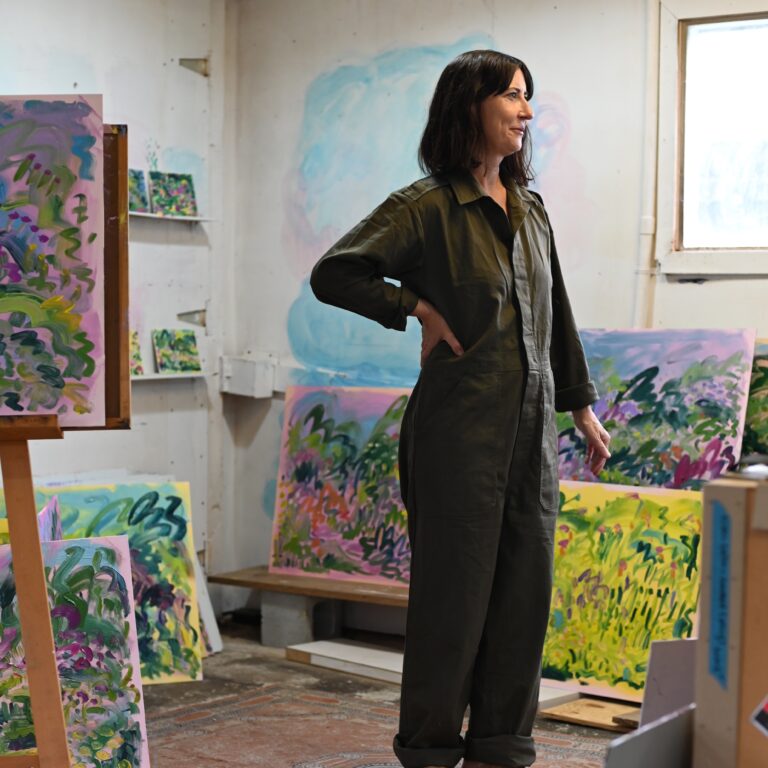
Rooted in Te Whare Pora as both a physical and spiritual state, Peata Larkin explores holding, endurance, and the transmission of ancestral knowledge through weaving traditions of raranga and tāniko.
Ahead of her presentation at the Aotearoa Art Fair with both Two Rooms and the Sculpture Trail, we spoke about the role of movement and scale in shaping experience, and how reflective, layered materials create a dialogue between lightness and weight, earth and atmosphere. Larkin’s work extends beyond objecthood, drawing viewers into a shared relational space with Ranginui and Papatūānuku.
__
 Ka Mau, Ka Ora speaks to holding, endurance, and the transmission of knowledge. How did these ideas shape both the concept and structure of the work?
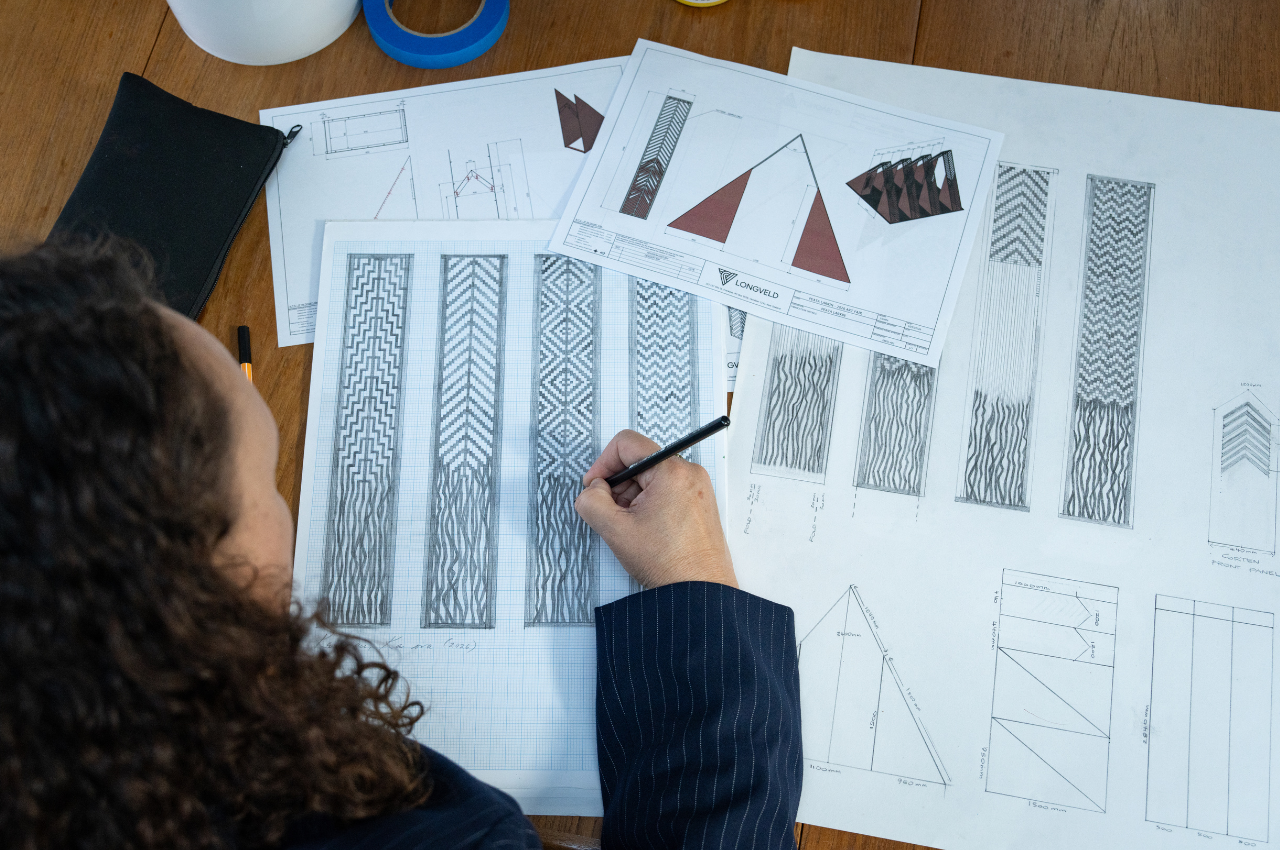
I wanted to express Te Whare Pora as a state of being, not just a physical place. Two key elements shaped this: drawing on ancestral raranga and tāniko forms, and grounding the work in the whenua it sits upon. These patterns carry knowledge, so they became a way to speak to both the space of Te Whare Pora and its deeper connections.
The 4 structures together resemble the shape of a whare, but they also create a passageway for people to walk through. It was important for the work to be experienced physically, as an entry point into the Aotearoa Art Fair. Moving through it becomes part of the work, a transition into another space.
The sculpture also honours and celebrates Hineteiwaiwa, guardian of Te Whare Pora, and atua of childbirth and the creative realms of wāhine Māori. She represents the continuation of life, navigation, and protection, so every element acknowledges wāhine Māori and the relationship between Ranginui and Papatūānuku.
I want people to feel that as they move through the work, they are entering my interpretation of Te Whare Pora, held within the presence of Hineteiwaiwa. I hope they can feel the wairua of that experience.
 Hineteiwaiwa (detail), 2026
 Hineteiwaiwa (detail), 2026
This work invites audiences to move through and beneath it. What role does the body, and embodied experience, play in how you want the work to be understood?
I’m drawn to sculptural installation because it behaves very differently to painting. It can interrupt, direct, and shape how a person moves within a space. My intention is to create a bodily experience where the viewer becomes part of the work, woven into the kaupapa rather than standing outside it. I want to create an atmosphere where the wairua and aroha of weaving can be felt. Scale plays an important role in this. I wanted the work to have an architectural presence, large enough to stand beneath and walk through comfortably, while still operating at a human scale so the experience remains intimate. It holds the body, rather than overwhelming it, which is reiterated in the narrow panels of each structure.
The materiality contributes to that experience. The laser-cut stainless steel has a reflective, almost ethereal quality. It allows people to catch glimpses of themselves within the work, but never as a complete or fixed image. The reflection is fragmented, shifting, and partial. The structure also draws the body upward and outward. It invites you to look up toward Ranginui, to feel the warmth of rā, and to notice the shadows moving across your body and the ground. In that moment, the viewer becomes aware of themselves within the shared realm of Ranginui and Papatūānuku.
The painter in me loves the evolving surface quality of Corten steel as it weathers. The Corten acts as the punga, the anchor. It brings weight and painterly effects, grounding the work in contrast to the lightness of the reflective stainless steel. I’m interested in that interplay, between the ethereal and the earthly, lightness and weight. These material qualities shape how the work is felt, not just how it is seen.

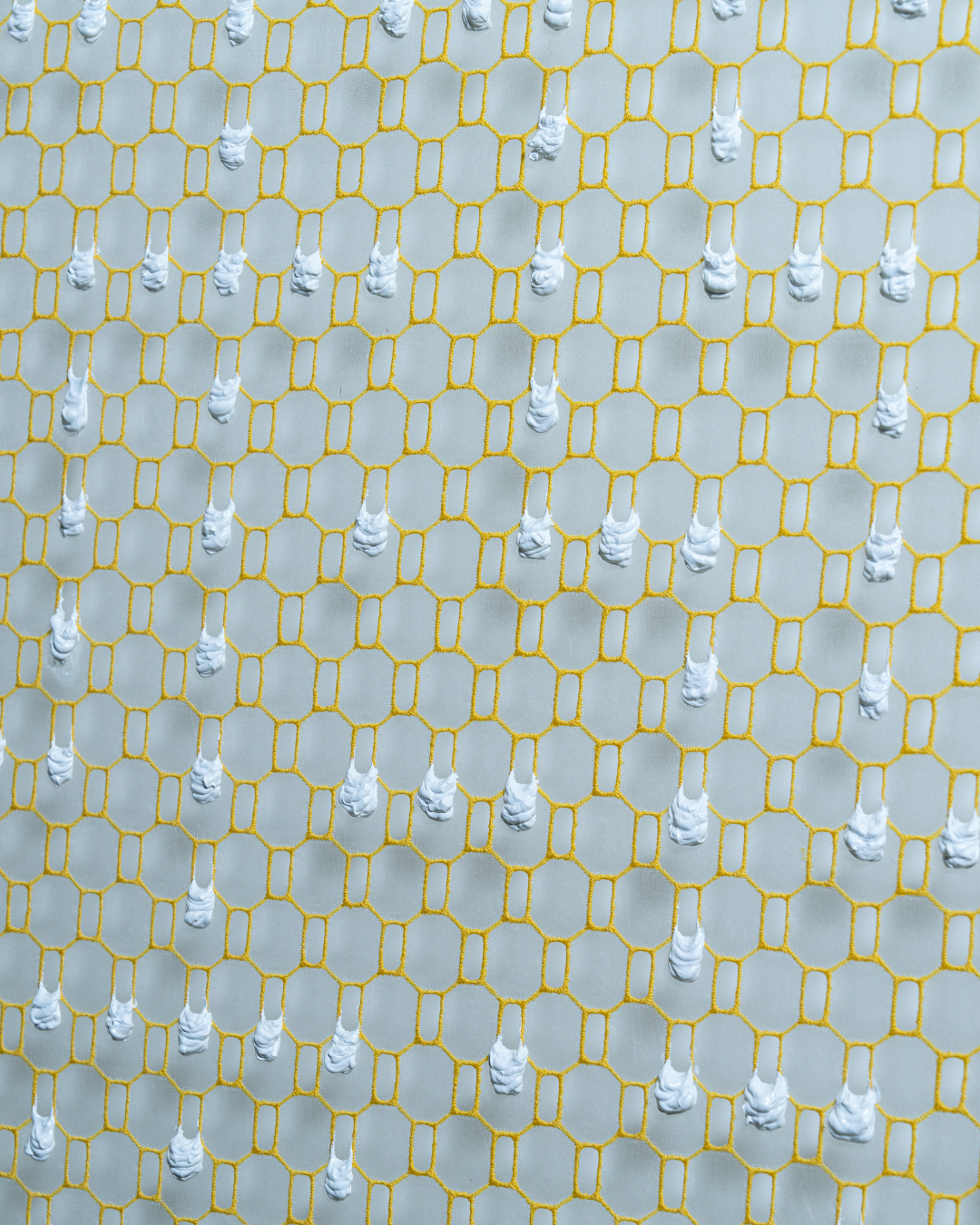
Silent Kōrero (detail), 2026
Hineteiwaiwa and the traditions of Te Whare Pora are central references here. How do you approach bringing these deeply rooted frameworks into a contemporary, public context?
One of the most powerful moments for me in recent Aotearoa history was when Rawiri Waititi said, “You may not know your maunga, you may not know your awa, but your maunga and awa know you… You may not know your reo, but your reo knows you.” That whakaaro stays with me. I see mahi toi, whether traditional or contemporary, as an extension of that idea, an expression of an unseen connection that exists within us.
There is something that stirs when we encounter our culture, whether we feel connected to it or not, whether we feel worthy of it or not. I know this because I’ve experienced it myself. As a young wahine, not knowing my whakapapa was confusing and painful. There was a deep sense of mamae and whakama. Creating became a way to move through that, a way to process and transform those feelings. It allowed me to find strength. Each work became a declaration of identity, a way of saying I am Māori, and that truth cannot be taken away.
Bringing frameworks like Hineteiwaiwa and Te Whare Pora into a contemporary, public context comes from that lived experience. I approach it through my own lens, understanding that my voice is shaped by both disconnection and reconnection. Everything I learn is carried into the work, and translated through my practice. In that way, the work sits both within my personal journey and within a wider continuum of tangata whenua.
Acknowledging and celebrating Hineteiwaiwa and Te Whare Pora is central to this because it is through these frameworks that I found my voice, my strength, and my sense of identity as a wahine. While my journey with te reo is ongoing, I feel deeply connected through making, through the inherited knowledge held in the hands of my tīpuna. To bring this into a public space for the Aotearoa Art Fair is an honour. This work celebrates wāhine Māori across generations, those who create, who nurture, who carry knowledge. By moving through and engaging with the sculpture, people are not only witnessing the kaupapa, but physically and, I hope, emotionally, acknowledging it as well.
How does the setting of the Sculpture Trail, alongside the Viaduct Harbour, shape the way the work is experienced?
It is important for me to acknowledge the whenua that the work sits upon. The repeated forms evoke Aramoana, the pathway to the sea, responding directly to its placement alongside the Waitematā Harbour. The sculpture also functions as a passageway, marking an entry point into the Aotearoa Art Fair. As people move through it, they pass by and beneath forms that reference kaokao, offering a sense of protection to all who enter. In this way, the location shapes the experience. The work is not separate from its surroundings; it is in conversation with the harbour, the whenua, and the movement of people through that space.
What work are you presenting with Two Rooms inside the Fair, and does it mark any new directions in your practice?
The work I’m presenting with Two Rooms is a large painting/lightbox titled Hineteiwaiwa. This sits within a series I began last year for Sydney Contemporary, starting with Mahuika, the atua wahine of fire. It felt apt to create Hineteiwaiwa given the sculptural installation placed outside the Fair.
I hadn’t created any painting/lightboxes for several years, one of the last being the large 5.5m x 11m painting/lightbox panels hanging in the Park Hyatt hotel lobby, located across from the events centre. The pull to create a new series of illuminated paintings was strong. I think materiality in my practice often operates at a subliminal level. For example, my silk works hold a tension between fragility and strength, which reflects what I’m exploring in those pieces. The materiality becomes part of the storytelling. The painting/lightboxes, on the other hand, speak more to states of personal enlightenment and otherworldly realms. That’s why I’m drawn to using modern materials in these works. They carry a contemporary energy and place the work within a present-day context. There’s also a connection to the visual language of screens and digital imagery, which feels relevant to how we experience the world now.
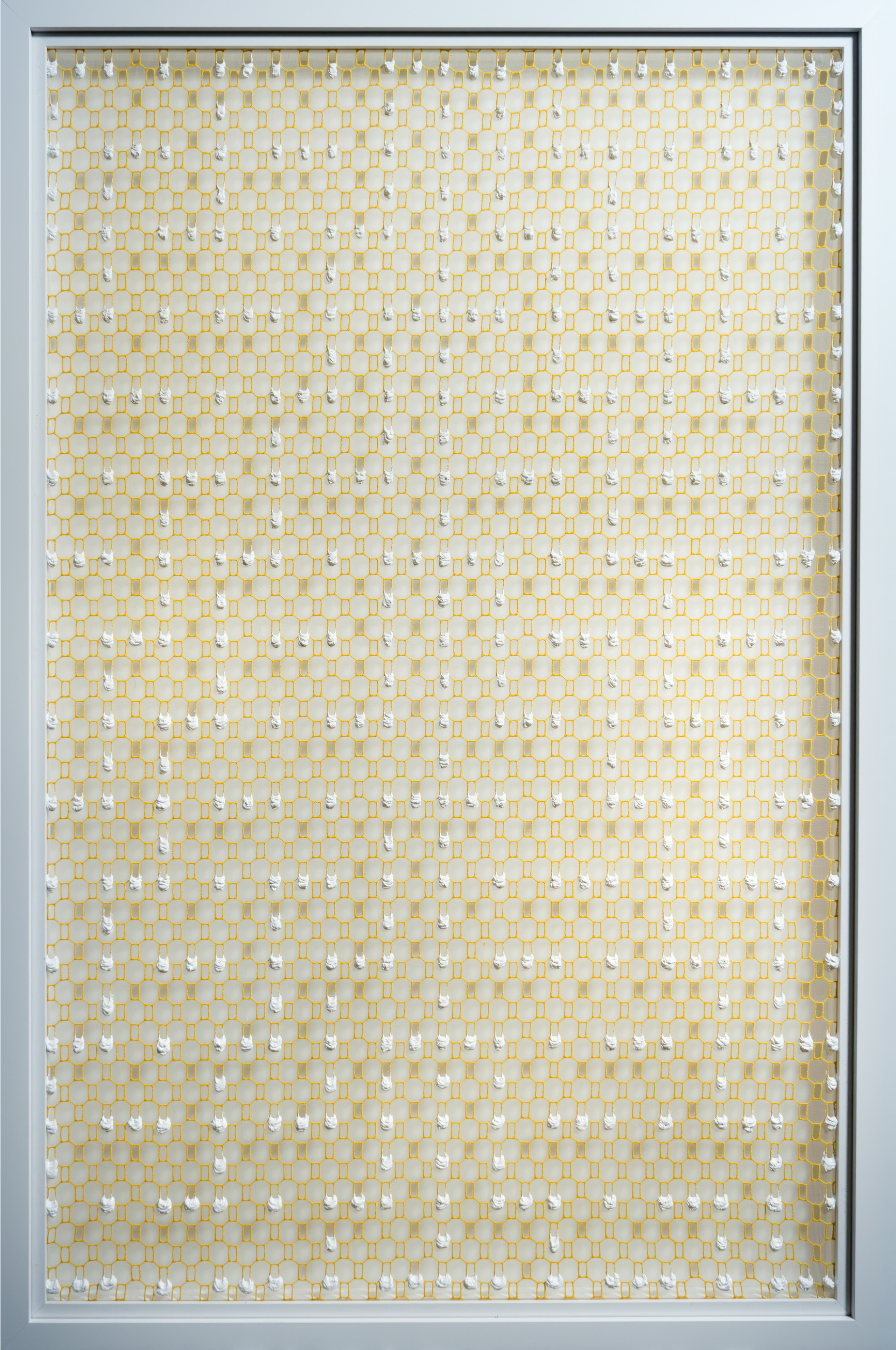
At the same time, I’m aware of painting as part of a long lineage. The act itself carries history, and I see my practice as both within and beyond that, where my paintings and sculptures move together, each informing the other, to shape a more holistic voice. Alongside Hineteiwaiwa, I will also be presenting a silk painting from my new Silent Kōrero series, titled Silent Kōrero (Mā_2026).

Silent Kōrero, 2026
Where do you see your practice evolving in the next 10 years?
I’ve been creating for over 2 decades, and I’ve never looked that far into the future, and I don’t intend to start now. I see each day of creating as a privilege. Every work, whether a painting or a sculpture, is informed by what came before it and shaped by lived experience, moments, feelings, and what I continue to learn from my whānau and iwi.
That’s how my practice evolves, through doing, through responding, through learning. I don’t try to map it out too far ahead. What I do know is that I will keep creating. It feels essential, like breathing. Where it leads, I’m open to that… It’s a beautiful journey I don’t take for granted.
Learn more about Two Room’s presentation at the Fair here
Aotearoa Art Fair returns to the Viaduct Events Centre from 30 April – 3 May. Tickets are on sale now.