Jake Walker’s practice is defined by a relentless commitment to the handmade. He crafts intimately scaled abstract paintings that exude personality, self-sufficiency, and autonomy. His work embraces the tactile and resourceful nature of creation, standing in deliberate opposition to the uniformity of mass-production. On the occasion of his first show with {Suite} Gallery, Auckland, we spoke to the artist about his process, his evolving approach to painting and ceramics, and the ideas behind his new body of work.
__
Your paintings resist structure and embrace spontaneity. What draws you to working in this space where order gives way to chance?
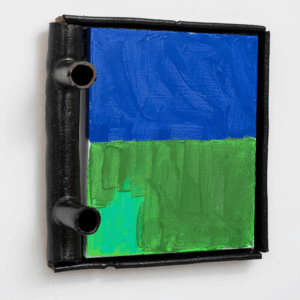
I usually have some idea of what I’m aiming for, but often when I get there it doesn’t live up to the vision so I destroy it and make something else that works with the frame. It’s best if I’m not wedded to an outcome and just hold the brush.
Image: Jake Walker, Blue/Green, 2025, Oil on linen, glazed ceramic, 540 x 530 x 20 mm
You’ve described connections between “informalism and graffiti”. How do these two visual languages come together in your work?
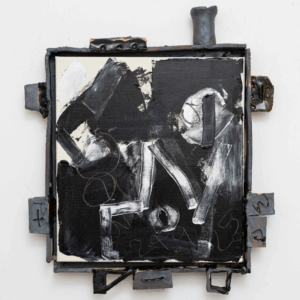
Graffiti was the first painting movement that really interested me. I remember watching Style Wars on TV in 1983, which I thought was going to be about break dancing, but it turned out to be about the NYC graffiti story. I loved the colourful technical pieces but as I got older I became more interested in tags, burnt out subway cars, the palimpsest of a hundred buffed out pieces, and the accidental/incidental and informal aspects of the painted surface. The ceramic component of my practice has allowed the informal to flourish.
Image: Jake Walker, Alley Cat, 2025, Oil on linen, glaze, ceramic, oxides, 570 x 500 x 40 mm
You often talk about the “unresolved” as a space to stay within. What does that mean for you in practice, and how do you know when a work is finished?
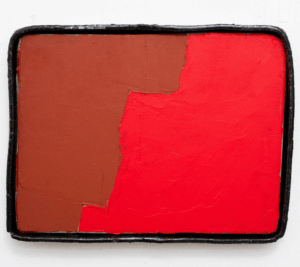
I teach painting and my students always ask ‘how do you know when a painting is finished?’ My reply is always “Stop before you think it’s finished”. I’ve said it so many times that it’s become a habit in my painting. Let the viewer fill in the blanks, leave some potential in the painting.
Image: Jake Walker, Crack, 2025, Acrylic on linen mounted on plywood, glazed ceramic, 360 x 470 mm
Having lived in both Aotearoa and Australia, do you see those different environments influencing your materials, palette, or sense of surface?
Aotearoa is vivid green compared to Hobart – it’s dry here, second only to Adelaide. Nipaluna (Hobart) shares something in common with Wellington and that’s the proximity of the hills to the built environment, they loom over the city and are a constant reminder of the wilderness beyond. I love the constant contrast: the trees then on the street, the land ends, the sea appears. I lived in Melbourne for years and it felt foreign, flat, grey and endless. It’s probably the reason the city is so vibrant with energy flowing inward.
Looking at this new body of work at {Suite}, how has your practice evolved since you first started exhibiting?
It’s simpler and more decisive. This show contains the biggest ceramic frames I’ve made to date – my skills are sharpened but my intention to be rough shines through.