Curator Natasha Conland on ‘Louise Bourgeois: In Private View’ at Auckland Art Gallery
Louise Bourgeois: In Private View is the first solo exhibition in Aotearoa New Zealand of Louise Bourgeois (1911–2010), one of the most intriguing and influential artists of the last century. This exhibition invites visitors into an intimate conversation with Bourgeois’s work, spanning more than six decades of her practice.
We spoke with Natasha Conland, Curator of Global Contemporary Art at Auckland Art Gallery, about the significance of bringing Louise Bourgeois: In Private View to Auckland, the curatorial decision to present the work in an intimate format, and what it means to experience Bourgeois anew, up close, and at a human scale.
Louise Bourgeois: In Private Viewis on now at Auckland Art Gallery Toi o Tāmaki until May 2026. Learn more on aucklandartgallery.co.nz.
_______________
What makes Louise Bourgeois: In Private View such an important exhibition for Auckland Art Gallery to present?
Louise Bourgeois is one of the most influential artists of the 20th century. Her career spans many of the key artistic movements of the period, and yet she remains the model of an independent figure – informed by a period of heightened change in the arts but equally rearranging what she saw into her own unique vision. Many artists and art enthusiasts from Aotearoa New Zealand will have spent time looking and thinking about her work. There have also been a great many publications and exhibitions internationally on her – but the chance to spend time with the work, as much or as little, through this free exhibition is a rare treat.
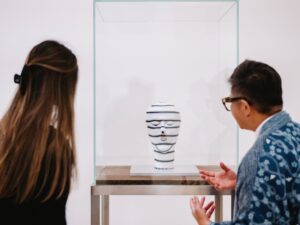
Image: Louise Bourgeois, The Couple, installation view, 2003, aluminum, on loan from a private collection.
This exhibition takes a deliberately intimate approach rather than being a “blockbuster” style show. What led you to choose this contemplative format? How long have you been working on this exhibition?
The artwork comes from a private collection. It has been lived with in the home, so for reasons of necessity, it is domestic in scale. This interests me. Louise Bourgeois herself spent the larger part of her career developing work from her home. I imagined when I was developing the exhibition, the transfer of artistic ideas from the home of the artist into the home of the collector. I asked myself what It must feel like to live intimately with an artist of this strength and power? How does it impact your experience of art, and what do you learn from it when you see it every day? The Gallery had the opportunity to work on an exhibition with some of the larger late works, and there has recently been a large scale exhibition in Sydney of her work, but what I found the more I lingered with the prospect of making this exhibition, is that sometimes when you think you know an artist’s work well, and are hit with its drama – perhaps you stop thinking about it and stop feeling it at a human scale. So, this was about re-experiencing Louise Bourgeois at a human scale. This had always been her intention with sculpture – to develop work in relation to her body that would be experienced in turn by our own bodies.
As the work comes from an anonymous private collector, is this the first time it has been shown to a public audience?
Yes, this is the first time that the collection has been exhibited together. So, both for myself personally and the Gallery staff we are honoured to obtain this level of trust and recognition from these collectors who have entrusted us with their work. It is also a unique process to convert the privately known and loved experience of art into a public one, and not in the process foreground the family and their own personalities, rather to foreground the experience of the work – to ask what kind of interest and attachment Louise Bourgeois and her work might provoke in us?
Image: Louise Bourgeois, Untitled, installation view, 2004, fabric, wool, steel, on loan from a private collection.
The exhibition spans more than sixty years of Bourgeois’s practice. What story did you want to highlight through the selection of works?
Because of the nature of the collection, it was a particularly unique opportunity to balance her late works in company with a strong grouping of work from the first decade of her exhibiting life. In the first room I have focused on her early exhibitions of painting and the establishment of her interest in sculpture. Rather than seeing this as a break in her interests, I have tried to focus on the development of her artistic expression, and a thread of her practice which is concerned with the relationship between the human, the built environment, and the natural/plant world, which was of particular interest to her in this early period. When Louise had her first major retrospective at the Museum of Modern Art, New York, in 1982 at age 70 she opened up enquiry into her personal life. In some respects, this period pre-dates that obsession. Here you see her exploring the relationship between the individual and the group, between the life of one thing and its ecology or if you like its social landscape. In these extraordinary paintings like Natural History #3, 1945 we can see her potential to grow in expressive power as a painter, through the unique concentration of subject, form and space; but we also feel her frustration as she moves into three-dimensions, yearning for the possibility to enhance form in proximity to her own scale – the scale of the body. The analogy she makes at the time about the needs of a human and the comparable need or cycle of life in the plant world feels very contemporary. I speak here of a widespread interest in understanding the Anthropocene, the current geological age, which separates humanity from the natural world, and the need for us as humanity to find new models.
Bourgeois’ works often seem to be autobiographical, reflecting her emotional state and trauma from her childhood. What impact did her relationship with her mother and father have on her work?
This is a very large question, and it dominates much of the literature written on Louise Bourgeois, partly directed by her, as she launched the story of her childhood at the point in which a larger population was introduced to her work through her MoMA retrospective. Critics have rightly pointed out that in the end, this is also a story, a kind of performance in which Louise playfully directs us to a form of intensified personalisation. For her undoubtably there is a powerful set of human emotions and memories attached to her work, but she was equally sure that in the end, the viewer will associate the work with new meanings and associations. In other words, meaning is not fixed to her own life story, but she herself had a lifelong interest in psychoanalysis and its potential to be a great source for understanding and interpretation. For its ability for example, to help us decode memories, social and family groupings, and the mythology of the individual.
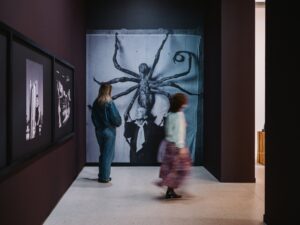
Image: Peter Bellamy, Louise Bourgeois with Spider IV, installation view, 1996.
Bourgeois work is often associated with surrealism and feminism. Why did she resist being associated to these movements?
Louise Bourgeois consistently denied the influence of Surrealism in her work, despite being associated with the movement, particularly through her work with Atelier 17, the printmaking workshop in New York where she engaged in printmaking over a long period of time and which was a site for much surrealist activity. While it is possible to see the influence of Surrealism in the early prints in the exhibition – He Disappeared into Complete Silence, 1947, through the use of free association and a play with unconscious rather than overt meanings, she disliked the emphasis in the movement on the analysis of dreams, and was known for disavowing a tendency towards the depiction of what she considered masculine subjectivity within the movement. As a rule she tended to avoid attachment to artistic movements, however she was much upheld by the growing feminist movement in the 1970s for her ability of her work to speak so holistically of the female experience – the experience of being confined to the home, pregnancy, sexuality and a certain potency – these are expressed in key works such as Femme Maison 1946-47 and Nature study, 1982 which features a hybrid wolf-female figure.
Bourgeois’s art is personal yet universally resonant. What do you hope visitors will take away from experiencing her work up close?
In some respects, there is a great simplicity of form in her work which resonates , and if we can still speak universally, it is for Its ability to attend to the full scope of human feeling, impulse and desire. These are not emotions that separate us, rather they are core attributes that are differently defined depending on our experience of life, time, culture and society. So when large swathes of visitors experience Louise Bourgeois’ work, they tend to find something in these sometimes quite abstract forms and ideas which resonate at a deeply personal level, this is surprising and extraordinary to watch. A gift that she provides by going deeply into the human question, and pulling out works that range across agitation, love, sexuality, constraint and many more states of being.
_______________
Natasha Conland is senior curator, global contemporary art at Auckland Art Gallery Toi o Tāmaki. She has over 20 years’ experience developing exhibitions of contemporary art, and has written for a number of contemporary arts journals and catalogues in the Asia-Pacific region. She co-edited Reading Room, a peer-reviewed journal of contemporary art published annually by Auckland Art Gallery Toi o Tāmaki, 2006–18. She has a long interest in performance, art in public space and the dissemination of the historic avant-garde.
_______________
Louise Bourgeois: In Private View is on now at Auckland Art Gallery Toi o Tāmaki until May 2026. Learn more on aucklandartgallery.co.nz.
Proudly supported by Auckland Art Gallery Contemporary Benefactors.