Working at the intersection of painting, poetry, and speculative imagination, Ruth Ige approaches image-making as a layered act of world-building, where time, ancestry, and diasporic memory collapse into shared space. Guided by intuition and a deep material connection to her practice, Ige’s works unfold as meditative portals, holding histories, futures, and multiple states of being in tension and harmony.
Ahead of her presentation with McLeavey Gallery at Aotearoa Art Fair, we spoke with Ruth about the poetic foundations of her São Paulo Biennale project, the role of time as both witness and material, and how her practice continues to expand.
Cover Image: Esther Ige
___
Your recent São Paulo Biennale project For time is the witness of humanity carries a powerful title, what were you exploring through that body of work?
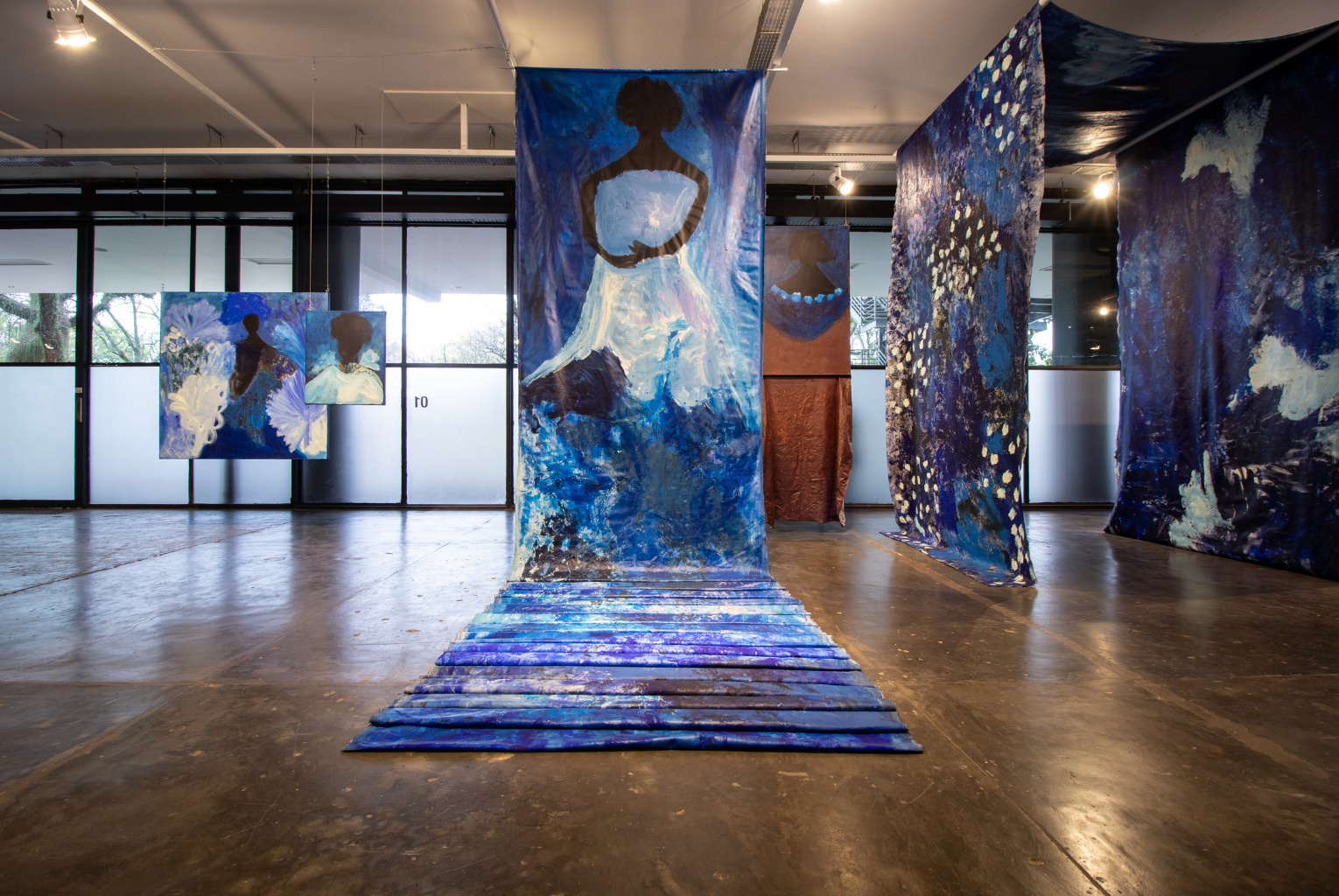
Bonaventure’s approach to the biennale is very poetic and deeply layered. The 36th São Paulo biennale is titled, Not all travellers walk roads-Of humanity as practice. Poetry is an important aspect of my practice. They go hand in hand. Titles of works and exhibition texts are an extension of my writing practice and poetry. Furthermore, I usually write a poem for each body of work I create. So, for the body of work for the biennale, I wrote a poem by the same title of my biennale work. In the first two lines I wrote, The many waters of our being, / Time you have seen it all.
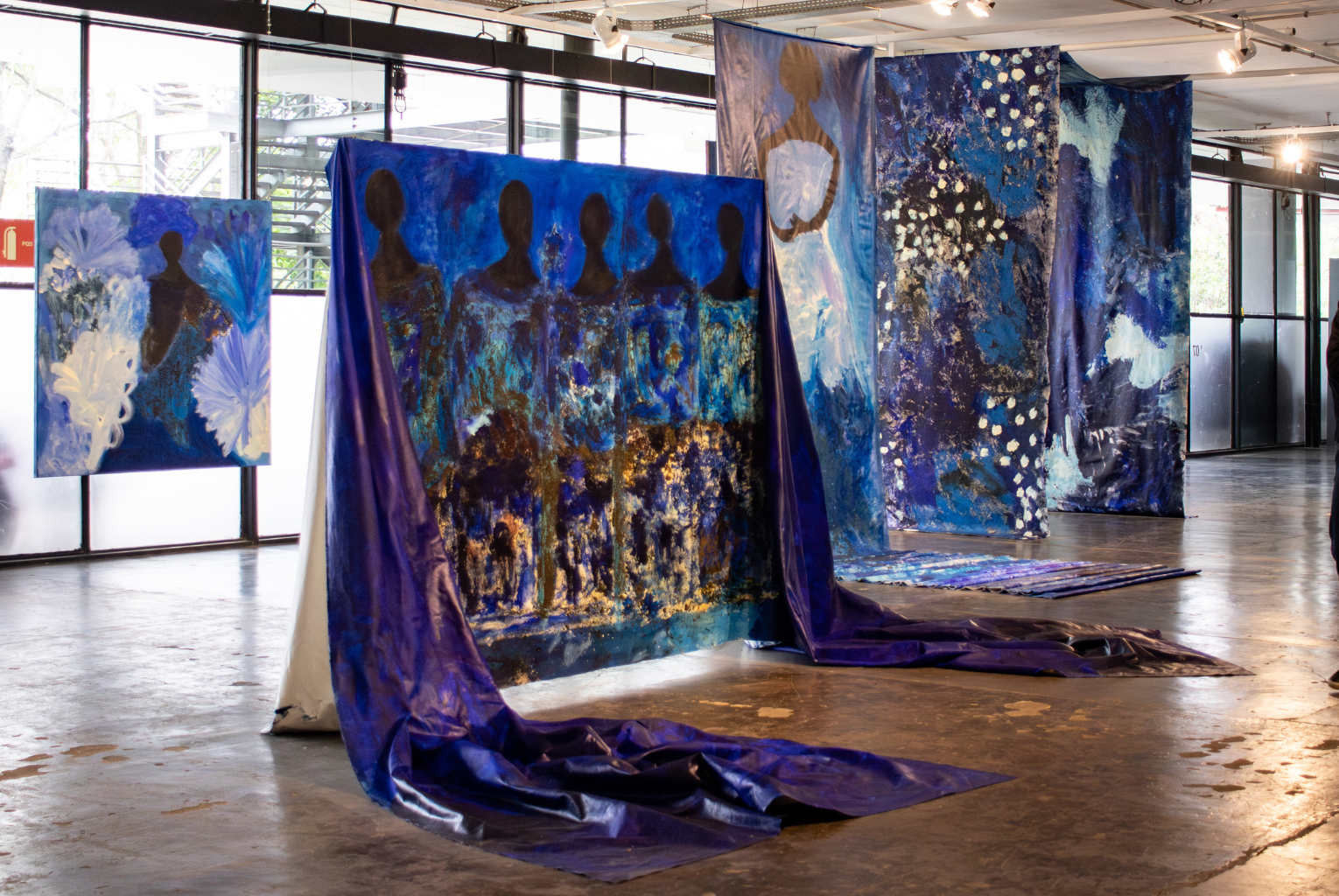
I saw time as an access point to discuss ideas of humanity, diaspora and ancestry. Time has always been a major part of my practice. In my work the past, present and future coexist in the same space. There is no separation between those three-time realms. Speculative fiction language and concepts are often the vehicle I use to talk about serious and complex topics in a way that brings a poetic approach. For the biennale I began to imagine time as this person or being who has witnessed all the progress of our humanity. The paintings are built around that personification of time. but it is also a meditation of time. It is also about the humanity lived through it. The thing about time is that we all must experience our lives and humanities through its abundance and constraints. In the paintings there are both mortals, immortals, ancestors and those in the future all practicing humanity in different ways, but coexisting.
Even some of the materials I used harken to time. For example, within some of the paintings I have materials such as Baobab leaf powder sourced from Nigeria. Baobab a tree native to Africa is one of the oldest living trees that has been coined as the “tree of life”. It lives for thousands of years and is mentioned in various African mythologies. Using a material that has been present during humanity for thousands of years, that has witnessed it all even the parts lost, forgotten and stolen is a powerful alignment for me conceptually. It also seen as a bridge between the heavens and the earth. A symbol of interconnectedness between nature and humans and the mundane and the spiritual.
The body of work overall is also an archive of black diasporic life. I am Yoruba and there is a strong cultural tie between Brazil and the Yoruba people. Those diasporic ties, spiritual ties and historical ties are also explored in the body of work. The body of work is a complex web of humanity and all the parts that it embodies. So, it is both historical, philosophical, anthropological, spiritual, ancestral, psychological and mythical. It is quite a layered body of work that has various threads of connections that make a whole.
For time is the witness of humanity, São Paulo 36th Biennale. Photo: Natt Fejfar / Fundação Bienal de São Paulo
What does it take, practically and mentally, to sustain momentum after a busy year like you’ve just had?
For me, it is to not lose sight of what has drawn me to art. I try to surround myself with things that continue to inspire me to paint and create. I fill up my spirit, heart and mind with things that empower me and liberate me. I am such a workaholic, but I have been recently learning to pause and rest during my busy schedule. Even if it is just for a day. I am still practicing that aspect. I do feel I am getting better at it. Recently I have taken various breaks from social media and emails when demands start to pile up. Then I return to tackle what needs to be done. I am still figuring out the best holistic way that works for me. However, I am truly grateful for all the wonderful opportunities.
For time is the witness of humanity, São Paulo 36th Biennale. Photo: Natt Fejfar / Fundação Bienal de São Paulo
How do you know when a work is resolved, especially within a practice that embraces ambiguity?
Intuition is major guiding force in my practice. There are elements in my work that are fixed such as my blue palette, the black figure and various cultural elements. However, intuition is how I navigate and respond to each brushstroke. I know a painting is done when there is a certain emotional response, I get from looking at it. There is a certain knowing I feel. Even if a painting looks resolved and I do not feel it is there, yet I will continue to work on it till I get that inner resolve that it is ready. I believe it makes each painting special and unique, because each was brought about by a different response or inner conversation.
Painting is truly having a conversation with the canvas. Sometimes it is a long passionate conversation. Each brush stroke spherically ascending to create form. Sometimes it is just listening. Sitting after each brush stroke and allowing it to lead. Sometimes it is just like breath, meditation and ancestral veneration where you connect to something bigger than yourself and pour that out onto the canvas. Painting is both magical and mundane. That is the thing that fascinates me about it.
Ruth Ige, Twins (Immortals), 2025. Photo: Cheska Brown
What can audiences expect from your presentation with McLeavey Gallery at Aotearoa Art Fair?
I am going to be showing my work alongside the amazing Zhu Ohmu. I will be presenting a small selection of my body work, The poetic notions of blue: A safe haven, which was recently awarded the Rydal prize. It exhibited in Wellington and so I am thrilled to show a selection of the work to the Tāmaki Makaurau audience. I will also be showing some new works on paper in conjunction to those works. The works on paper will be little snapshots or time portals to those havens
What kinds of conversations do you hope your work opens up for viewers?
I hope it opens conversations around ideas of perception. What are the ideas that we use to perceive the world and those around us. Especially when we perceive those different from us. Learning to not look at people with fixed stereotypes that have been systemically placed to oppress those very people. That instead of having a fixed conclusive assumption of someone it is ok to not to know. Instead, it is ok to just listen. I also hope that the paintings allow people to meditate, to escape, to rest, to heal and to wonder beyond their own realms of understanding into other distant realms. I hope that people see the multiplicity of blackness that has always been.
Ruth Ige, Garden (A haven), 2025. Photo: Cheska Brown.
Where do you see your practice evolving over the next decade?
Wherever the spirit of creativity takes me. I see my practice expanding in various forms and ways. Painting is central to what I do. However, there are other elements of my practice I want to bring out more alongside my paintings. Elements such as sound, poetry, adornment, performance art and various ancestral practices. A major part of my paintings deals with world building and so I want to continue to bring those elements out in grander and bigger ways. Also to continue to explore, deepen and expend my research and use of Nigerian leaves used in traditional medicine, food and practices as painting pigments. I have already begun this. You can see these materials and explorations in my work in the biennale and the works that will be presented at the fair. I am excited to continue this exploration. It is something I am passionate about. In studio I am continually experimenting with various cultural material and seeing how it translates into paint. The sky is the limit at this point.
Learn more about McLeavey Gallery’s presentation at the Fair here
Aotearoa Art Fair returns to the Viaduct Events Centre from 30 April – 3 May. Tickets are on sale now.