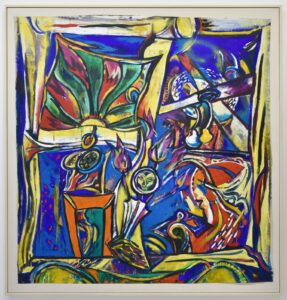
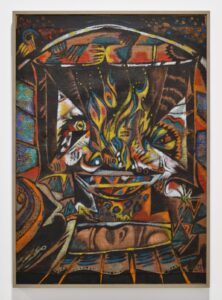
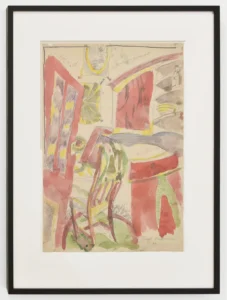
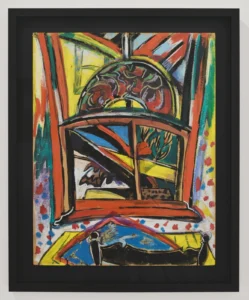
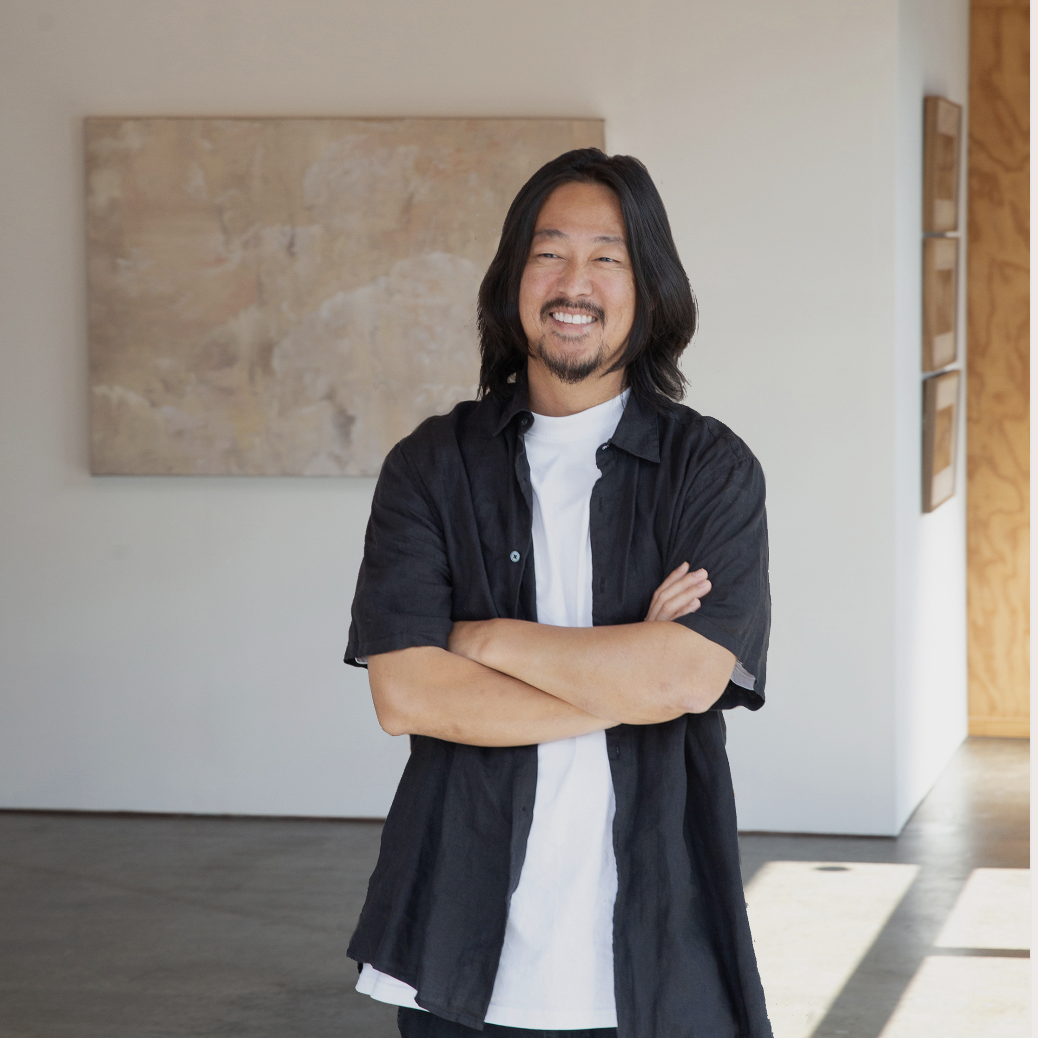
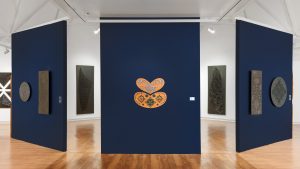
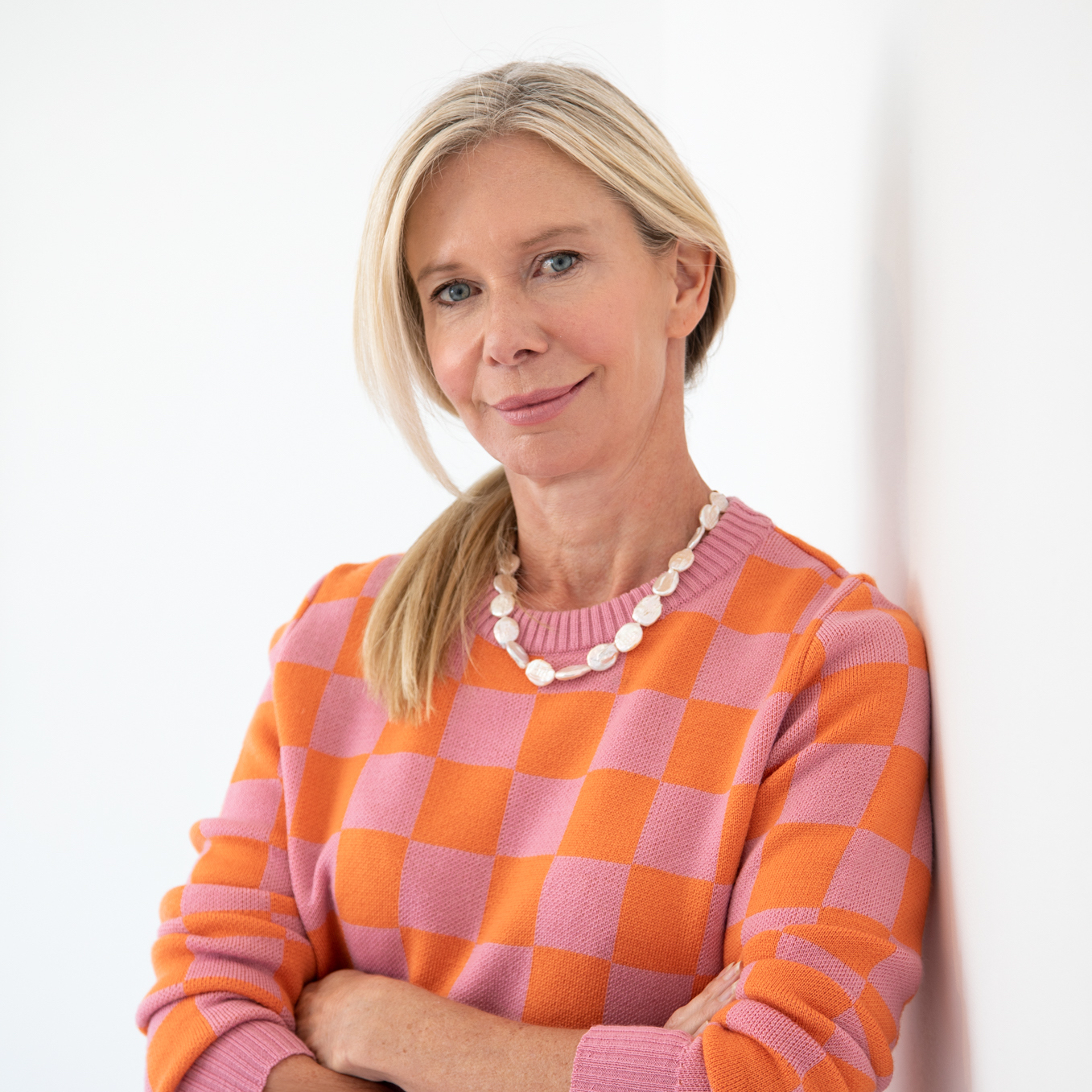
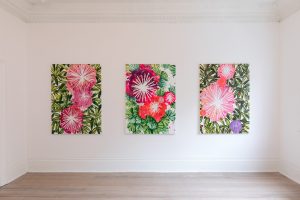
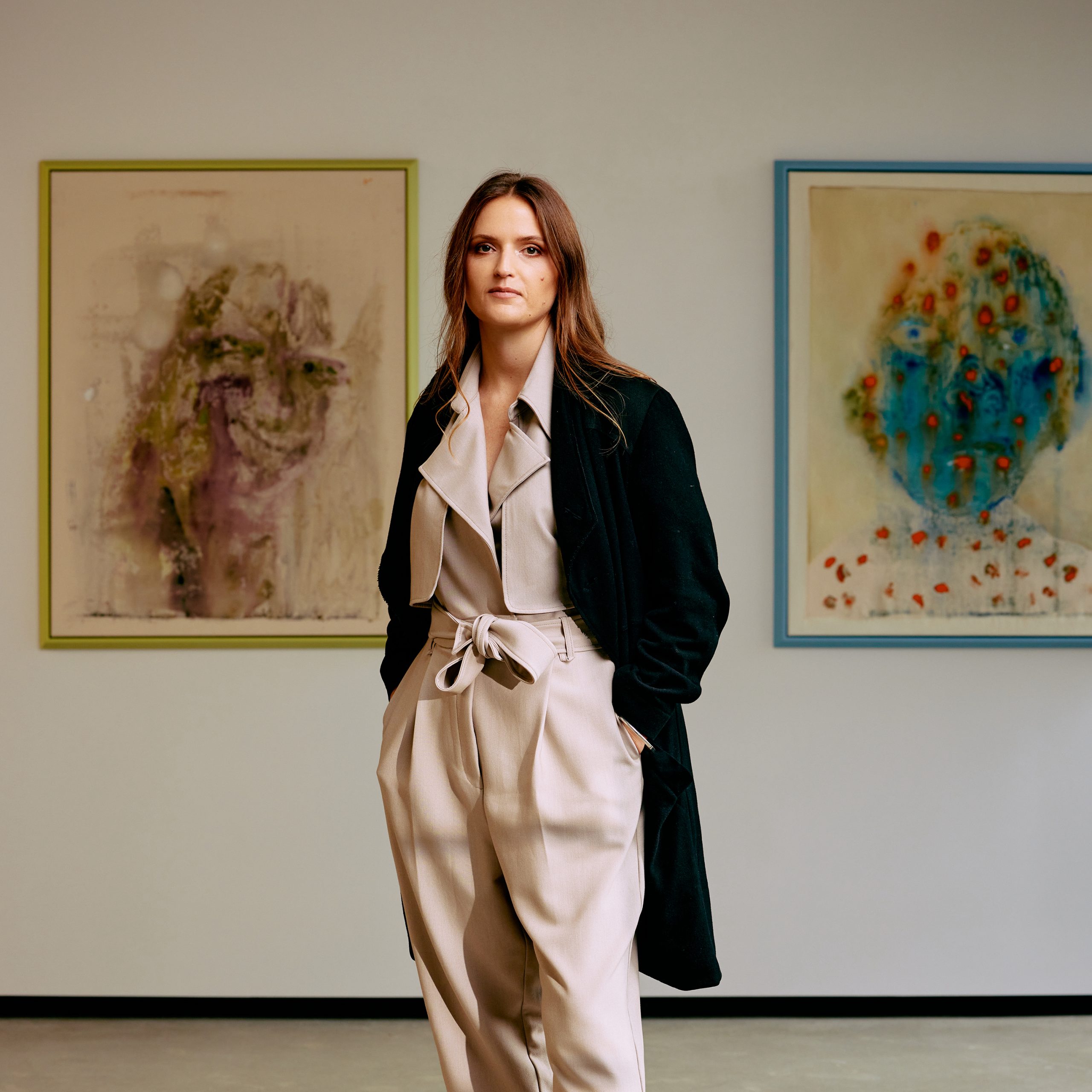
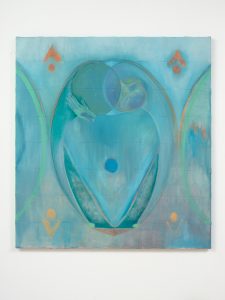
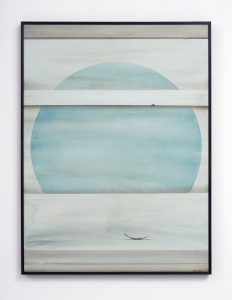
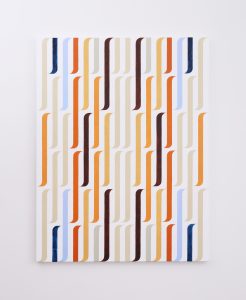
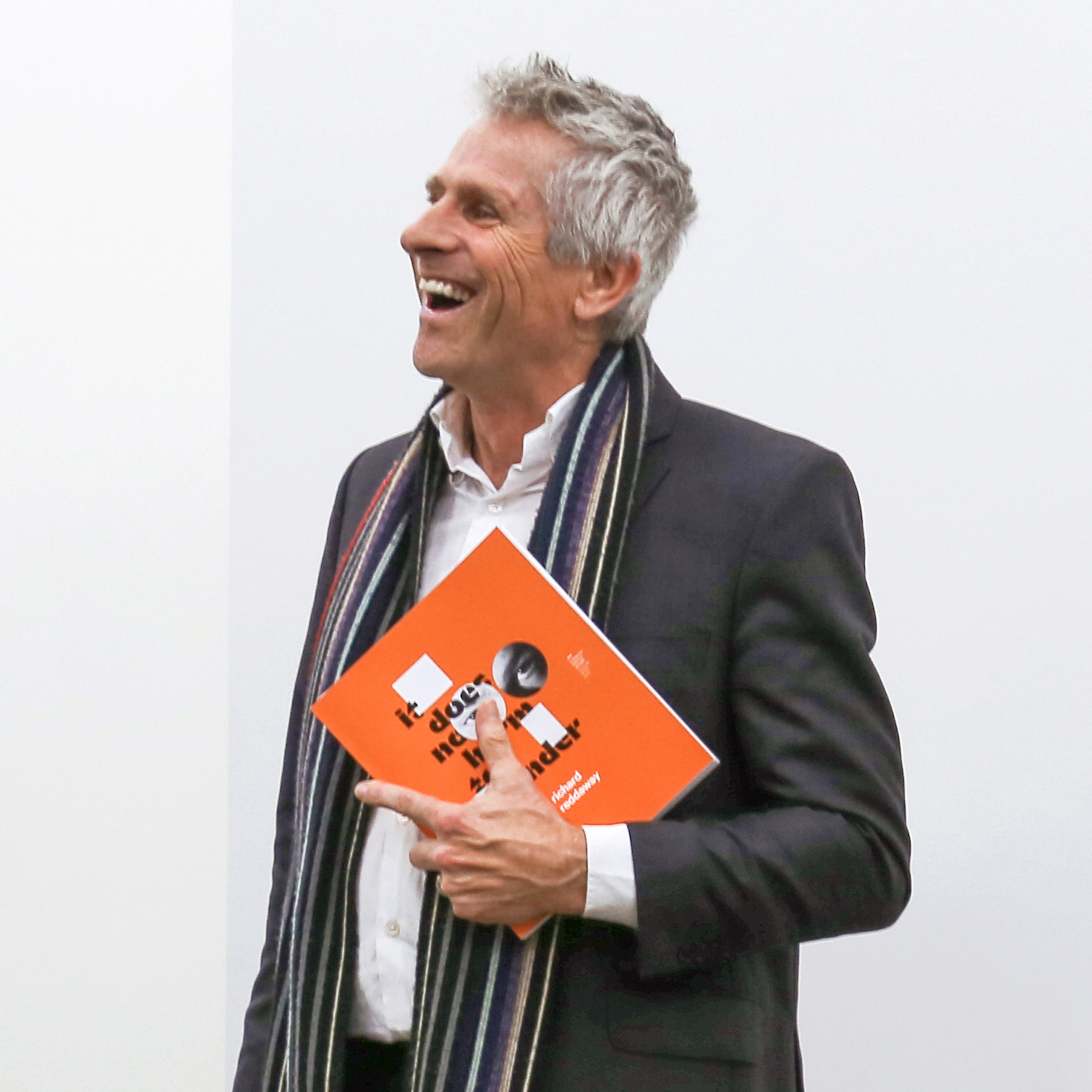
Currently on view at Gow Langsford Auckland, ‘Windows’ brings new light to the work of the late Philip Clairmont (1949–1984), one of New Zealand’s most singular and expressive painters. Focusing on the recurring motif of the window, the exhibition traces how this image evolved across Clairmont’s brief but intense career, from early explorations of domestic interiors to luminous late works charged with emotion and reflection. To coincide with the show, we spoke with his son, artist Orlando Clairmont, about rediscovering these works, his father’s enduring fascination with the interior world, and the ways in which his legacy continues to resonate today.
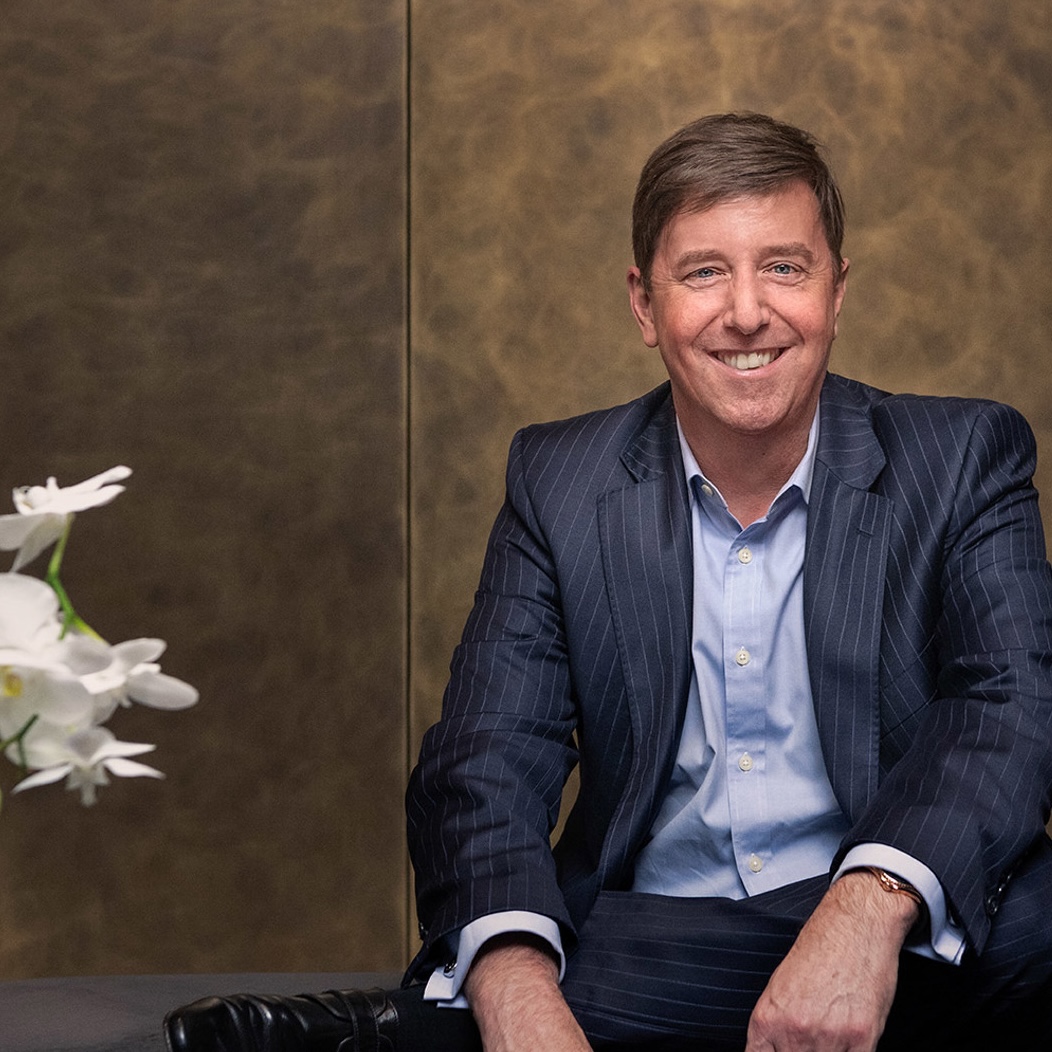
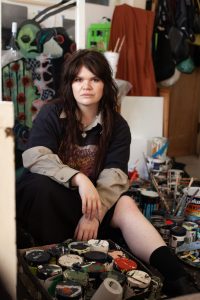
Image (Right): Photo by Brenda Ramos
__
This exhibition looks at how windows appear throughout your father’s work. What do you think drove your father’s intense focus on domestic objects and interior spaces?
From a young age he was often sick in bed “with a weak chest” (according to his mother Thelma). He was very bookish and read widely and became fascinated by “pictures in art books”. He clearly was quite observant from a young age and drew constantly. The first surviving piece of writing the Clairmont Estate has of his is a book he made in the first year of primary school, so around 5 years old. It’s called “All about Philip” and has (his first) self portrait on the cover. The only page of text we have is titled: “My Bedroom” – where he writes:
“I am standing in my bedroom. On the floor there is some carpet and some lino. By the bed there is a table. There are two beds. The quilts are green and red. There is a fireplace in the bedroom.”
It’s fascinating that he mentions a fireplace and a table (two big themes later on) and also the specific colours of the quilts and even lino on the floor – which years later he would carve into majestic prints. He also became quite fascinated with Goya and his etchings of bullfights and some early intermediate school works are copies of these Goya bullfights. So the human figure was an early preoccupation too. Weirdly, he doesn’t mention if the room has a window?
His Art school Thesis “An Exercise in Perception” (1970) was also completely based around the interior of a single living room in Christchurch. Many of his domestic and interior themes are already apparent in the related thesis works. Windows also make an appearance in the background but the focus is mainly on the objects in the room. In a 1978 interview he said: “I think an object has a life of its own. It has an essence. And it’s that essence that I’m trying to express”.
Part of the interior focus may have been practical. He had a baby daughter while finishing art school and so had to be home, part-parenting while painting. I think it really enabled him to focus on objects “without having to confront people”. He could get to know things, deeply, from many angles. I think the Interior was also a strong metaphor for the inner realms of emotion, the mind and imagination. While much NZ art is about looking at the landscape around us – he seemed more interested in the mindscapes within us.
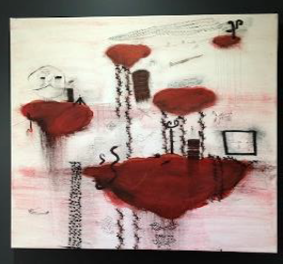
Image: Philip Clairmont, Large Window Painting, 1981-82 oil and acrylic on canvas, 1900 x 1820mm
Some of these works have never been shown before. What is it like seeing them all together for the first time?
Quite a thrill to be honest. I’ve spent much time looking at photos of them on screens, but nothing beats seeing them together on a wall, talking to each other (and the audience). Even now when I see the show I notice new connections between the works or how some seem to demand my immediate attention while others sit back quietly waiting for the right moment. The other thing with seeing them in person is that texture was such an important part of the painting process for Clairmont. You can really see the different effect different materials have, how the hessian functions versus canvas and even the small elements of collage and mixed media which are hard to pick up in photos, particularly the brief flashes of gold paint or the delicacy of the pencil, ink and watercolours.
Image: Philip Clairmont, Fireplace, 1970 oil on hessian on board, 1012 x 710mm
What’s something people might be surprised to learn about Philip Clairmont or his process?
I know from my own experience studying “Expressionism” (briefly) at secondary school, much focus is made on the immediacy and emotion of the act of creation. Sometimes as if these things were thrown together without thinking.
Particularly after looking at Clairmont’s amazingly detailed notebooks – I think people would be surprised to learn just how much thought, planning, experimentation, preparatory sketches and studies were involved in mapping out each painting.
While they might (hopefully) look effortless and intuitive, they were also quite thoroughly mapped out beforehand.
Image: Philip Clairmont, Through the Doorway, 1977, black biro and wash on paper, 600 x 420mm, 815 x 625mm framed
As both Philip Clairmont’s son and an artist yourself, how does it feel to see his work being revisited in this way? Has it influenced how you think about your own art?
I’m still amazed by his work just from a purely technical level. Some of the work is so layered and complex I have no idea how he actually did it. My own work in comparison is very simple and decorative (but fairly flat and basic compared to Clairmont) and often done for commercial clients on glass windows, hence the name Paint On Glass. I have looked more to his print-making practice possibly and his occasional use of stencils, etc for inspiration. I have incorporated this in my heavy use of hand-made stamps, which means I can cover large areas quickly, with repeating patterns. It is quite ironic that we both ended up with “windows” being a major theme!
How do you think Philip Clairmont’s work connects with audiences today?
Great question. I don’t think passion is ever out of fashion. And anyone who looks at the work will immediately recognise the “passionate intensity”. Hopefully it inspires people and in particular young people to feel like they can express themselves, experiment, create colourful worlds and channel powerful emotions and messages into art. Clairmont truly believed in the accessibility of art, that it was a grounded, humble but important occupation and a key way for bypassing increasingly corporate and privatised agendas. I think he would have been amazed and impressed by the recent flowering of “street art” and the scale and complexity of some young artists today working on walls outside the gallery system. Hopefully some of these artists themselves might get inspired by his work and the feedback loop of culture continues to create exciting, meaningful imagery.
Image: Philip Clairmont, Study for Window, Still Life, 1982, pencil, pastel, acrylic, oil on board 720 x 560mm, 860 x 700mm framed
Have you discovered anything new about his work or artistic intentions while undertaking your research?
Too much to mention! There’s still much to be discovered. I will be giving a talk at Gow Langsford Gallery at 2pm on the 18th of October – where I will go into more detail about specific works.
With the focus currently on the Windows exhibition, I think it’s a great metaphor for taking a peek through the window, into the artist’s studio: into his practice and work. It’s really just an introduction (or re-introduction) to his prolific output and oeuvre but the late window works were hardly ever exhibited and rarely seen or mentioned so it shows another side of him; opening out to the wider world and life outside the claustrophobic mirrored interior.
I was also very interested in discovering how he was starting to combine his print-making and painting practices, planning a range of hand-coloured woodcuts (one is in the window at Gow Langsford) where each one is totally unique but based on the same printed ink foundation. Similarly in some of the last paintings he was actually printing his linocuts onto fabric and collaging them into the painting itself. I’m not sure of any other artists really combining techniques in such a way but I think he was very excited to keep experimenting in those directions and only wish he had lived longer to see those ideas manifest more of their magic.
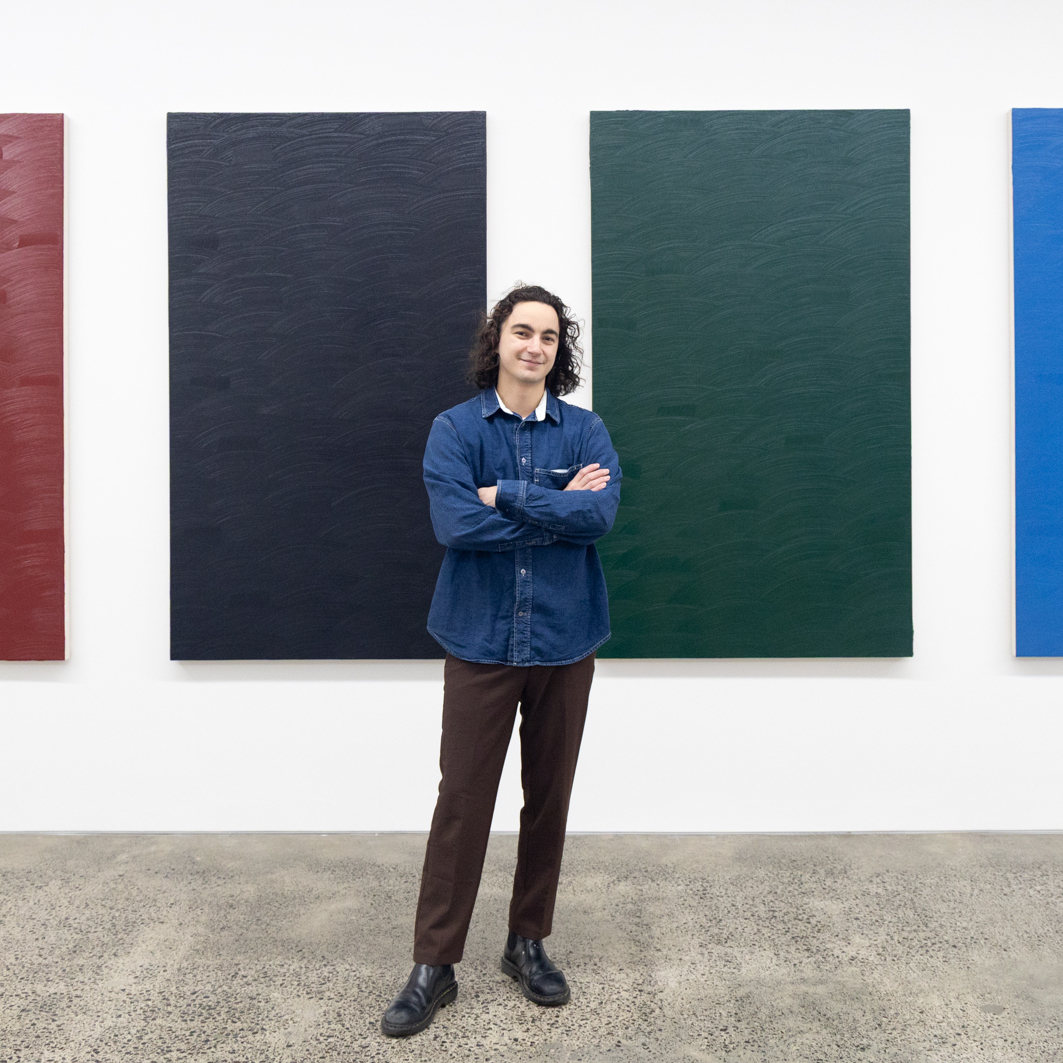
We spoke with artist Jamie Te Heuheu (Ngāti Tūwharetoa), about his current exhibition with STARKWHITE. Read on to discover more about Jamie’s creative journey.
____________________
Looking back, what moments or experiences set you on the path to becoming an artist?
There are so many… The earliest is when changing high schools in my final year, and being unsure of what to do after graduating. I had a supportive and enthusiastic art teacher who encouraged me to consider art school. Of course, when I arrived it wasn’t easy. I was told that I lacked fundamental drawing skills and would struggle to get into painting the following year, while it was hard criticism to take in, it was the kick I needed. I proved that lecturer wrong in the end, we have a good relationship now too! He’s a big supporter of my practice.
One moment I reflected on often was the first time I encountered Painting 1972 by Milan Mrkusich, at the Christchurch Art Gallery, it was the first time I experienced that ineffablepower that artworks can have, it really shifted the furniture and changed how I appreciate, and encounter works of art. It’s an experience that I hope my works cause other people to have.
And lastly, it’s the many people that I have met along the way, I’m really fortunate to have formed many friendships that have supported me to be where I am today.
You’ve described this series as a “deep dive into colour theory” – what have you learned or unlearned about colour through this process?
I’ve been thinking about colour theory in two ways, the practical side of colour mixing and the psychological and emotional impact of colour.
Prior to this exhibition, while my recent works have explored colour almost exclusively, most of the paints I used were created from trial and error, using an emotional response to the paint to decide if it was right or not, I never really slowed down to understand and take note of how I created these colours.
For this exhibition, I spent time researching limited colour palettes used by artist such as Anders Zorn, famous for only using four colours. While my palette differs significantly from his, studying these constraints helped me think more intentionally about my choices, creating boundaries that challenged and expanded my approach.
So, for the current body of work I wanted to slow down and revisit the basics, in order to deepen my understanding of how colours interact, of how colours combine create new hues, tints, shades, and tones, and how subtle changes can alter our response to the work.
The other side is that I view colour not just as a visual element, but as a way to express emotion, evoke a sense of place, and convey the complexities of feeling. I’ve been thinking more and more, especially as I start to investigate multipaneled painting, I’ve been paying attention to how colours interact with one another, how the tension and/or harmony between these colours effect our read of the work.
While I’m classed as a colourist, I’ve still got a lot to learn, it could be a lifelong investigation.
What kind of experience do you hope viewers have when they spend time with your work?
I have intentions in mind when I create the works, the associations I want, whether they are emotive or historical, and sometimes the works themselves can evoke that, but sometimes they don’t, and that’s fine too.
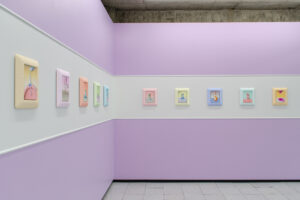
But, when it comes to exhibiting the work, my thinking is much more in tuned with the minimalist. The meaning is not inherent in the object itself, but rather it emerges from the viewer’s interaction with it and their personal interpretation. What I want to do to is create work that slows down the viewing experience, artworks which change as you move around it; where colours are elusive, changing with your position and with the surrounding light. I want the works to reward a longer viewing experience, and in turn changes how you, the viewer, thinks and feels. The titles are there to help the viewer find a way in, should they need it.
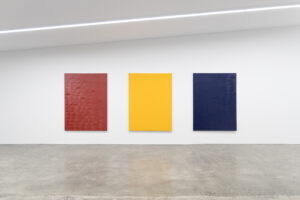
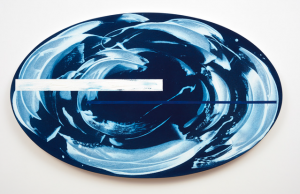
Pictured: Jamie Te Heuheu, You and I In Unison (Installation View), 2025
Is there a colour you’re drawn to again and again, even unintentionally?
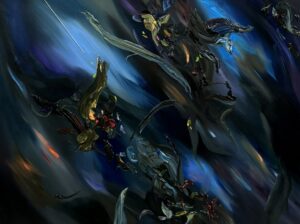
Black and dark blues, I’m not sure why, they remind me of the ocean on a stormy day, where the sea and the sky almost merge into one on the distant horizon. I’d like to paint it one day, to replicate that feeling of experiencing it. It’s powerful, dramatic and quite contemplative.
How do you imagine yourself, your practice, to look in 10 years time?
Tough Question! It’s great to have a game plan written up a few different directions. A few years ago I could only imagine I would be supported by my current galleries and I still can’t believe I am where I am now. I often to have to stop a moment and appreciate it all.
I have so many ideas that I am still figuring out quite how to pull off, so I hope my practice is continuing to evolve as I continue to push myself, my boundaries and deepen my research.
Currently, I am balancing a full-time job, a busy practice and everything else in life. I’d love to have a financially sustainable practice and a sustainable balance in life where I can focus and devote more time and energy to my practice, and time to the many things that inform my practice; though I’d hope this is much sooner than 10 years.
I’d love to exhibit internationally, take part in residencies, and find ways to contribute to the eco-system around me, especially by supporting the next generation of emerging artist.
Pictured: Jamie Te Heuheu, You and I In Unison (Installation View), 2025
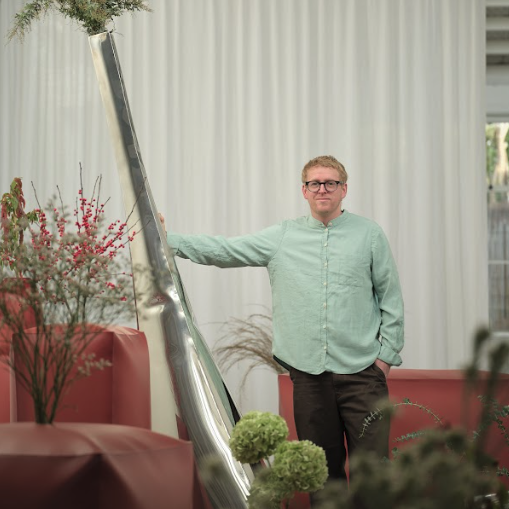
We spoke with architect and artist Gerard Dombroski, about his current exhibition with Season. Read on to discover more about Gerard’s creative journey.
____________________
What first drew you to making art, and how has your practice evolved over time?
A lot of my childhood was spent making things in the woolshed, so I think I have an innate need to make things. I also have a lot of ideas that I want to see realised, and the easiest way to see them come to life has proven to be doing it myself.
I began more seriously making objects a few years into working at my first architecture job. While it started with a love of furniture, it quickly developed into more complex questions.. It went through a period where I saw my workshop as a design gym, a place where I could make and then question, I was attracted to the fast feedback loop and thought I could teach myself to be a better designer this way. Later I rationalised it as architecture research as I started to look for more conceptual ideas.
Furniture started to feel too “furniture-y,” and I found the questions I wanted to answer were moving into the realm of material experimentation and juxtapositions, e.g., hard things looking soft. Some of my favourite architecture seemed to be buildings whose structure was tied directly to its architecture, in this way they were very material driven and process based, but also buildings which offered an unexpecting experience or moment really caught my attention. So, in a rambling way to answer the question architecture led me to art but I did not know that at the time.
Now I am running an architecture practice upstairs and a predominantly sculptural practice downstairs. I can assure you it is not the simplest way to make a living but it is incredibly engaging artistically and allows me to propose ideas I might not otherwise consider.
You move between art, design, and architecture, how do those different approaches shape the way you think about and create sculpture?
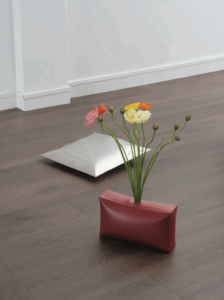
Being an architect can be all encompassing and it really is a monocle through which you see the world so I can say with confidence that I view all my practice as architecture just at different scales. I think the different titles are helpful for people interacting with it but in my mind, I am just playing with a spectrum of domestic and structural elements all imagined to work as or with architecture. It may be a reference to architecture, for example a work I have at Season is called Chimney which is a reference to the wedge like chimneys on old DOC huts. Or it may be designed to work within architecture like a large vase that reads like a table.
As another thought the show, I was lucky enough to contribute to at Objectspace by Octavia Cook, we discussed architecture as an object that could perhaps be viewed as jewellery on the landscape. I think my introduction to the artistic world has allowed me to view things through an architectural lens but also to view architecture through a jeweller’s or potter’s lens as an example. I think this can become an incredible design tool.
While I drift away from time to time, I try to gear my making towards architectural experimentation and research. Structural systems, material experiments and most importantly touch, personal interaction and the idea of an object as a special tool. A large blue couch I made a few years ago I imagined almost as a landscape — something you could push together and inhabit like a pool.
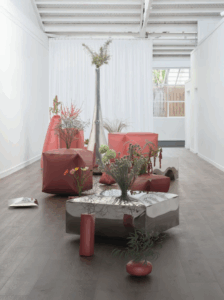
Pictured: Gerard Dombroski, Inflation (Installation View), 2025. Courtesy of Season by Samuel Hartnett.
What inspired you to start using high-pressure water to inflate steel for these works at Season, and what do you enjoy about the process?
You may laugh but I enjoy a YouTube channel run by a British guy called Colin Furze. He is a very clever, mechanically minded person. He once made an object by welding two sheets of steel together and then inflating it with a water blaster. Around that time, I was making a café in Wellington in which I made steel curtains – sheets of metal flat along the top and pressed at the base so they draped like a curtain. These were then repeated along the wall of the café. This was an early experiment creating something visually soft out of a hard material and I thought to myself, watching this video, that I could make something very fabric looking, cushions. My mind was blown. This opened a whole new line of enquiry for me that I am still working through.
Something I love about the process is the giving up of control. I weld my shape together and then let the hydroforming do the rest, this is sometimes effortless, and other times incredibly frustrating as the shape may be too complex and the weld, at a certain point, is under too much stress – so it springs a leak before it has taken on a decent shape.
Pictured: Gerard Dombroski, Inflation (Installation View), 2025. Courtesy of Season by Samuel Hartnett.
Your sculptures often resemble playful, exaggerated versions of everyday objects. What draws you to making things that feel both familiar and strange?
I am very happy that is what comes across. I came across an artist called Porky Hefer during architecture school and he has been a good reminder for me to inject joy and the unexpected into my work. Combined with my architectural angle I often end up drawing on domestic elements. Imitation, I imagine also makes work relate to people, whether its nostalgia or someone sees the object within, the ease of understanding appeals to me. In the architecture world we can design from a conceptually dense place but sometimes we do not give people a bridge to know or even ask if there is more, they may just see a building. For example, I Made a café at the aquatic centre in Wellington where the café is entirely blue from floor to table height and white above. All the table tops are rounded wiggling shapes -‘ripples’. The café concept as you may have guessed, is a ‘swimming pool’ and I hope it is so obvious young children can engage with the whimsy and run around pretending they are swimming.
Looking ahead, where do you see your practice in 10 years, and what kinds of ideas or materials do you hope to explore?
I hope to have a practice where art and architecture weave together fluidly, in service of each other or imitating one another. I am deeply inspired by past architects who felt the need to design everything they could get their hands on, and hope to deepen my involvement in built projects. I think I am finally at a place where my office is equipped to bring that level of engagement and craft to any scale of a project – for example, knives and forks. I hope to meet a whole host of interesting people that want to go on exciting architectural and sculptural journeys in and beyond New Zealand.
My architecture practice currently has a community project where, to bring a depth of meaning to the very artistic community, I am proposing a living sculptural wall. A cladding that is designed to house and present a mass of curated community made sculptures and objects. I think this could bring both a unique architecture for the community and more individual meaning in a public building.
In the short term however, I am looking to upscale the hydroforming sculptural works into architecture. This will initially be through the construction of small-scale buildings such as sleepouts or back yard studios. This new scale of hydroforming is bound to bring a whole host of problems to solve, but that’s part of the fun. It also has the promise of an architecture I suspect has not been seen yet. I often wonder how far you could push this concept; I have been finding my self thinking of a long low mirrored rectangle house laying in the landscape, the reality of which is over 1million litres. This would comically need to be by a river or lake.
Fundamentally, I want to be creating architecture and objects that deliver the unexpected – in process and outcome – and that people feel they can interact with.
How did your journey as a curator begin, and how long have you been working in this space?
My journey as a curator began in 2011 after I finished a degree in Art Business at Christie’s Education in London and launched Marcelle Joseph Projects, a nomadic curatorial platform that produced four or five exhibitions a year in various locations in the UK from galleries for hire in Shoreditch to stately gardens behind the former royal hunting lodge of King Henry VIII. I’m now over 50 exhibitions in and after finishing my MA in Art History in 2018 with a specialisation in feminist theory, I work exclusively as an independent curator, curating exhibitions for commercial galleries and museums. My curatorial focus has largely been the exploration of the performativity of gender by female-identifying and queer artists with material-led practices.
You’re widely recognized for championing women and queer artists. What sparked that focus for you, and how has it evolved over time?
The reason why I champion women artists is to explore my own subjectivity as a woman in this world and to redress the gender imbalance in the art world. Over time, I have embraced the fluidity of gender across the spectrum and resisted ingrained gender binaries that disenfranchise women and queer people. What I’m most interested in achieving across all my activities – whether it be curating, collecting or patronage – is the representation and support of artists who have been marginalised by the patriarchal canon. At the end of the day, I want to platform and invest in excellence, and excellence has no gender, race or class.
What words of wisdom would you offer to emerging curators trying to find their voice in today’s art world?
I started out working in a very DIY fashion, which I highly recommend. Back in 2011 and 2012, I had to find the venue for the exhibition, choose the artists, write theexhibition text, promote the exhibition, organise the transport, installation and photography of the artworks, and sell the work. I curated shows in so many different non-traditional spaces from a disused workshop in London’s Diamond District to private members’ clubs and country house hotels. I learned so much by doing and having to adapt to each new space. In terms of finding your voice, I recommend viewing as many exhibitions as you can, visiting as many artists’ studios as you can and reading as much as you can in your field of expertise or chosen research area.
If you could select three works from the Aotearoa Art Fair for your personal collection, what would they be—and what draws you to them?
I call my collection a “collection of conversations” as almost all the artworks in my collection were made by artists in my network or acquired from gallerists I know, respect and admire. So I would firstly choose one of the works from the Sanderson booth at the fair as they are showcasing women artists and Sanderson is run by a dear friend of mine, Lydia Cowpertwait. We co-curated a large group exhibition in London in 2013, featuring the work of 59 women artists from the collections of seven women collectors.
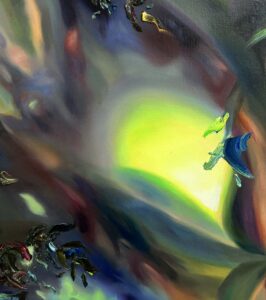
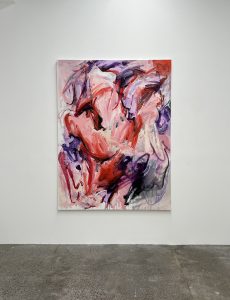
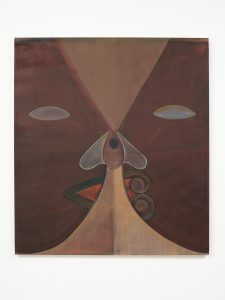
I would choose the painting Un-gardenesque (2024) by Molly Timmins, an artist of Māori heritage who uses the garden as her motif to question the colonial influence over both the garden and the history of painting as well as the way in which women have historically existed in these spaces within Aotearoa in the last century. I love the way this artist uses her own matrilinear biography in her practice. Her grandmother owned a Bromeliad business, which her mother runs to this day. Given the world we live in today that is always on the brink of ecological disaster, this return to nature in Timmins’ work is a place for restorative healing.
Image: Molly Timmins, Un-gardenesque, 2024
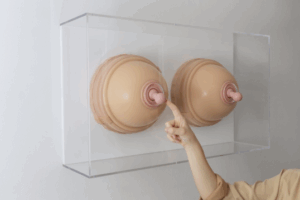
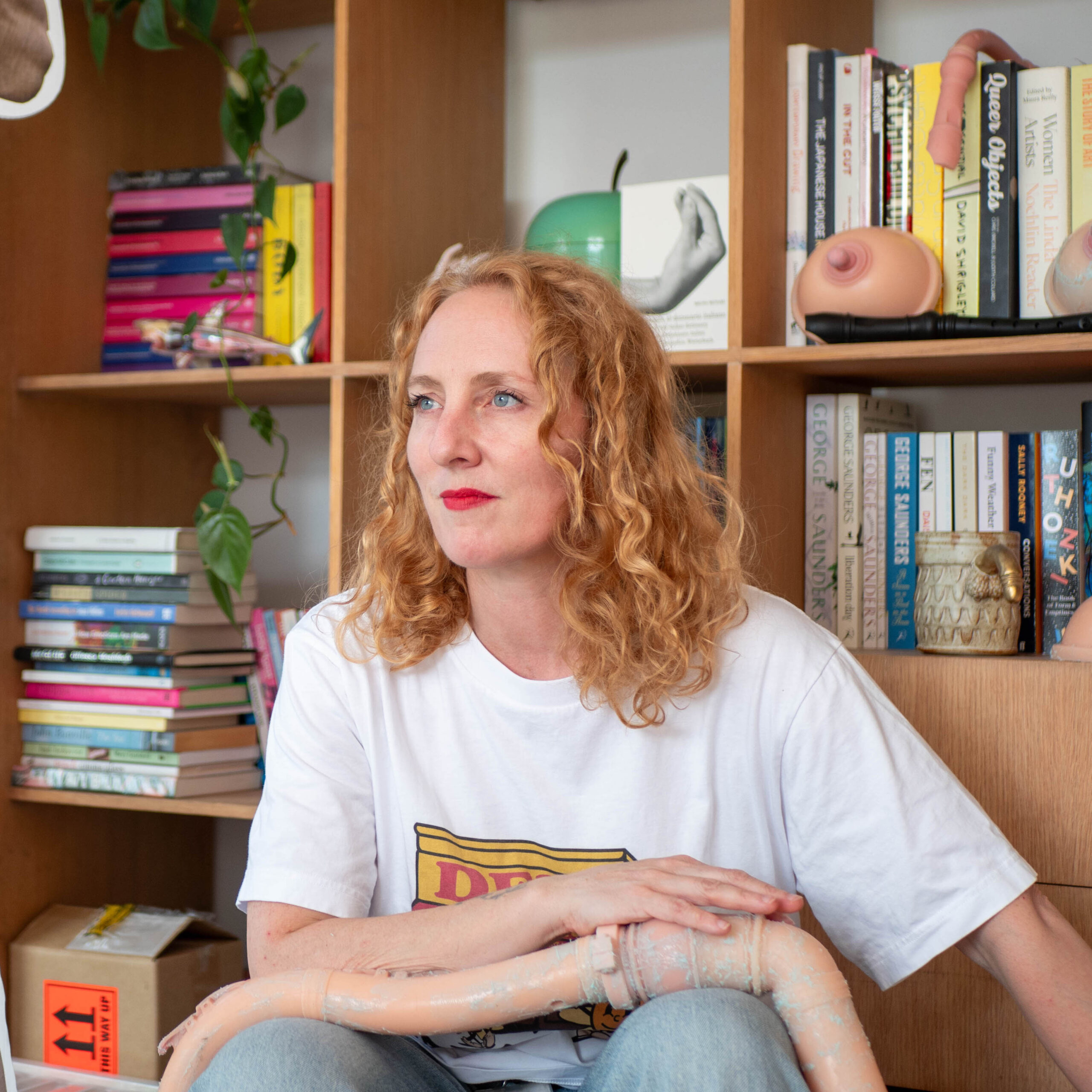
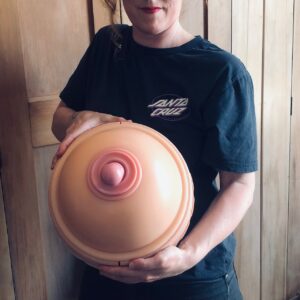
My second choice is a work from mothermother, a gallery in the Young section of the fair, as I love to support emerging galleries. It is a wall-based silicone and resin sculpture that depicts a pair of gendered breasts, complete with nipples that jut out from the work’s Perspex casement, begging to be touched by the viewer. Titled Canons and made by Caitlin Devoy in 2024, this work jibes with my curatorial focus on identity politics and embodied lived experience. I love the artist’s use of humour and tactility to subversively examine sexist and binary attitudes to gender and bodies.
Image: Caitlin Devoy, Canons, 2024
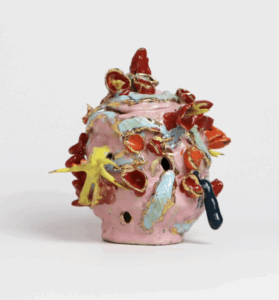
My third choice is a ceramic sculpture by Virginia Leonard titled Urn 4 (2024) as I am drawn to material-led practices and absolutely adore ceramics. I love when you can see the artist’s hand in the making of an artwork. This work is presented by the Gow Langsford Gallery.
Image: Virginia Leonard, Urn 4, 2024
Looking ahead, what projects or exhibitions are on your radar for 2025?
In terms of visiting museum exhibitions, I look forward to visiting the Helen Chadwick exhibition at the Hepworth Wakefield in Yorkshire in the UK and the Ithell Colquhoun exhibition at Tate Modern. I will be in New York in May so I look forward to visiting the Hilma af Klint exhibition at the MoMA and the Amy Sherald exhibition at the Whitney. I am hoping to visit the São Paulo Biennial in Brazil in September. Fingers crossed! Otherwise, I have the third edition of the residency I co-founded and run coming up also in September 2025 in the Aquitaine region of southwestern France. Called the GIRLPOWER Residency, it offers three female-identifying or non-binary artists the chance to research, reflect and make work for one month in the rural countryside, outside the demands and distractions of studio life in a big city.
Featured Image: Independent curator and collector Marcelle Joseph at home in Ascot, UK with an artwork by Samara Scott. Photo: Gabrielle Cooper.
Can you tell us about how Artor Contemporary came into existence?
Artor Contemporary was founded from a deep-rooted love for both fine art and the quiet craftsmanship that brings it to life. After years working as photographers—both in Aotearoa and Australia—Rozenn and I felt the pull to return home and contribute to something more enduring. We envisioned a space where artists could share their voices freely, and where we could foster growth in a creative community we care deeply about. Artor is our way of giving shape to that vision—an offering to the art world, and a reflection of the path we’ve chosen to walk together.
Image: Artor Contemporary
Who are you bringing to the Aotearoa Art Fair and why?
For the Aotearoa Art Fair, we’re bringing together a group of artists whose work reflects both material sensitivity and conceptual clarity. Robyn Penn, Paul Nathan, Kate Serebrianskaia, Andrew Rankin, Lucy McMillan, and Michelle Reid each explore distinct ideas—whether it’s the quiet tension of climate anxiety, layered visual memory, or the tactile resonance of ceramics and textiles. These artists aren’t bound by a single theme, but rather by a shared commitment to thoughtful, considered practice. Our presentation aims to offer a rich and balanced encounter with contemporary art from Aotearoa and beyond.
Could you share one of the most memorable times you’ve had working as a gallerist?
One of the most memorable moments was the opening night of our very first exhibition. After months of preparation, it was deeply moving to see the gallery filled with people—friends, artists, and curious newcomers—all engaging with the work. There was a genuine sense of openness in the air, with conversations unfolding between strangers and artists connecting directly with their audience. It was a reminder of why we created Artor in the first place: to offer a space where art could spark connection, reflection, and a shared sense of something meaningful.
What’s happening next in the world of Artor Contemporary?
Looking ahead, Artor Contemporary is expanding its reach with a focus on more immersive exhibitions and collaborative projects with local and international artists. We’re also developing a program that brings art closer to the community, offering interactive events and workshops, where visitors can experience art not only as observers but as participants in the process. The goal is to continuously push the boundaries of what a gallery can be, both in art and in the experience we offer.
We spoke with artist Molly Timmins (Ngāpuhi, Pākehā) about her upcoming presentation with SANDERSON CONTEMPORARY at the Fair. Read on to discover more about Molly’s creative journey and what we can expect to see:
____________________
What inspired you to pursue a career in art, and how has your journey as an artist evolved over the years?
I grew up in a creative family, and the artistic freedom I was given throughout my childhood carried me through into my schooling. It was at school I found a real interest in realistic paintings of landscapes and whenua.
During my BFA at Whitecliffe I introduced embroidery into my paintings in order to observe material hierarchies within art history. My Master’s thesis in 2023 focused on gardens, through paintings that transition between depictive and abstract approaches of botanica as well as broader ideas of what “garden” and “non-garden” can mean in a painting context.
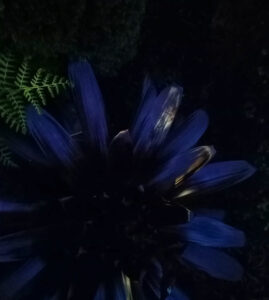
My most recent development of research is looking at Te Pō (night) and the transition between daylight and darkness.
How do you approach the creative process when starting a new painting? Do you have any specific rituals or techniques?
When preparing to make my most recent series of artworks, which are showing at the art fair, I spent time outside sitting in my mother’s garden at nighttime. I observed the sounds and smells, as well as the colours and atmosphere as the garden transitioned from day to night.
In the studio, I refer to some photographs but I try to allow for a bodily response to the remembered atmosphere, as well as letting the paint lead some of my decision making.
Within the pieces that have both paint and embroidery, for drying reasons, I do the stitching last. This process can be quite different to my painting approach, and it slows down the pacing of the work.
Image: Molly’s research photograph
What drew you to explore gardens as both a physical space and an artistic subject?
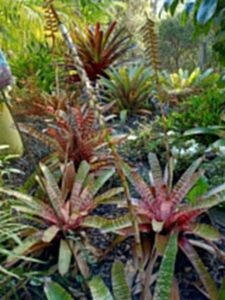
My mother and her mother both owned bromeliad businesses while being passionate gardeners. Growing up surrounded by plants is what inspired me to honour this lineage, and I look to my own Māori (Ngāpuhi) whakapapa alongside my heritage to colonial gardens, to consider a nuanced approach to gardens as an environment.
I’m equally as interested in what gardens can represent, and speak about, within the broader framework of Aotearoa. I aim to paint in a way that observes the hierarchies within these physical environments, as well as the idea of “garden” and “non-garden” and how this may translate through both the physical paint and how different modes of brushwork may fit or contrast within garden- painting history.
Image: Her mother’s bromeliads
What can we expect to see at your presentation at the Fair with SANDERSON?
At the Art Fair, I will be presenting a mixture of paintings and embroideries that explore nocturnal gardens. This is through a mixture of observational or botanical moments, and abstract mark-making. The combination of stitching and paint aims to observe the histories and hierarchies carried within the materials, and considers the relationship and metaphors between painting, embroidering, and gardening. A cooler, blue-toned palette is carried throughout these artworks, which feature abstract and gestural responses to the contextual research of gardening and painting history within Aotearoa.
What have been your career highlights to date?
Creating 3-metre long paintings for my Master’s graduate show in 2023 was an exciting experience, which I gratefully showed with Sanderson last year in my show Rewilding the Garden. Over the last 4 years, I have worked as an arts educator at Corban Estate Arts Centre. Making art with thousands of tamariki has been an incredibly rewarding experience, and the kaupapa of this mahi enriches both my studio ethic and my paintings. I’m also very grateful to have received early-career funding from Creative New Zealand last year, which has helped towards studio costs for my solo show at Sanderson later in the year, as well as other projects worked on during this time, including the work shown in the Aotearoa Art Fair.
Image credit: Molly Timmins
How do you imagine yourself, your practice, to look in 10 years time?
Big question! I hope that my paintings evolve into new territories while I’m developing my research. I want to keep an element of freshness towards new ideas and processes. In some ways, I hope that my work is visually quite different in ten years to what I am making now, and that it continues transitioning throughout my whole career.
I hope to exhibit overseas, perhaps through a residency. And I would love to see more landscapes and art around the world, to absorb those learnings into my painting language. Most importantly, I hope that I am still painting, still exhibiting, still making art.
We spoke with artist Caitlin Devoy about her upcoming presentation with mothermother at the Fair. Read on to discover more about Caitlins’s creative journey and what we can expect to see:
____________________
What can we expect to see in your presentation with mothermother at the Aotearoa Art Fair?
I’m very fortunate, and excited, to be showing at the Aotearoa Art Fair with mothermother, an intergenerational collective of artists. We share an appreciation for the interconnected networks that support and sustain us, the bodily connections we hold to the land, our societies, each other and our futures. I will be showing works alongside Tori Beeche, Phillipa Blair (1945-2025), Inga Fillary, Nat Tozer and Anouska Wallis-Lewis.
My tactile, sculptural works reference aspects of our experience as thinking bodies stumbling around in the world. The works combine humour with the erotic and explosive politics of the body, subverting binary attitudes to gender and bodies. I often think of my works as quite behavioural objects, dangling temptingly in front of the viewer, sometimes like an artifact of an action, sometimes a provocation.
Image credits: Caitlin Devoy
Your work explores the relationship between materials and the body. How do you choose materials, and how do they engage the viewer physically?
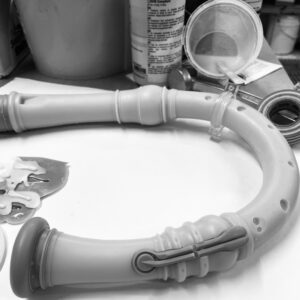
I enjoy the humorous associative possibilities afforded by making objects which have body-like qualities. A flaccid recorder, a cheeky toggle switch, a pinched cleft in a portrait frame.
I choose materials which are very tactile and which don’t feel inert. For example silicone, reacts to touch and can move like our bodies. It could be my dance background influencing my thinking and feeling for the material’s kinetic weight, bounce, touch, flex.
Silicone carries a lot of associations with the body. Medical devices, sex toys, prosthetics, for example. Its base is silica, the same as traditional sculptural materials like marble, yet it is rubbery and movable rather than static. It’s like the kink version of marble, undermining the gravitas.
What do you hope visitors to your booth at the Aotearoa Art Fair will take away from their experience with your work?
A feeling. Maybe when you’re looking you can feel the touch of the work (not necessarily literally). Some of the humour is located in that feeling of self consciousness or bodily awareness.
We’re all just flailing around trying to project intelligence or sexiness or power or whatever else with varying degrees of success. To a detached observer theres a lot of ridiculousness. Like watching a dance video with the sound turned off.
Image credits: Caitlin Devoy
How do you imagine yourself, your practice, to look in 10 years time?
I want to develop a business which financially sustains my art practice. Having the means to travel and take up residencies overseas is another goal. It’s hard work surviving as an artist and managing to balance time to make art with time spent working to pay all the bills and support my kids.
I want to have the funds to be able to bring to life all the larger works I have in mind. My notebooks are bursting with sketches, plans and drawings of sculptures. Making those larger works, being able to devote more concentrated hours to my practice, and exhibiting both in New Zealand and internationally are my focus.
We spoke with artist Jack Hadley about his upcoming presentation with Laree Payne Gallery at the Fair. Read on to discover more about Jack’s creative journey and what we can expect to see:
____________________
What can we expect to see in your presentation with Laree Payne Gallery at the Aotearoa Art Fair?
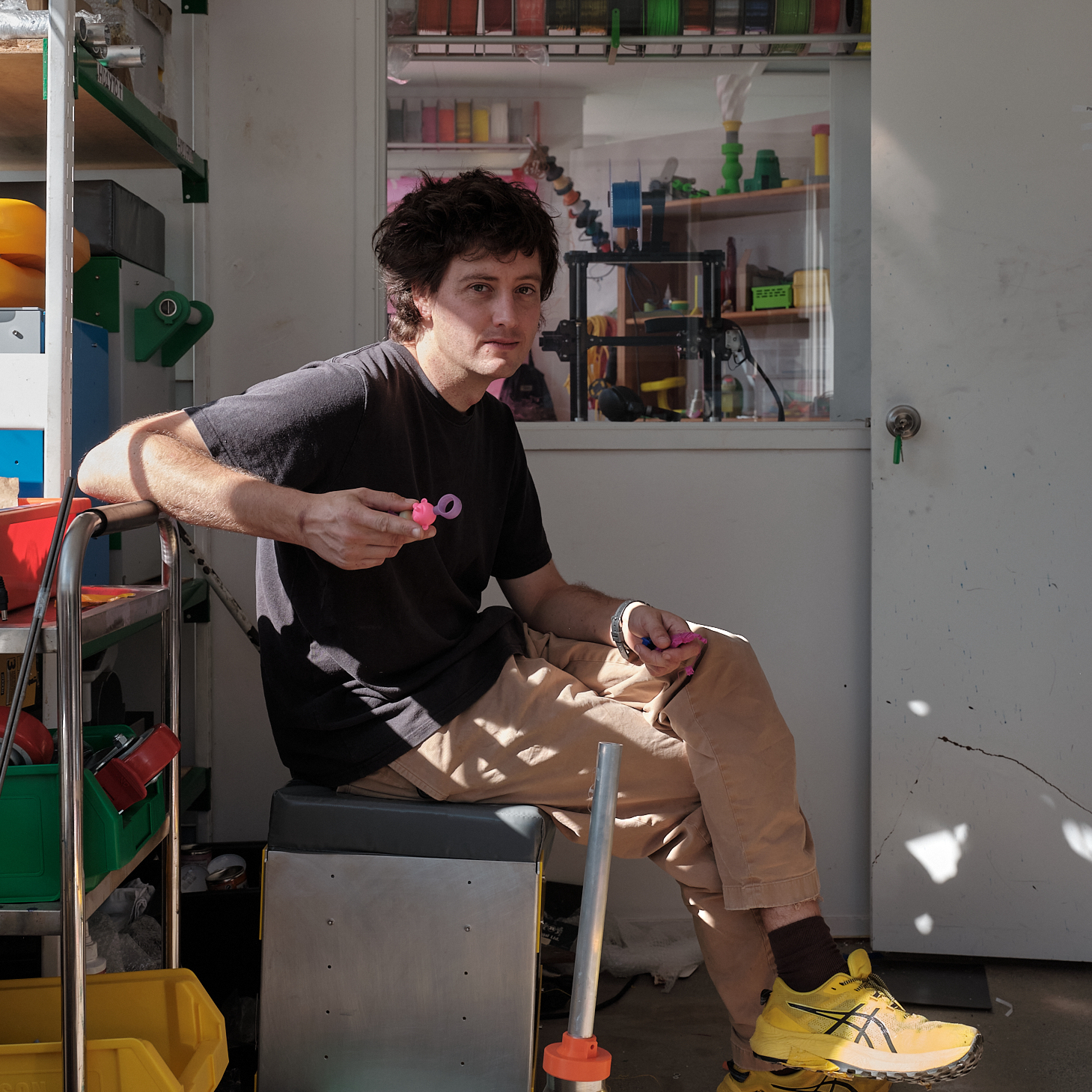
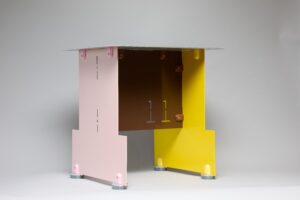
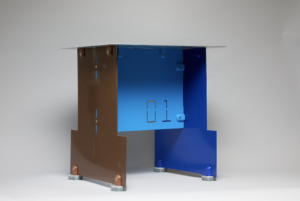
I have been working on a new series of modular furniture pieces. For the fair, I will be presenting a collection of seats, a table, and a floor lamp. The works are assembled from custom aluminium components that are powder-coated in an array of colours. The colours and parts are combined in different ways so that each work is unique.
Image credits: SS3_11, 2024, Powder coated aluminium, aluminium, thermoplastic polyester, stainless steel fixings, 44.5 x 45 x 35. Image by Mark Hamilton. Courtesy of the artist and Laree Payne Gallery
You blend different references in your art, from architecture to children’s toys. What do these influences mean to you personally?
I get really excited about lots of different things and this is reflected in the work I make. I borrow materials, forms, and techniques from different disciplines and contexts. The lamp I am making for the fair draws upon the Vienna Secession as well as the temporary signals used in roadworks. I enjoy this way of working and the layering of disparate references.
Your pieces are known for their unique visual language. Can you walk us through how you develop the aesthetic of your work?
Like the furniture for the fair, much of my recent work is assembled from interchangeable parts. The visual language of the work is a way of expressing this modular logic. Joints are exaggerated, and components are painted different colours to show how the works fit together. While the modular forms are informed by utilitarian industrial design, I am interested in the decorative possibilities of working this way. By exaggerating a joint profile it becomes like a baroque motif.
Image credits: SS3_01, 2024, Powder coated aluminium, aluminium, thermoplastic polyester, stainless steel fixings, 44.5 x 45 x 35. Image by Mark Hamilton. Courtesy of the artist and Laree Payne Gallery
Many of your works seem playful at first glance but reveal deeper meaning on closer inspection. How do you hope people experience your art?
This sense of play is more important to me than a deeper meaning. In making the work, I am very directly playing with colour and form. I hope this transfers to how the audience engages with the work. Because the works are modular, I like the idea that people can imagine other possibilities for the work and how the components can be assembled.
How do you see your art practice evolving, and what direction are you most excited to explore?
At the moment, I am learning about electronics and have been producing my own custom circuit boards. I am really excited about the technical possibilities and aesthetic language of circuit board design and how I can apply these in my practice.
What got you into valuations and collection management?
I’ve always loved the behind-the-scenes side of art—what it’s worth, which collection it’s held in, and how it moves through time and space. Valuations and collection management felt like a natural fit. It’s about protecting the story of the artwork just as much as the object itself.
Has your approach changed over time?
Definitely. Early on, I only focused on valuations. But over time, I’ve leaned more into the strategic side: why a collection exists, how it’s valued, and how to protect it long-term. Valuation is an essential part of the bigger picture.
What kind of collections do you like working with?
I have the privilege of working with all sorts. I love a focused private collection with a clear story just as much as a big, complex institutional one that’s evolved over decades. From a valuations perspective, I especially appreciate collections that balance emotional value with strategic intent.
Any advice for someone starting out with collection or managing a collection?
Get your paperwork in order early! That includes purchase receipts, provenance information, condition reporting, valuations, and insurance. It might not sound glamorous, but it saves a lot of headaches down the line. And ask questions—there are plenty of us in the art world who love to help.
Is there an artwork or project that’s really stuck with you?
One project that stands out involved a rare folio of 17th-century Dutch watercolours, which was the subject of an insurance claim. The appraisal was a deep dive into art history, conservation, and market research all at once. Projects like that highlight how much value—cultural and financial—can rest with rare and unique items.
We spoke with artist Emily Hartley-Skudder about her exciting upcoming presentation with Jhana Millers Gallery at the Fair. Known for her playful, thought-provoking installations and vibrant oil paintings, Emily invites viewers into a world where everyday objects, gendered spaces, and nostalgia collide. In this conversation, she shares the inspiration behind her new series, “Petite Spa,” and her unique process of collecting found objects, while reflecting on the role of domestic spaces in shaping our identities. Read on to discover more about Emily’s creative journey and what we can expect to see:
____________________
What can we expect to see in your presentation with Jhana Millers Gallery at the Aotearoa Art Fair?
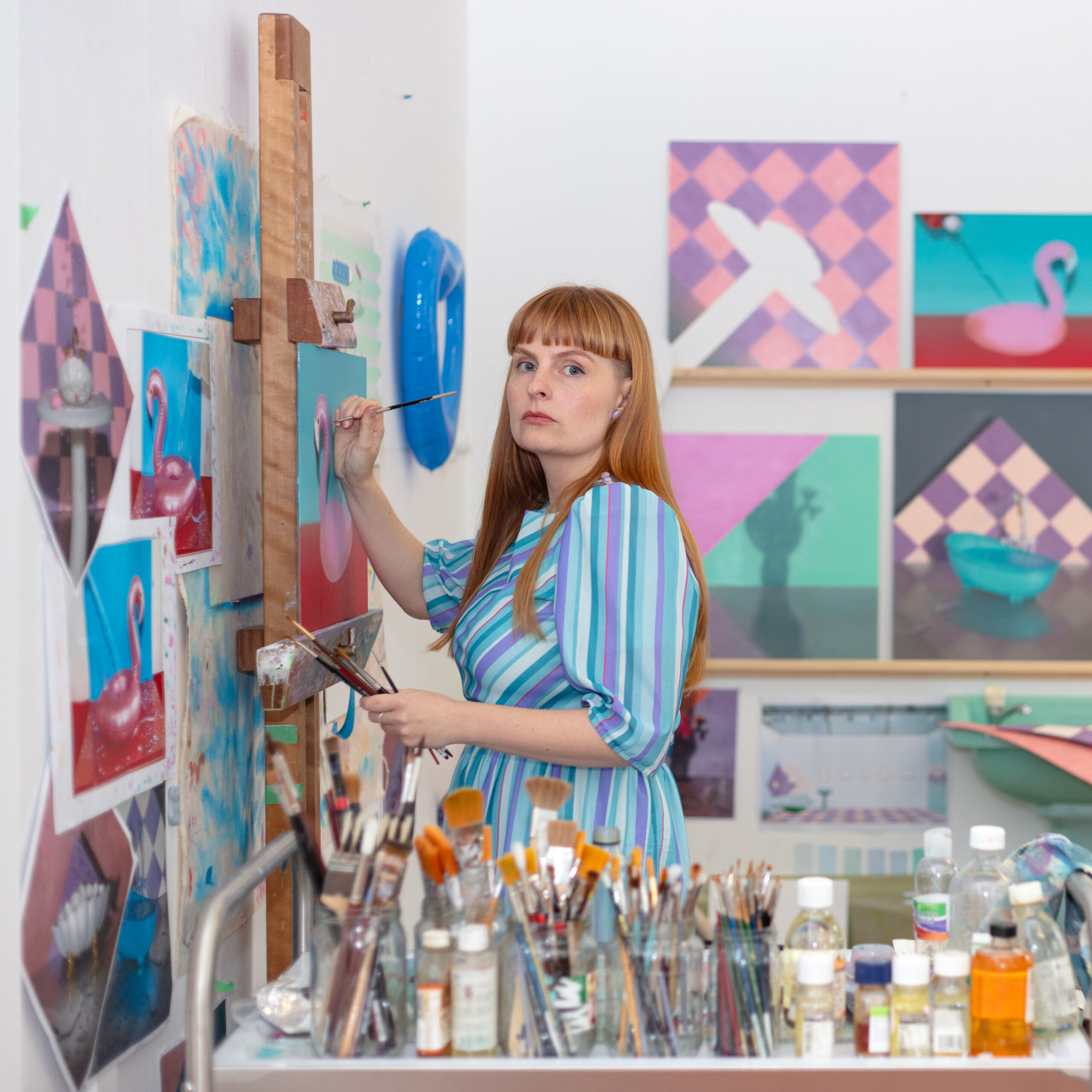
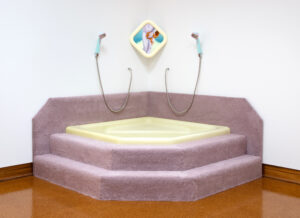
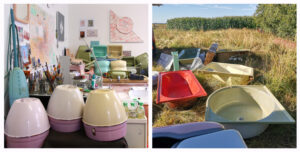
I’m looking forward to riffing on the fair as a big ‘expo’ by transforming our booth into a bathroom showroom, complete with a distinctly unfashionable shub and bidet, and icecream-parlour pink and purple lino – with paintings to match of course. Luckily, Jhana is super supportive of my more eccentricinstallation ideas.
My new series of paintings have a lot of splashing going on. I build table-top sets in my studio and chuck water and objects around, capturing them in-camera with high speed flash to crystallise the splashes of sparkling liquid. I then translate these images into oil paintings, which include the colours and textures of the installation they’ll sit within at the fair.
This new project is called Petite Spa, which takes its name from a brand of single-use shampoo and conditioner bottles populating motel bathrooms. I’d like audiences to step into my bathroom tableaux – IRL and within my paintings – and perhaps be inspired to reconsider their grey and white home-décor decisions, or at least leave with a sugary, retro taste in their mouth.
Image: Splash Club Installation, Emily Hartley-Skudder
You have a fascinating process of collecting found objects. Can you tell us more about how you choose and respond to these materials?
It all started with collecting miniatures as a child which I just couldn’t let go of, and I brought them out again at art school. The scenes I was constructing with miniatures began to make sense as life-sized installations, which meant the objects I collected had to scale up too. I trawl junk shops, building recyclers, and Trade Me, and end up spending a lot of time coordinating trips and pick-ups around the motu – with my partner and family’s help – to expand my treasure trove of retro carpet, bathtubs, sinks and hairdryers. I wouldn’t necessarily recommend it. For this new series, I’ve come full circle and started collecting bathroom themed miniatures. So I’m taking a trip back to the diminutive and having fun with scale.
I love taking objects that already exist in the world as my starting point – they give me an anchor and also come with their own host of associations and meanings which can be played with and manipulated. I’m drawn to dated home-décor trends; the colours and styles some people now love to hate. Also, cheap materials that mimic luxurious materials; things like pleather, poured resin to imitate marble, and parquet flooring that’s actually lino. These things speak to taste and class and societal pressures, and I love the rush of finding something that you may never find again. When it comes to items that might have existed in the carpeted bathrooms of the past, sometimes the real is stranger than anything I could have dreamed up myself.
Image: Emily Hartley-Skudder
Gender, public and private spaces seem to play a key role in your art. How do you think the objects you use reflect societal expectations?
I often think about how we construct our personalities with the objects we surround ourselves with, and how this can be explored really well through the still life genre. The domestic space, especially the bathroom, brings with it a whole lot of gendered connotations and the ways we try to control our bodies and literally flush away waste. I began diving into the recycling bin and including my own toiletries, inhalers and cleaning products in my still lifes, which then led to me searching out objects with very direct links to the body – breast pumps, douches, speculums.
Then there’s toys – you can’t escape how they are very much part of the socialisation of children, especially when it comes to gender. I’d like to think there’s an underlying tension in my work, between elevating something while also critiquing it. It’s a fine line. For instance, I wouldn’t spend hours a day rendering glistening pink plastic if I didn’t kind of love it. I celebrate overtly feminine and ‘girly’ aesthetics, but also explore how it’s used in an extremely commercial way as a toxic marketing strategy, exposing the absurdity of gender divisions – especially when it comes to products for children. Capitalism, eh.
Image: Rinse and Repeat Installation, Emily Hartley-Skudder
How do you imagine yourself, your practice, to look in 10 years time?
Not a tough question at all! Hmm. My partner Hamish Coleman (also exhibiting at the fair) and I would love to find some kind of amazing commercial building where we could set up studios and live there too. So an epic live/work studio, with storage and workshop facilities, and with lots of cats, would be the dream. But honestly, just to have a sustainable art practice and be a bit more stable financially would be incredible, but I’m not sure if that’s wishful thinking.
I also have lots of ideas and ambitions for large scale installations at public galleries, and would like to exhibit internationally in a more serious way. But a lot of things are out of our control as artists, so we’ll have to see. Everyone’s life plan – win the lotto?
We spoke with Sue Gardiner, Chair of the Chartwell Charitable Trust, Co-Director of The Chartwell Collection and Co-Director with Karen Gardiner of the Squiggla project, to explore the Trust’s 50-year legacy in supporting Aotearoa’s vibrant visual arts community. Sue shares the story behind the Trust’s founding, its evolution, and its enduring commitment to growing the impact of the visual arts and enabling access to the Chartwell Collection, now housing over 2,000 works. With highlights including significant acquisitions and impactful public art projects, Sue reflects on Chartwell’s role in promoting creative visual thinking and social change. As the Trust celebrates its milestone anniversary, Sue reveals their exciting plans for the future, continuing to inspire and shape the arts landscape in New Zealand.
___
What inspired you to start the Chartwell Trust 50 years ago, and what has kept you motivated over the years?
The Chartwell Project has been an explorer of the visual world for 50 years. My father Rob Gardiner established The Chartwell Trust as a charitable trust to grow, assist and support the visual arts. The Trust established The Chartwell Collection in 1974, inspired by the need for a public art gallery in Hamilton. So, with its home based in Hamilton, the first Collection acquisitions were made with the public art gallery in mind. The thinking around the role of public art galleries and the role of the visual arts in the wider culture encompasses the need for an in-depth investigation, as Rob has written, into the “nature of art working: the making and seeing part, art at work – artworks!” This sense of enquiry honours the work of visual artists who have made artworks important to our culture and who epitomise living a creative life. This focus encompasses Chartwell’s continuing motivation to grow a widening community of people who are attentive and understanding of the mind and body, tools, materials and processes at work in our arts and culture.
How has the Chartwell Collection grown and changed since it was first established in 1974?
Having first been housed in the Waikato, including, between 1982 to 1994, at the Centre for Contemporary Art (CFCA) Chartwell’s own public art gallery, the growing Collection relocated to Auckland Art Gallery Toi o Tāmaki in 1997 with over 200 artworks. A strong trans-Tasman lens on collecting had already developed and continued to grow through ongoing acquisitions and exhibitions, with artists such as Kathy Temin, Peter Tyndall and John Nixon and Emily Kam Kngwarray entering the collection the same year. Chartwell’s early painting acquisitions included expressive, gestural abstraction and, later, non-objective abstraction. Today, the Collection comprises over 2,000 artworks and its holdings include not only paintings, but also an expansive drawing collection, sculptures, installations, archival collections (by Richard Maloy and Daniel Malone for example), performance art, textiles, ceramics, books, audiovisual, prints, photographs and other stimulating objects.
How has your approach to collecting evolved over time?
Drawing on a philosophy around how a contemporary art collection can be an active space of being, seeing, making and thinking, the Chartwell Collection has evolved through a commitment to the art viewing public who are encouraged to turn their attention to the visual artists who have made artworks important to our culture and who epitomise living a creative life. This has meant that the Collection has evolved and responded in ways that offer access to creative actions and to the continual generation of new ideas.
Was there a work of art that got away?
Maybe I can ask this in another way- was there a work of art that was given away?
In 1997, Chartwell was gifted two large murals Godwit/Kuaka by Ralph Hotere (1977) and Prelude to a Journey by Pat Hanly (1977). These murals were first commissioned by the Auckland Airport in the 1970s and now were looking for a new home. They became the first works to enter the Collection at its new base at the Auckland Art Gallery and have come to signify the start of the long and important relationship with the Gallery. While the Hotere mural was able to stay intact within the Collection, Hanly’s work was so large that the artist made the decision to divide the 34 panels into smaller groupings and establish a series of new works. These works were then gifted by Chartwell to other public collections around the country including Te Papa Tongarewa in Wellington and The Hocken in Dunedin, with a set remaining with Chartwell which is currently on display at the Gallery. Some of Chartwell’s related archival material is also on display in the vitrine by the E.H. McCormack Library at Auckland Art Gallery. Curated by Megan Shaw, Philippa Robinson and Freya Elmer, Archive Display | Being, Seeing, Making, Thinking: 50 Years of The Chartwell Project is on until 4 May 2025.
What impact do you hope Chartwell’s projects, like CAST and Squiggla, have on the wider community?
For Chartwell, research is vital for the articulation of the wider impact of the arts. Te Rito Toi – Centre for Arts and Social Transformation (CAST), in the Faculty of Arts and Education at the University of Auckland, research how the arts have the potential to make a more socially just and equitable world through improving the quality of life of all citizens. Arts-based research is urgently needed to deepen this understanding.
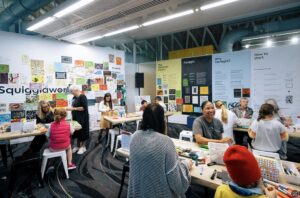
Knowing we can all benefit from the interconnectedness of art and a creative life, the Squiggla Project, managed by Karen Gardiner, was developed by Chartwell as an outreach project to encourage open-ended creative participation. So with the artists in the Collection being the inspiring creative leaders, the Squiggla outreach project focusses on intuitive mark making as a playful means for everyone to start to know themselves as creative people. Squiggla calls on us all to turn our attention inwards, towards sense-based creative experiences that are missing from too many lives. Engagement with Squiggla programmes is growing quickly and the team work with an expanding range of organisations and communities and are always pleased to welcome people at the Aotearoa Art Fair.
Image: The Squiggla Making Space at Aotearoa Art Fair 2024.
What are some of the most memorable moments or achievements in Chartwell’s history that stand out to you?
Firstly, Rob was awarded honours in 2000 (ONZM) and 2015 (CNZM) for services to philanthropy and the arts.
With gallerist Sue Crockford and the Gallery team, Rob and I worked on an unusual acquisition in 2007. Black Market Next to My Name, 2007, by Daniel Malone was originally presented at Gambia Castle gallery as a kind of ‘market’ for all of Daniel’s belongings as he headed off overseas. Conceived as part garage sale, part archive, more people realised how significant the exhibition was, not only as a portrait of the artist’s life but as an accumulation of ideas that represented the wider art community. So instead of each item being distributed to a great many people, the work, as one extraordinary entity, entered the Chartwell Collection soon afterwards.
Welcoming Te Pohio o Hine-Moana, 2021, by Raukura Turei into the Collection was a memorable acquisition. It has become a much-loved work on display in the Auckland Art Gallery with many school groups spending time with the six metre- long work, made with onepū (iron sand), raw pigments and oil on linen.
Memorable too have been the four dedicated Chartwell exhibitions presented in The Chartwell Gallery, on level 2 at the Auckland Art Gallery since its redevelopment in 2011. Natasha Conland curated the exhibitions in 2012, 2017 and 2022 with Stephen Cleland curating the Chartwell show in 2014. These on-going exhibitions, held every three years, are significant for their ability to deeply explore a wide range of contemporary art and ideas for audiences in Aotearoa New Zealand.
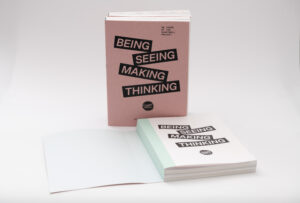
The opportunity to further celebrate artists as part of our 50th Anniversary programme of exhibitions and events from March 2024 to March 2025 has been memorable in so many ways. With over 100 artworks on loan, reaching a large public gallery audience from Auckland to Queenstown over the year has been hugely significant. All culminated in the recent launch of Being, Seeing, Making, Thinking: 50 Years of The Chartwell Project co-edited by myself and Megan Shaw, and co-published with The Auckland Art Gallery. I’m pleased that the book is available at the Aotearoa Art Fair.
Looking ahead, what are your hopes for the next 50 years of the Chartwell Trust and its impact on the arts?
Hopefully it won’t take another 50 years to witness meaningful progress towards developing a culture which is supportive of the value of the visual arts and committed to encouraging more people to experience and benefit from art making and viewing. We will keep working to achieve this. We will continue to lend our voice to all those who see the future of public art galleries as being fundamental to our way of life and culture and, for Chartwell, to continue to support the exploration of big contemporary ideas that reflect visual arts communities. But, right now, I know the last 50 years of Chartwell activity has delivered change often at an extraordinary pace, with huge heart and extraordinary empathy for the deep belief in the possibilities of a creative future. In that, we are all invested together. Please read more in our new book Being, Seeing, Making, Thinking: 50 Years of The Chartwell Project, available at the Fair, bookshops around the country, and on www.chartwell.org.nz.
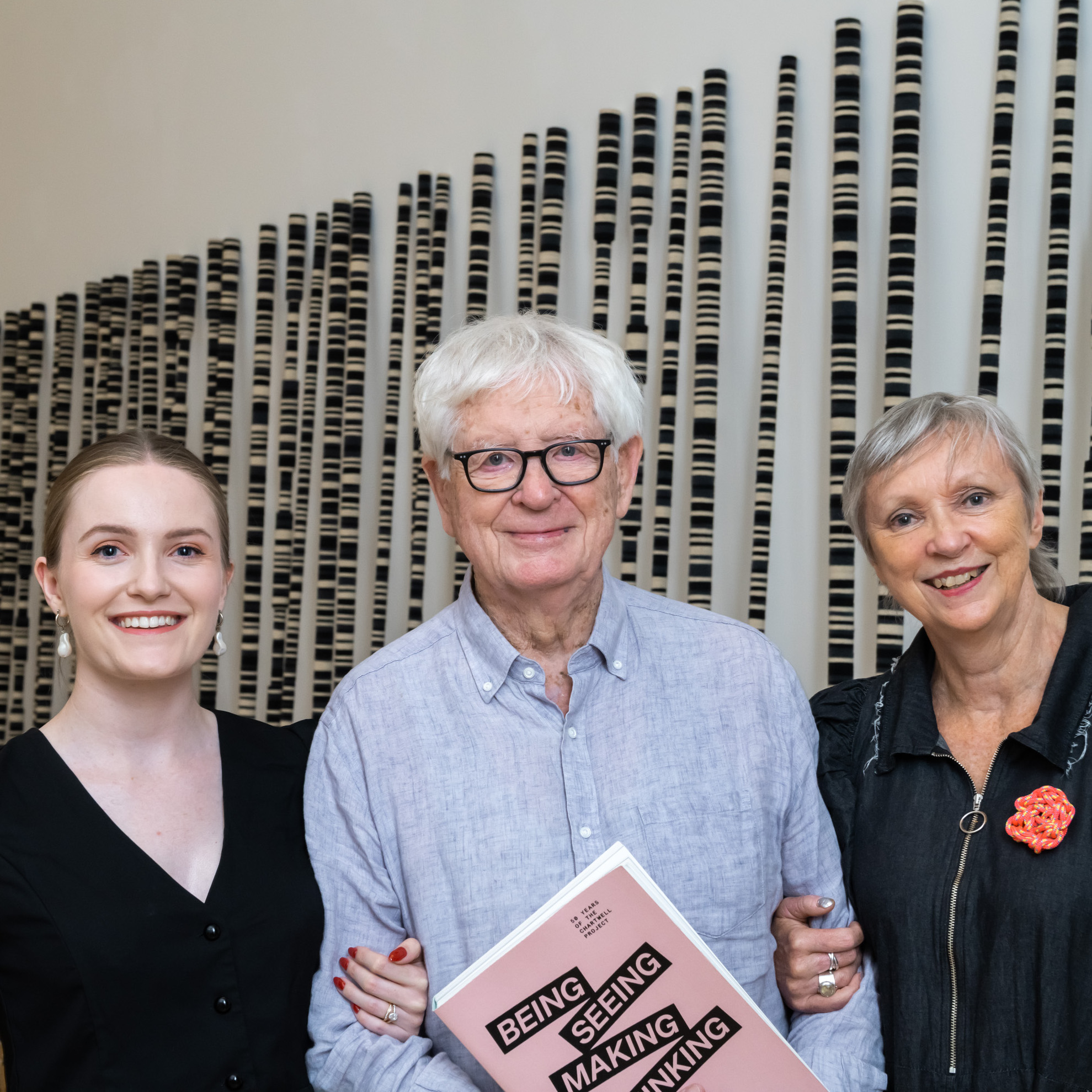
Image: Being, Seeing, Making, Thinking: 50 Years of the Chartwell Project.
Featured image credit: Being, Seeing, Making, Thinking: 50 Years of The Chartwell Project co-editors, Sue Gardiner (right), Megan Shaw (left) with Chartwell founder Rob Gardiner.
N.Smith Gallery has come a long way in a short time, and their journey is a fascinating one. From discovering an unrepresented emerging artist to becoming a prominent gallery representing 24 artists with global projects, it’s a story of passion and growth. Ahead of their second appearance at the Aotearoa Art Fair, we caught up with them to learn more about their journey, the artists they represent, and what’s next for the gallery.
___
Can you tell us about how N.Smith Gallery came into existence?
I met a brilliant, unrepresented emerging artist and knew I needed to help share their work. (Almost) 4 years later and we now represent 24 artists with projects all over the world.
Who are you bringing to the Aotearoa Art Fair and why?
This is our second time exhibiting at Aotearoa Art Fair, and we’re thrilled to continue to develop our relationship with New Zealand curators and collectors. This year we’re honoured to be presenting the work of Nikau Hindin – an incredible, culturally-significant Māori artist dedicated to reviving and preserving the artistry of aute making. We wanted our first project together to be in Aotearoa, so the art fair made perfect sense.
Image: Nikau Hindin
Could you share one of the most memorable times you’ve had working as a gallerist?
Too many come to mind. The first artist saying yes. Our first opening. Artists winning prizes and included in major museum exhibitions. Hiring each of my amazing team. The week we relocated to our new gallery space. Travelling with the artists. Meeting incredible curators and collectors all over the world.
What advice would you give someone looking to start their own art collection?
Ask yourself why you want to collect. Do you want to be the custodian of important cultural objects? Do you want to decorate your home? Perhaps you like the colour blue or paintings of dogs? There are no wrong answers, but it will inform what and how you buy.
The most important thing to remember is that a collection starts with just one artwork – so start!
Image: N. Smith Gallery
What’s happening next in the world of N.Smith Gallery?
I’m currently writing these answers at an art fair in Tokyo. We have upcoming projects around the world, a busy gallery exhibition and museum exhibition schedule, and pop up exhibitions around Australia. We’re also looking at locations for our second gallery space.
The Aotearoa Art Fair are delighted to welcome Studio Italia as the VIP Partner. Studio Italia exclusively represents leading Italian furniture design brands and delivers expert design and craftsmanship to New Zealanders. Keep an eye out for their exquisite furniture at the 2025 Aotearoa Art Fair!
We spoke with Valeria Carbonaro-Laws, founder of Studio Italia, about her journey in art collecting. With over 15 years of experience in the Aotearoa art scene, Valeria discusses what made her want to start collecting, how her collection has evolved, the pieces that have shaped her passion for art, and more.
_______
What made you want to start collecting art?
I’ve always had a love for art. About 15 years ago, I became part of an art group, which gave me the opportunity to understand art more deeply, research it, and eventually start collecting.
How has your approach to collecting evolved over time?
What’s evolved most is my commitment and love for art. Once I entered the NZ art world, I realised how much I truly appreciate it. Going to galleries, meeting artists, attending talks and walks—these experiences made me want to invest in art more than anything else. Over the years, I’ve learned that it’s better to buy one great piece that really makes you happy than to settle for something less.
What is the focus of your collection? Are you more interested in emerging or well-known artists?
I’ve collected both. Some emerging artists have done really well for me. Being in an art group, the budget often limits us to emerging artists, which I actually enjoy. It feels more like investing in the artist themselves than just the piece.
What advice would you give to someone looking to make their first purchase at the Aotearoa Art Fair?
I’m not sure my advice will be that great, but here it is: A few times, I’ve gone to the fair with the intention of restraining myself—but I’ve never succeeded! One or two pieces always get the better of me. The Aotearoa Art Fair is a great place to buy art because the galleries invited are well-established and have great reputations. I’d say go with your gut instinct and choose the piece that speaks to you the most.
What is your favourite piece in your collection and why?
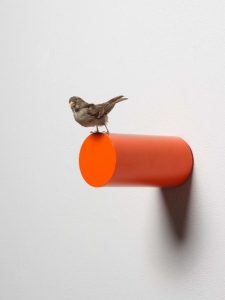
I love every piece I have, as they all mean something special to me, but there’s one I wanted for a very long time. Over 15 years ago, I visited a client’s house and saw a Michael Parekōwhai bird on a small orange trunk. I absolutely fell in love with it—but it wasn’t for sale. I had to wait 15 years before I found one at Art and Object. By then, nothing was going to stop me. Now it proudly sits on my wall.
Image: Micheal Parekōwhai
Was there a piece of art that got away?
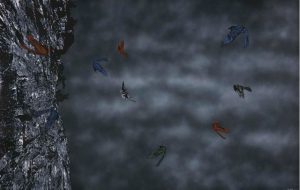
Yes… and I’m still thinking about it. I had the chance to buy a Shane Cotton piece. It was stunning, as most of his work is, but this one really spoke to me. It was dark with a few birds (yes, I love birds) in different colors—very mesmerizing. This was over 20 years ago. At the time, I had just bought shares in Studio Italia, and unfortunately, I didn’t have the money for this kind of purchase. In hindsight, it would have been a fantastic investment, especially since his work has become much more expensive since then.
Exploring the interconnectedness of whakapapa through art, Maioha Kara’s work draws on both personal legacy and broader cultural narratives. Currently featured in a solo exhibition at Hastings City Art Gallery, Maioha discusses how she uses materials like timber and glitter to honour her father’s legacy, reflect on Māori cosmology, and explore the rhythmic energy of te taiao. Speaking with Aotearoa Art Fair, she shares insights into her creative process, her ongoing evolution as an artist, and what she hopes visitors will take from the exhibition.
____________________
Through your practice you explore interconnectedness. Can you explain how this concept shapes the way you approach your work and materials?
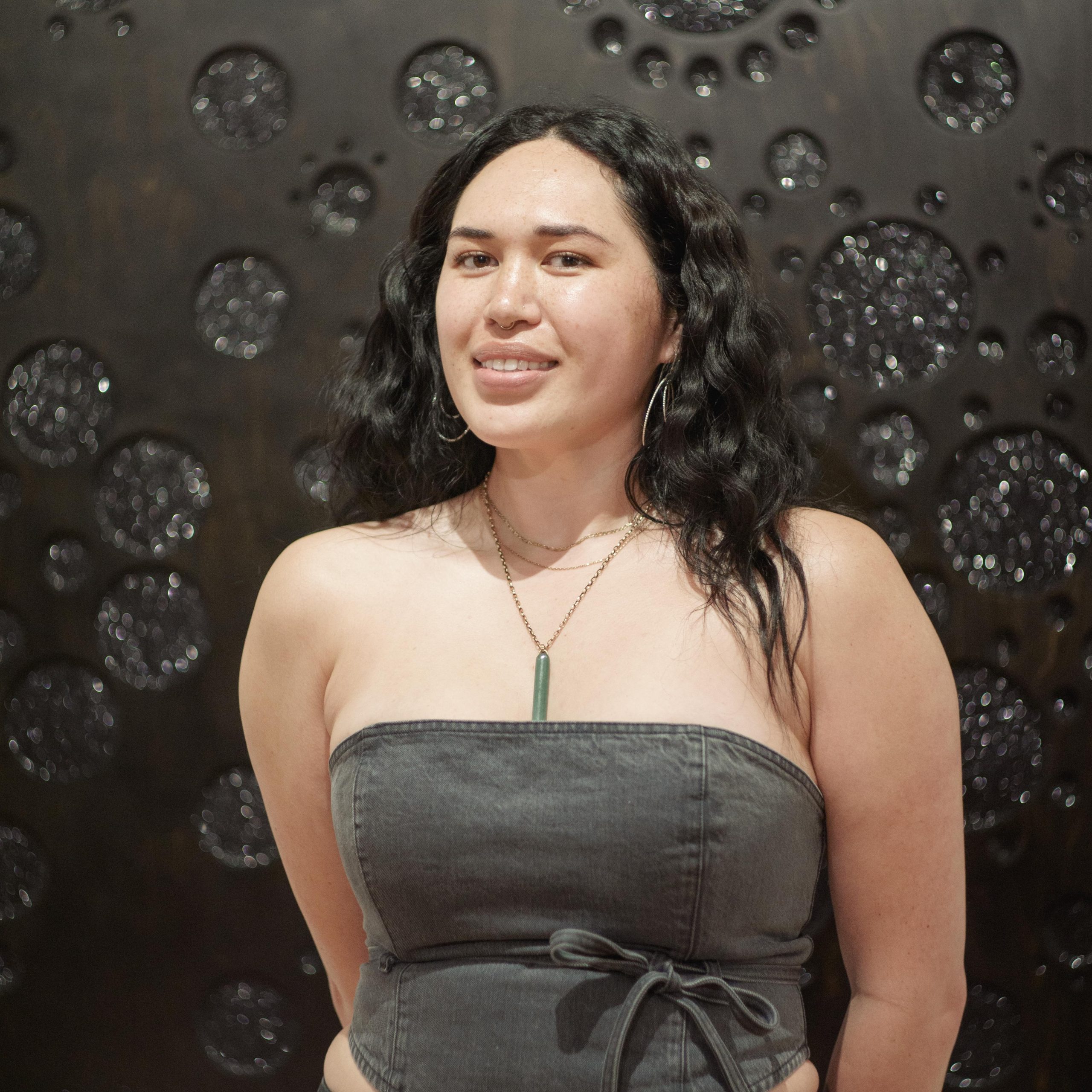
The concept of interconnectedness is almost incomprehensible, I often use whakapapa as a conceptual gateway as it provides a gentle way in. In terms of materials and making, my father is a pukenga toi (an expertly skilled arts practitioner) so it was natural for me to reach for timber when it came to making work (I have used timber for more than seven years now). Working with this material not only connects me with my Dad, but of course timber is also a living material that embodies a sense of time and interconnectedness. Glitter is the other pronounced material in my work, employed to suggest our cosmological link to te whānau marama. I like to consider the ira (spots) across the surface of my work as vessels of light energy or mauri.
Image: In Good Relation: Maioha Kara, Māhanga, 2023, Te Whare Toi o Heretaunga Hastings Art Gallery
How does your father’s artistic practice influence your own, and in what ways do you see your work as a continuation or evolution of his legacy?
Being from Rotorua, where it is accepted that wāhine Māori don’t carve, it wasn’t something I actively considered as a possibility for myself. When I began art school however it wasn’t long before I became interested in working into the surface and surprisingly, I didn’t consider it to be a sculptural intervention. All my life I have been surrounded by whakairo and sculptural objects, a normalised privilege largely due to my Dad. Retrospectively the influence of his work (and other members of our whānau) is so abundantly clear when I look at my own work and in this way, I see my work as an evolution of his legacy. My father is incredibly adept in his work, I hold it as my personal standard of excellence.
Image: In Good Relation: Maioha Kara, 2024, installation view at Te Whare Toi o Heretaunga Hastings Art Gallery
In your practice, you reference Māori and Kuki Airani art forms like whakairo rākau and tīvaevae. What is something which inspires you about these art forms which you bring into your own work?
One of my favourite things which can be found within Māori and Kuki Airani art forms alike is this incredible sense of rhythm and liveliness. When looking at the whare whakairo, for example, and the shift of hand placement on the poupou, I see how subtle changes contribute to a sense of movement and that this emphasises the animate nature of the whare. Employing subtle variation and playing with symmetry and asymmetry is something I do a lot in my own work to build rhythm, gently asserting the notion that stillness/stasis do not exist in te taiao and that this is something to be celebrated.
Image: In Good Relation: Maioha Kara, Whakatā, 2024, Te Whare Toi o Heretaunga Hastings Art Gallery
What do you hope audiences take away from experiencing the exhibition?
The relational worldview held by te ao Māori is something to be cherished and shared. I hope that in visiting In Good Relation, audiences get a sense of this way of interacting with others and te taiao, taking away with them a sense of optimism and hopefulness.
___________
‘In Good Relation: Maioha Kara’ runs at Hastings City Art Gallery until 29 March 2025. Maioha Kara is represented by Laree Payne Gallery in Aotearoa New Zealand.
We’re excited to share insights from Pip England, Chief Executive Partner of Chapman Tripp, into his journey as an art collector and the influences that have shaped his eclectic collection. From early inspirations to his approach of buying what he loves, Pip reflects on the evolving nature of his collection and offers advice for first-time collectors. Chapman Tripp is the presenting partner of Horizons, a new sector aimed at supporting early career artists at the Aotearoa Art Fair 2025.
What made you want to start collecting art?
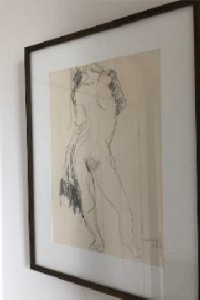
For me, there were two key influences. Firstly, my parents – who loved art and took me to galleries in New Zealand and offshore when I was young. I was very fortunate as a teenager to meet Toss Woollaston with my parents at his Riwaka studio, near Nelson, after they had bought a watercolour and I had bought my first real artwork (a pencil sketch nude). Toss apparently wanted to meet the 17-year-old Kiwi boy who would spend money on art.
Image: Toss Wollaston, Nude, 1977
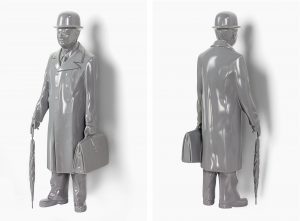
Another key influence was Jonathan Smart, my art teacher at high school. He was so passionate and knowledgeable about art, and made it very approachable and interesting. I would have loved to be an artist myself, but (through no fault of Jonathan!!) I have settled for being an art collector. I have continued to see Jonathan at the Art Fair and in Christchurch. It was Jonathan who introduced me to Michael Parekowhai, selling me a Rainbow Servant Dreamer.
Image: Michael Parekowhai, Rainbow Servant Dreaming, 2005
How has your approach to collecting evolved over time?
Our collection is eclectic. We buy what we love. Sometimes I buy something without telling my wife. As a result, we now have a designated room at home with a number of these works that she would rather hadn’t joined our collection. It’s fair to say they’re not highly visible. I am quite comfortable now that not everyone will love every piece (sometimes including my wife), but as long as it provokes discussion, it’s worth getting, in my view.
Is there a focus in artists in your collection? Are you more interested in emerging or well-known artists?
We don’t have a particular ‘focus’. We have tended to buy New Zealand artists – but not necessarily the well-known or ‘popular’ artists. We have never bought a work because everyone else is buying that artist or because people are saying we ‘should’ buy a particular artist. Nor do we just buy from one gallery. We have bought from a number of galleries over the years.
When we were younger, I set a $15,000 cap for any work. So, that tended to mean we were more often looking at emerging artists. I remember negotiating on a Pule re-sale purely because I couldn’t breach my (arbitrary) cap. Luckily, the gallery owner understood my completely irrational thinking perfectly. I still love the Pule – even more because we had missed some (rather rude) writing on the work that was first spotted by my mother-in-law. Again, it provoked ‘discussion’!
Image: John Pule, Red Cloud, 2003
What advice would you give to someone looking to make their first purchase at the Aotearoa Art Fair?
Make sure you truly love the work. Don’t buy it because you know the name of the artist and think you should. And ideally, make sure your better half also likes the work. It does make life easier.
What is your favourite piece in your collection and why?
That is hard. It depends on my mood, and what I have been thinking about – people, places, events, etc. Right now, my favourite work is a Todd Hunter work we bought from Fox Jensen. It is an amazing, evocative work – but more importantly, was bought for us by a good friend who is not well, so it is very special because of the connection with her. Over the summer break, I was lucky to spend a lot of time staring at a beautiful Gretchen Albrecht that mirrored the blues of the sea and sky off Waiheke.
Image: Gretchen Albrecht, Blue Surge (White Light), 2014
Image: Todd Hunter, We’ll take that ride, 2023.
Was there a piece of art that got away?
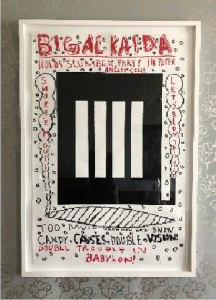
Many. But the most unusual was an early Peter Robinson work that I had seen at Peter McLeavey’s gallery in the late 90s. Olivia McLeavey had shown it to me from the stock room. I then rang – on mobile (a mistake, I later found out) – to confirm I wanted to purchase the work. Peter refused to sell it to me until I had proven I was not a yuppie with a mobile and actually appreciated art. I eventually got him over the line. He put the Robinson on the wall (balanced on two pins…) to show me the work. It fell and cracked the edge of the work, rendering it unsellable. I didn’t get my Robinson until many years later when Peter sold me a Big Al Kaida work (which we still own and love).
McLeavey Gallery is located in Wellington Central, how does the community and neighbourhood around you inform the gallery
The Gallery is located in Cuba Street which is the bohemian heart of Wellington. We are surrounded by great restaurants, vintage shops, cafes, live music venues, other galleries and a wide mix of creative people. It’s a dynamic and exciting atmosphere. We are located between two universities so we see a lot of students and academics. This neighbourhood attracts people to the Gallery with a point of view.
Can you tell us one of the most memorable times you’ve had working as a gallerist?
Every exhibition is different and has its own organic energy, they are all memorable. However perhaps one of the most memorable, as a child I witnessed was a two-man show between Julian Dashper and John Reynolds, it was titled “Omaha Beach” and they painted huge velvet canvas with globby bright oil paint in the gallery. John must have been in his early 20s and brought a huge ghetto blaster into the gallery to listen to while they painted the show. It was so exciting, it planted a seed of how exciting the art world can be. Wonderful that all this time later we are still working with John and bringing his latest collaboration (with Karl Maughan) to the Art Fair.
What advice would you give someone looking to start their collection?
My advice is to look at a lot of work before you decide to buy, to hone your eye. Also to collect your contemporaries, people of your age and generation who share your concerns and experiences. Also, buy the best you can afford.
What are you most excited about for the Aotearoa Art Fair 2024?
I love the opportunity to see so much work from such a variety of artists all in one spot. Also for me, it’s a wonderful opportunity to connect with colleagues and friends in the art world and I always really enjoy the convivial atmosphere and the social element that goes along with the fair.
Learn more about what McLeavey Gallery is presenting at the Aotearoa Art Fair 2024 here.
Images:
Olivia McLeavey portrait, photo by Russell Kleyn.
Extra Floral #1, Extra Floral #2 and Extra Floral #3, John Reynolds & Karl Maughan, 2023, Oil & acrylic on canvas, 1400 x 1000 mm
Your gallery is located in Wellington Central, how does the community and neighbourhood around you inform the gallery?
Te Whanganui-a-Tara, Wellington is a fantastic small city, punching well above its weight. It is progressive, collegial, and collaborative. Since opening in 2018, we have had a huge amount of support from the Wellington Arts community, both from my existing networks and new supporters. In particular, the public gallery curators and directors, and other dealers have been super supportive of the gallery and our artists and programme.
Can you tell us about how Jhana Millers Gallery came into existence?
Initially I trained in Contemporary Jewellery and Fine Arts. While studying for my Masters I was managing a non-profit philanthropic gallery in central Wellington, 30Upstairs, owned by Art Collector Malcolm Brow. The gallery supported recent arts graduates and, in many cases, gave them their first exhibition outside of the University institution — some of these artists are Kāryn Taylor, Emma McIntyre, Yolunda Hickman. At the gallery I worked alongside Jade Townsend from Season, and Pauline Autet, from Contemporary Hum. It was here I furthered my experience organising exhibitions and managing a gallery, alongside the experience gained participating in and planning my own exhibitions. I also had several other paid and volunteer arts administrative roles. After 30upstairs ran its course, I chose to open my own gallery to continue to support other artists in their journeys, rather than continue my own arts career.
Who are you bringing to the Aotearoa Art Fair and why?
We are presenting a solo exhibition by early-career artist Hannah Ireland. Hannah is based in Tāmaki Makaurau and has a joint degree in fine arts and psychology. From her teenage years Hannah has been painting portraits, and since graduating from Elam in 2022 has become well known for her ambitious, murky and somewhat haunting works. For this year’s Fair, Hannah is working in paint on canvas and incorporating motifs and patterns as an exploration and expression of her whakapapa.
What’s happening next in the world of Jhana Millers Gallery?
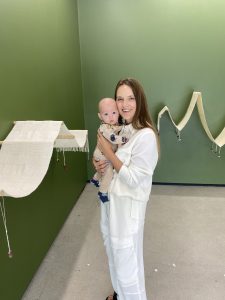
For the rest of the year our focus is on presenting solo exhibitions by our represented artists, with the one exception — we are launching a limited edition print series with an exhibition in May. This will accompany the launch of an online store for books, prints and artworks under $1500. We will also be updating our brand identity and website, hopefully in time for the Fair. Personally, I am finding a work/life balance with the addition of my new baby boy Atticus.
Images
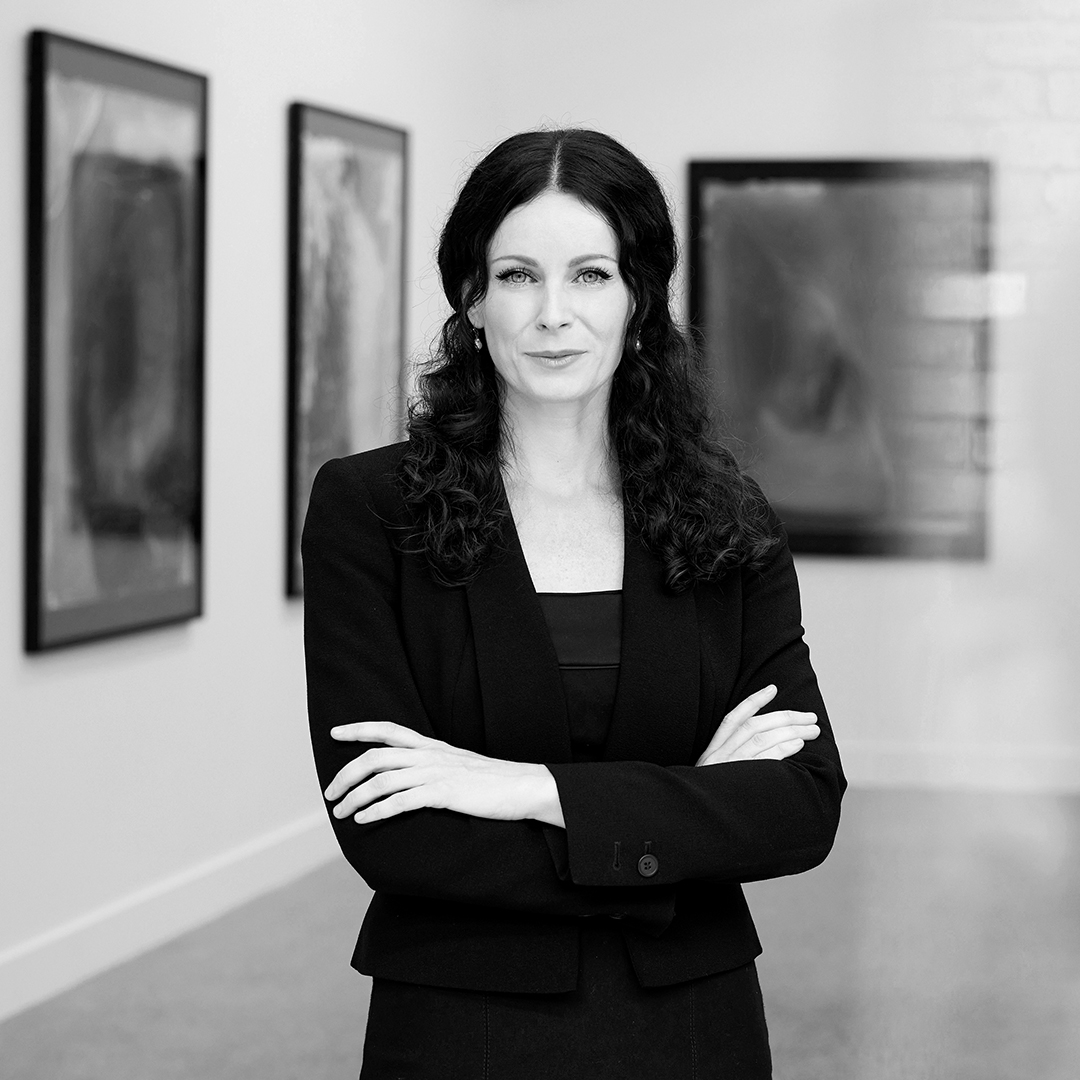
Right – Jhana Millers portrait in the gallery, Image by Profile Pics
Jhana Millers exterior
Hannah Ireland. Up on the Mountain, 2024. Flashe and acrylic on (stitched) canvas. 1450 mm (H) x 1300 mm (W)
Hannah Ireland. Back To Sea, 2024. Flashe and acrylic on (stitched) canvas. 1400mm (H) x 1300mm (W)
You recently took over the directorship of Sanderson Contemporary. What about this role excites you the most?
I think it’s a real privilege to be able to do what you love. I have been passionate about supporting artists and their work for a long time and have worked in galleries since I was 18. I felt I was already in this privileged position but I feel it even more so now that I am the owner of Sanderson. What excites me most about the role is getting to see the impact we can have on artists careers and on their lives. I want to work really hard for them and make as positive an impact as I can.
Could you share one of the most memorable times you’ve had working as a gallerist?
One of the most memorable experiences was co-curating an all-female artists exhibition in London, which showcased the art collections of seven prominent women collectors from Europe and America. We hosted two panel discussions, one with Iwona Blazwick, Director of the Whitechapel Gallery, moderating and the other with Bloomberg curator and art critic Sacha Craddock moderating. Dame Phyllida Barlow, who represented Britain in the Venice Biennale and passed away last year, was part of the exhibition and on one of the panel discussions. What struck me about the experience then, and even more so now looking back on it, is the profound impact women can have on the industry. Whether it’s through curating, working as a gallerist, being an artist or a collector: all of the women involved in the event had incredible vision and drive and had achieved so much. It was inspiring to work alongside them.
What advice would you give someone looking to start their art collection?
Make sure you go with your gut and what you feel you really love. Its great if the artwork is also a good investment but don’t let that be what leads your decision making. I think being able to have artworks in your home that inspire you and bring you joy every day is the best part of having a collection of your own.
What are you most excited about for the Aotearoa Art Fair 2024?
We are presenting a group exhibition this year with Zara Dolan, Stephen Ellis, Wi Taepa (Te Arawa, Ngāti Whakaue, Te Āti Awa) ONZM, Simon Kaan (Waitaha, Kāti Māmoe, Kāi Tahu), Kāryn Taylor and Jon Tootill (Ngāi Tahu). We’re excited to present this line up of artists. They each have such a unique practice and we know people will enjoy engaging with their works.
This year the art fair is under new management with Art Assembly at the helm. I am excited about this change because Art Assembly are already so well-rehearsed at putting on great fairs in the Asia Pacific region. Having the new venue is going to bring a fresh new dynamic to the fair. There is also a great range of galleries coming with a combination of solo and mixed presentations in the booths so I think it’s going to be fun.
See what Sanderson Contemporary are presenting at the 2024 Aotearoa Art Fair here.
Artwork Images:
1 (Left) Simon Kaan, Te Au, 2023, Ink and oil on board, 1200mm x 900mm
2 (Middle) Kāryn Taylor, Horizon, 2022, cast acrylic , 900mm x 600mm x 45mm
3 (Right) Jon Tootill, KORE TAITARA I, 2023, acrylic on canvas, 1000mm x 1300mm
4 Portrait photo courtesy of Olivia Kirkpatrick
Can you tell us about how Jonathan Smart Gallery came into existence?
JSGallery came into existence in 1995 when Andrew Jensen and myself (after 7 years of working together in Jonathan Jensen Gallery, Chch) split the partnership and he went to Wellington whilst I stayed in Te Wai Pounamu – wanting still to make a contribution for the better in Ōtautahi, the city in which I had been raised.
Could you share one of the most memorable times you’ve had working as a gallerist?
There have been many memorable moments, good, bad and everything in between. Surviving the half hour with guards brandishing AK47s locked in an immigration room in Mumbai airport in the early hours of the morning, having to explain my baggage and motivations for coming to India was quite an achievement. I was presenting a group show of NZ art at Chatterjee & Lal, a terrific contemporary gallery in Mumbai. And Mort Chatterjee recommended that I carry everything with me, that avoiding Customs was the best way to go about things in India. But the young Army man in his crisp white uniform and gold epaulets could not come to grips with my luggage, my tubes of rolled canvases, photographs and small sculptures. I was a drug smuggler. And it was my job to prove him wrong. Offering my body and a couple of artworks for x-ray saved my bacon. We enjoyed a wonderful Opening a couple of days later, and the show ran for 3 months – a tribute to its reception.
What advice would you give someone looking to start their own art collection?
For those who want to start: pick a couple of good galleries, look hard at the range of work they offer and ask questions of the Gallerist as to the whys and wherefors. Learning to appreciate work is the quickest way of becoming confident in personal taste. As one needs to love a work that might grace one’s life for some time – to be fascinated and mystified about it even if it may over time become an investment.
What are you most excited about for the Aotearoa Art Fair 2024?
I enjoy the collegiality of Art Fairs. We rarely get together as a sector, and this is a chance to catch up in the widest sense of the word. I’m very excited to be presenting a solo stand of new paper, canvas works and quilts by Mark Braunias – one of my originals, an artist with whom I’ve had the privilege of working for 36 years now!
Stay Connected
Be the first to hear about exhibiting galleries, artist highlights, and what's on at the Fair.
Stay Connected
Be the first to hear about exhibiting galleries, artist highlights, and what's on at the Fair.