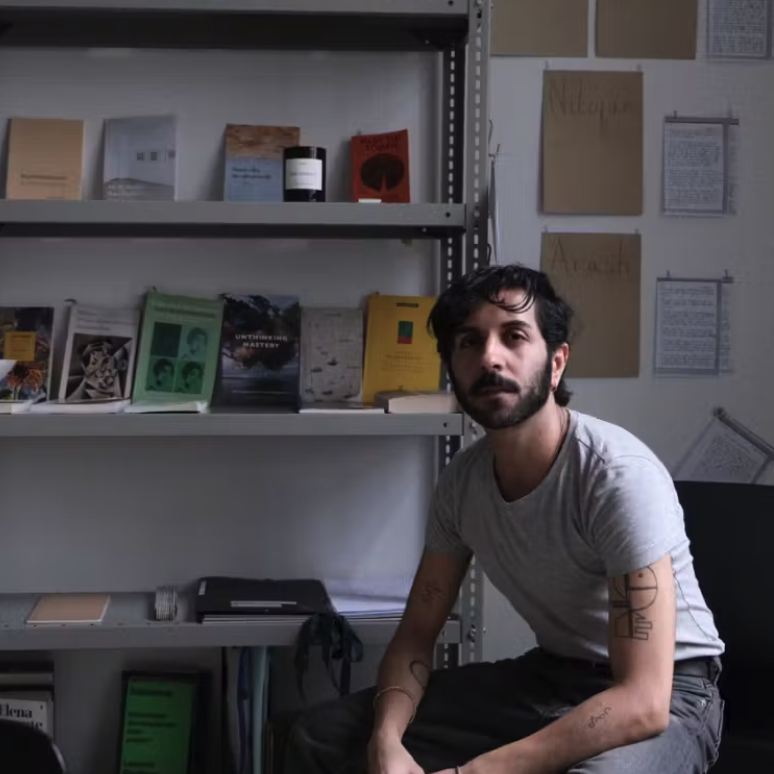
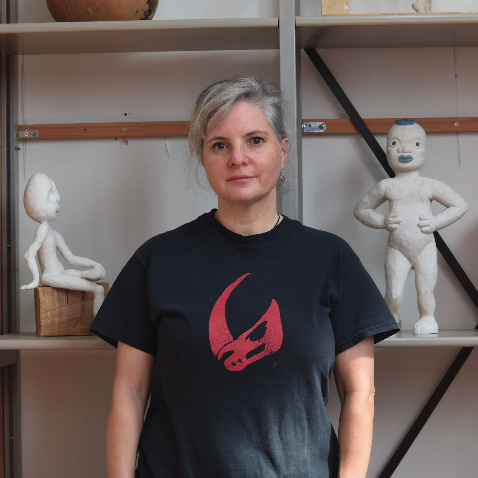
In this conversation with Nadine Rubin Nathan for Vitrine, Areez Katki speaks to repair, inheritance and the pull of London ahead of their Gasworks residency.
Read the full interview on Vitrine.
Earlier in the year, at Aotearoa Art Fair in Auckland, Tim Melville gallery dedicated the first two days to a solo exhibition of hand-embroidered artworks by Areez Katki created on textile fragments given to the artist and former ordained Zoroastrian priest by his family’s Parsi tailor in Mumbai, India. The embroidery works, mounted painting-style on the walls of the booth, were first shown in 2025 in Innsbruck, Austria, at the Taxispalais Kunsthalle Tirol.
Born in Mumbai in 1989 and raised in East Auckland from age 12, Katki studied Art History and English at the University of Auckland and Creative Writing at Wellington’s International Institute of Modern Letters. They returned in 2018 to their ancestral Parsi home in Mumbai, a shift that became a catalyst for wider research into Zoroastrian histories and sites across Gujarat, Iran and Azerbaijan. The Parsi community, an ancient ethnominority who follow the Zoroastrian faith, were persecuted after the Islamisation of Persia in the eighth century and many, including Katki’s ancestors, fled to India.
Katki’s practice explores the complicated and often queer contours of migrant identity, bringing ancient traditions and personal archives into conversation with the present. The past two years in Berlin, initially as the recipient of the 2024/25 CNZ Berlin Residency at Künstlerhaus Bethanien, has seen Katki begin to develop an experimental novel, a publication, a performance-based ritual, and a new moving-image work. During their time at Gasworks, Katki will continue the research and development for this new performance and moving-image work, ‘An Internal Dissenter Who Remains in Relation’.

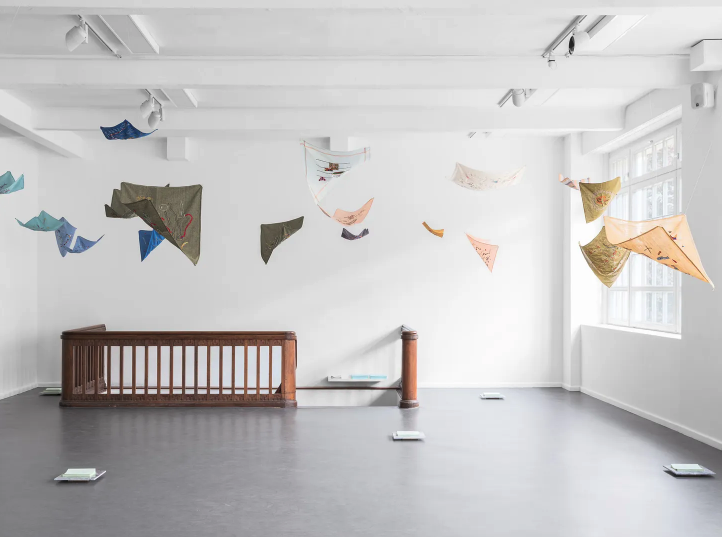
Areez Katki. ‘How to puncture the sky and hear the stones sing’ (install view). Künstlerhaus Bethanien (Berlin, DE), 2025. Photograph: Julian Blum.
Vitrine: Your practice is built around stitching, mending and layering. Do you think repair is an artistic act, a political act, or a spiritual one?
Areez Katki: I feel like each time I’m confronted with the subject of repair I have slightly varied responses. Today, repair to me looks a bit more like resistance. Perhaps this indicates that it is currently more motivated by political intentions? If you had asked me this at another juncture, I might’ve responded differently. Ideally the act of repair, whatever its objectives, has an outcome that aids our understandings around the materiality of loss.
Vitrine: Can you share an example?
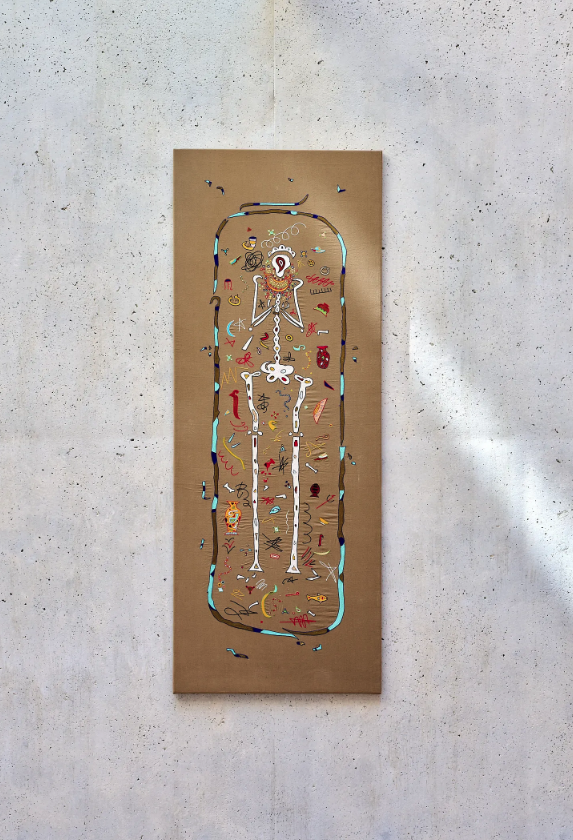
AK: My grandmother used to cover the furnishings in her flat (the one I now use as my studio in Mumbai) with large bolts of slubby khadi cloth whenever she left for extended periods of time. For a recent work titled ‘She took a long bath (after Jacques de Morgan)’, 2025, I imagined one of these bolts as a ground for interconnective ancestral material—accrued, gathered, hoarded—utilised as a means of understanding (our) histories against colonial theft. There emerged an intimacy but also an immediacy to this mode of fabular storytelling. I felt compelled to contextualise my grandmother’s dust cloth against the recorded evidence of a bronze bathtub-shaped coffin in Susa during the late-Achaemenid period. The coffin contained the remains of an elderly female with a broken hip. She was surrounded by objects of personal significance: ceramic vessels, gold, silver, faïence and bronze treasures. The recorded dimensions of the skeleton bore physical similarities to my grandmother’s, who also sustained a fractured hip in her later years. A French archaeologist named Jacques de Morgan documented this gravesite in 1905, and published a small watercolour rendering of it alongside a report of his excavations of Achaemenid Susa, in ‘Mémoires de la Délegation en Perse’ (Vol. 8, Plate 2), titled Découverte d’une sépulture achéménide à Suse. While the original painting, as well as the treasures and remains, are still held in the collection of the Musée du Louvre in Paris, I tried to approach theft not through the fantasy of recovery, but as a way of understanding loss. A way to reclaim ephemera on our own terms: by re-drawing in embroidered thread, on a much larger scale than the original painting, how the confines within which ancestral residues and their earthly treasures continue to rest in the imaginations of their descendants. For me, this becomes a form of repair: tethering a familial history across geographies and generations.

Areez Katki. ‘She took a long bath (after Jacques de Morgan)’, 2025. (install view). Cotton thread hand embroidery, found textile. 1885mm H x 720mm W. Exhibited in ‘The Daughters’ Trilogy Chapter II: COMMUNION’ at TAXISPALAIS Kunsthalle Tirol (Innsbruck AT), 2025. Photograph: Günter Kresser.
Vitrine: Contemporary art is often preoccupied with the language of identity. Your work seems interested in inheritance instead. Are those the same thing?
Areez Katki: Identity and inheritance are often enmeshed, but I believe them to be distinct in their ultimate pursuits and pathways. The way I see it, preoccupations with identity are often rooted in a desire to reconcile the self against a global context, imagined as a fractured subject, whether through geopolitical frameworks or instances of biographical rupture. These languages may not directly cite psychoanalysis, but they can nonetheless steer toward methodologies of understanding in which the self begins to resemble a model proffered by Western schools of thought.
Inheritance, as an alternative pathway, is coded with similar desires— yet I feel like it opens this conversation up to paradigms that resist emphasising a reconciliatory outcome for an individual. I find it far more compelling to frame phenomena through plurality, interpreted and reinterpreted across generations in cyclical modes of understanding and transmitted knowledge systems. In doing so, the self is dwarfed by a constellation of affective inheritances that we may read, follow through annals, and commune with on a deeper level. Inheritance allows us to act as receptors through which ancestral voices may emanate and subsequently flow outward, to the next generation—who will invariably add their own layers of interpretation and experience onto a collective tapestry.
Ultimately, I think it could be about two distinct pedagogical approaches: one that centres the individual, another that situates the individual within a continuum.
Vitrine: Do you think queer artists from formerly colonised cultures face a particular pressure to reconcile sexual identity, cultural inheritance and Western ideas of liberation?
AK: Certainly. I think part of the pressure comes from the assumption that queerness must be positioned against cultural inheritance, particularly when that inheritance is imagined through the lens of heteronormativity. For queer people from formerly colonised cultures, Western narratives of liberation can sometimes arrive as another framework through which we are asked to understand ourselves: first by locating ourselves against the supposedly conservative traditions we inherit, and then by measuring our liberation against Western models of sexual and gender freedom.
I’m more interested in what happens when inheritance isn’t treated as a fixed thing that must either be defended or escaped, but as an archive that can be reinterpreted. A queer body can inherit, alter, contradict and transmit simultaneously.
Vitrine: Indigenous knowledge and textile traditions were routinely devalued. Do you think reclaiming these practices is inherently political, or can that argument itself become reductive?
AK: It might be reductive if such claims pursued political motivations alone as their objective. I think it all comes back to pedagogy for me, and how such traditions might be sustained in order for a Global Majority audience to self-reference their own histories, on their own terms. This gets more complicated when an audience demands explanations in order for such work to feel more intimately understood or ‘readable’. Must everything be translated for the dominant culture before it is allowed to count as knowledge? It might be helpful if these conversations happened in places unencumbered by systems, dare I say, where authorship is still controlled by those who continue to occupy positions of institutional power. I think here of Gayatri Spivak’s writing on epistemic violence: the problem of what happens when knowledge is only sanctioned legitimacy once it becomes legible within the structures of those already authorised to produce it.

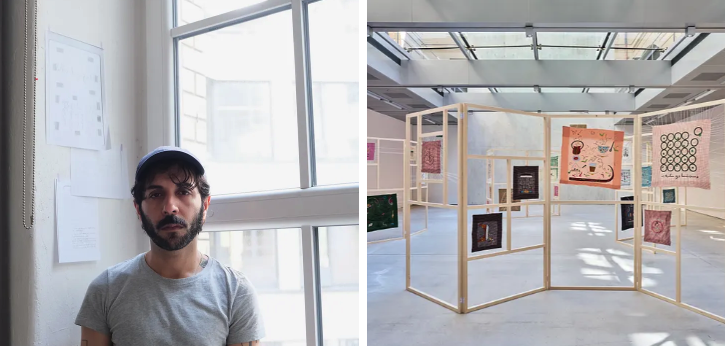
Left: Areez Katki. Photograph: Rick Burger. Right: Areez Katki. (extra)ordinary affects, 2024 – 2025. (install view). Cotton thread hand embroidery, found textiles, cotton twine, pinewood scaffolding. Exhibited in ‘The Daughters’ Trilogy Chapter II: COMMUNION’ at TAXISPALAIS Kunsthalle Tirol (Innsbruck AT), 2025. Photograph: Günter Kresser.
Vitrine: The Gasworks residency has a particular history of bringing artists from outside Europe into dialogue with London’s contemporary art world. What, if anything, do you want to resist about the way Londoners might read your work?
AK: Perhaps I’d resist the comfortable option of explaining my work and its objectives? I’d like very much to explore the expansive possibilities of my role as a descendent of Zoroastrian Maji, a knowledge-holder and storyteller, whose position isn’t perceived as an ethnographic spectacle but rather one that is able to transmute beyond its formerly parochial and patriarchal iterations.
At the same time, I think it’s kind of fun to play with the expectations of certain audiences, and dialogue with the why and where of those assumptions and desires: how they arose, or why they think it’s relevant to discuss these details—those emphasised expectations to justify one’s work that are placed upon non-european practices. If there’s fragility to be encountered in those conversations, I say pass the popcorn.

Areez Katki. ‘An Internal Dissenter Who Remains in Relation, 2025’ – ongoing. Film still preview from multi-channel digital video (in development).
Vitrine: The residency is deliberately self-directed. What are you hoping it will unsettle in your practice?
AK: At this point, I’d rather stay observant, curious and open to what London might unsettle in me. I imagine there might be ways of developing a deeper understanding of the UK’s Parsi-Irani diaspora and (our) global positionality. I’d like to find ways to engage in discussions around an entanglement of subjects—migration histories, convenient erasures, colonial complicity—as ways to trouble, perhaps unsettle, some of these complex histories and how they might be critically approached today. I also have family in London, a nephew and niece whom I’d love to sit in conversations with, and learn more about their relationships with being Kiwi, British, Indian, Parsi.
Vitrine: In London, do you imagine yourself looking at the city or looking back at it?
AK: Probably both, although I suspect looking at London will inevitably become a way of looking back. Because London is not a neutral geography: it is an imperial archive. I don’t think one can look at London without wondering what London has looked at. I’d like to walk my nephew through Room 52 in the British Museum, and see his reflection against the glass vitrines containing objects once used by our ancestors. He’ll probably ask, “How did they get here?” — and perhaps I’ll respond, “How did we get here?”
Vitrine: What do you think the West still fundamentally misunderstands about the cultures it once colonised?
AK: The West continues to underestimate how much of what it calls ‘tradition’ is actually a living, adaptive, intellectual system, often mistaking legibility for understanding. The colonial museum transformed relationships between people and objects into relationships between subjects and specimens. I think that distinction still shapes how cultural practices are encountered: what cannot immediately be translated into the museum’s existing categories is too easily treated as decorative, folkloric, spiritual, or otherwise outside intellectual discourse.
Vitrine: You’re spending a lot of time in Berlin. How has that city affected your practice?
AK: I think that Berlin has made me realise that distance is itself a material—one with which my practice is growing better acquainted. Alongside drawing, embroidery and repair, there is an experimental novel that I’ve been working on for the past six years. It has been on the forefront of my mind, and Berlin has nurtured it in ways that have been productive, but also disruptive. The writing has also fertilised various projects and series of works that I’m currently developing: a publication, a performance-based ritual, a new moving-image work.
Vitrine: Which conversations about contemporary art in Aotearoa (or in the world at large) do you think are exhausted, and which have barely begun?
AK: I’ve been living outside Aotearoa for a few years, so I’ve been engaging with the local contemporary art ecosystem from more of a distance. But one conversation with a senior curator at a social gathering some years ago stayed with me. They were describing the work of an artist who had just been commissioned to make a work for an institution—a remarkable award-winning work—and the curator made a remark directed toward me. They described with awe and admiration how this artist’s sensitive approach to materials was so compelling because it was devoid of any craft. This made me smile. And it stayed with me because it made me wonder why material intelligence, however it may be presented, acquires greater institutional value once it has been separated from the markings of historic labour and cultural practice that produced it. I suspect that is one conversation that is far from exhausted.
Areez Katki is represented in Tāmaki Makaurau Auckland by Tim Melville and in Pōneke Wellington by McLeavy Gallery.
Read more of Nadine Rubin Nathan’s writing at @vitrineaotearoa
@nadinerubinnathan_writer
@areezkatki