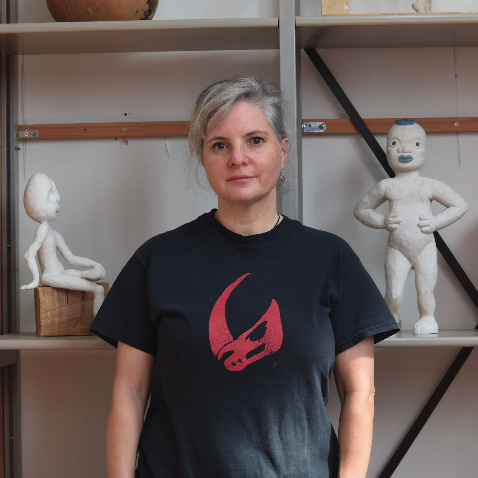
Gavin Hurley paints faces borrowed from art history, layering flowers and familiar poses until portraiture starts to feel like homage. On the occasion of Other People’s Flowers, a group exhibition with Kirstin Carlin and Julia Holderness at Melanie Roger Gallery, we spoke with the artist about borrowed flowers, the pipe as a stand-in for masculinity, and painting Jean Cocteau’s face onto a stranger’s.
Your practice has long been grounded in portraiture and the codes of representation embedded in art history. With this series, the flowers partially obscure your portraits. What led you to use them as a kind of veil rather than a purely compositional device?
About twelve years ago, I was part of the Tylee Cottage residency in Whanganui. I often visit second-hand bookshops for research, and while I was there I found an image of Ben Shahn’s Blind Botanist.
It was a series featuring a young man holding thistles away from his face. In other works, the Botanist has grown old and the thorny branches cover his face. I have based many of my paintings on the idea of “growing up”, and I read these works by Shahn as depicting someone being overwhelmed by life. He described the version with the older man as being “to express a curious quality of irrational hope”.
You’ve drawn specific flowers from Gordon Walters, Michael Illingworth and Louise Henderson for this body of work — how did you choose which artists and which specific paintings to pull from?
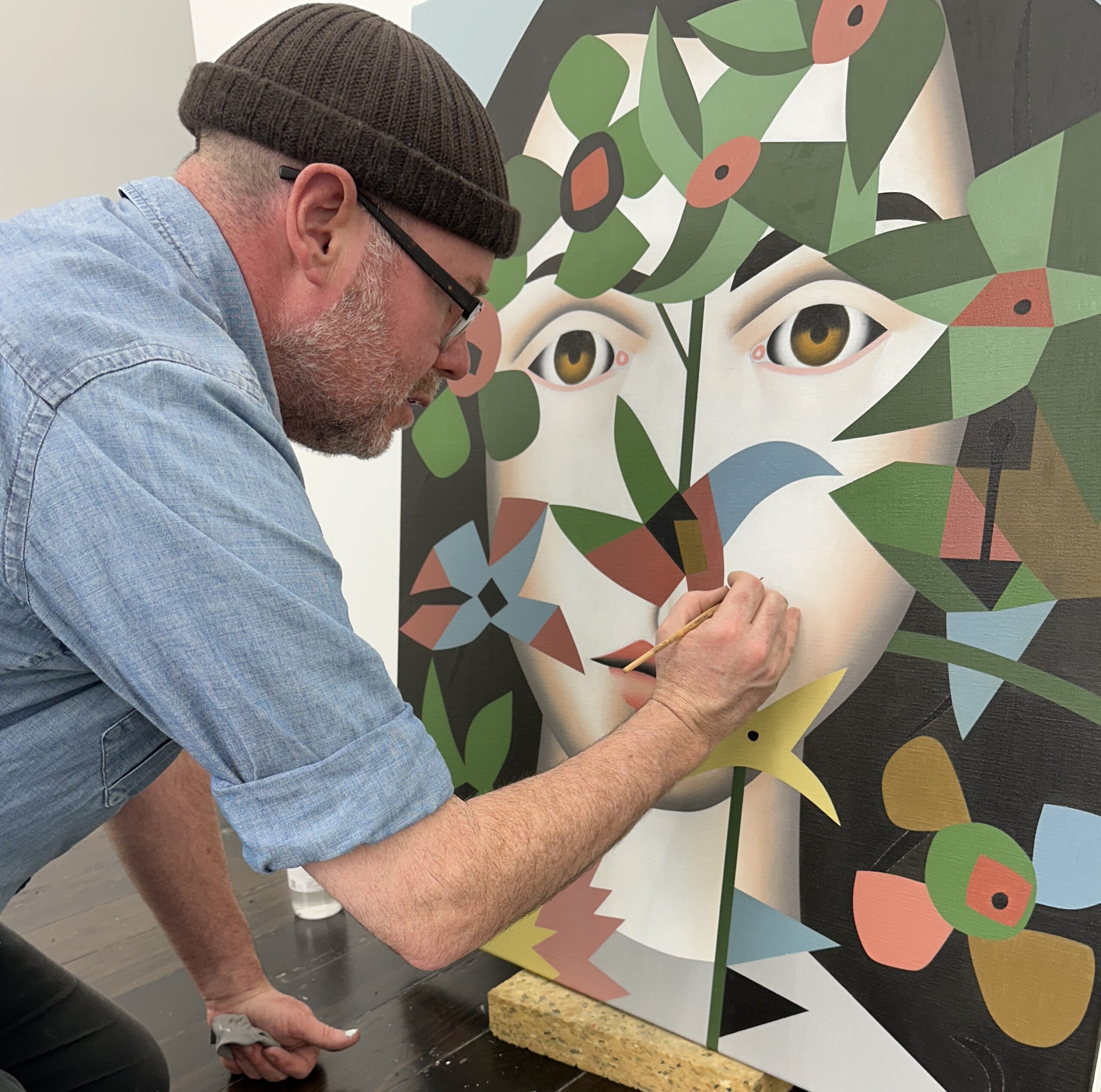
I have borrowed flowers and abstract shapes from Louise Henderson’s Paper Flower Merchant before. In some of my paintings, they partially cover faces, although for these works I isolated a few flowers that emerge from the pipe.
I have always found Michael Illingworth’s paintings strange, but I love faces on things, so I had to try one of his flowers for the show.
The Gordon Walters chrysanthemum wasn’t part of my original plan. Then I read that it was one of his favourite paintings, and that making it gave him a sense of freedom and pleasure. I liked that, and it seemed like a good reason to include it.
The pipe recurs across the second series and carries quite loaded associations — Surrealism, colonial portraiture, a certain performance of masculinity. Was that ambiguity something you set out to explore, or did itemerge as you worked?
Pipes have recurred in my work many times over the years, for different purposes. I have never been a smoker, but I find images of smoking in art fascinating. In this group show, the flat shape of the pipe is like a thought or speech bubble. Other People’s Flowers is the title and theme of the exhibition, so the referenced flowers grow out of the pipes as homages to these artists.

Gavin Hurley, Boy with Illingworth’s Flower, 2026. Courtesy of the artist and Melanie Roger Gallery.
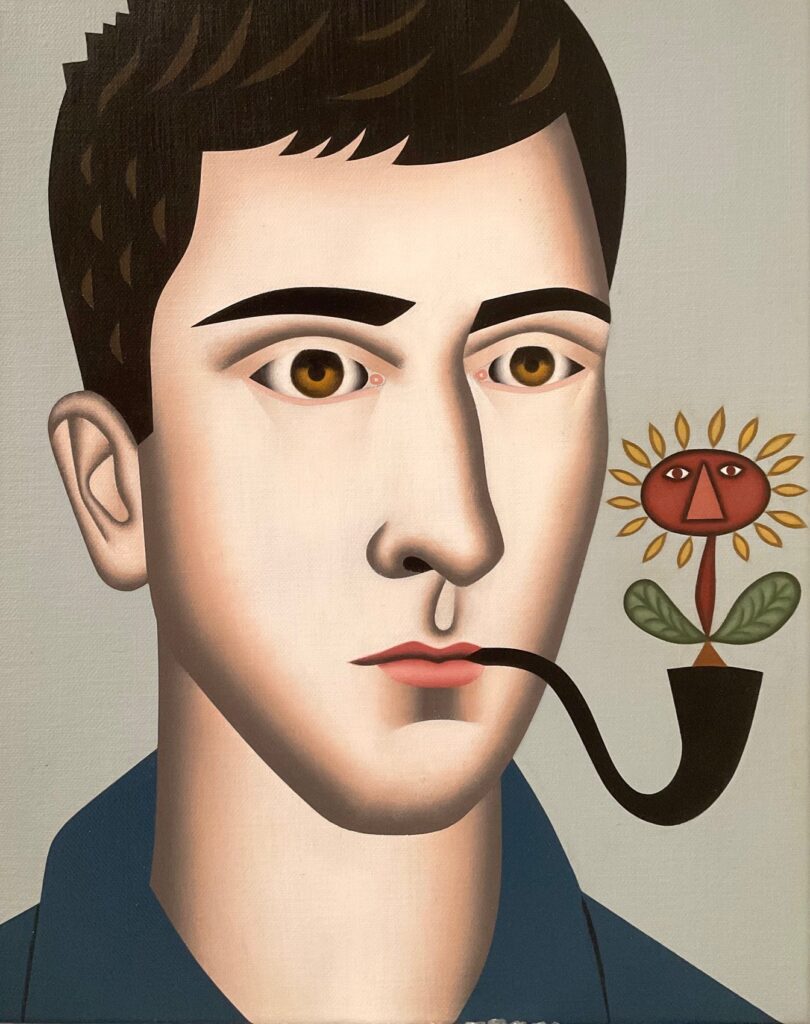
Does the young male figure across this series represent a particular type, or is he more of a recurring character you return to across bodies of work?
The guy in these paintings is based on a sketch I found in an old catalogue of Jean Cocteau as a young man. I changed his hair but kept the shape of his face from the original drawing.
I made three of these paintings at the same time, keeping them almost identical apart from the flowers in the pipes. I had also underestimated the size of the flowers, so I had to use smaller brushes than I had originally expected.
Your practice has largely centred on male figures and the ideals of masculinity attached to them. In this series, though, women take centre stage in two of the larger works. Is that a shift in direction for you, or does it have more to do with the works’ connection to flowers?
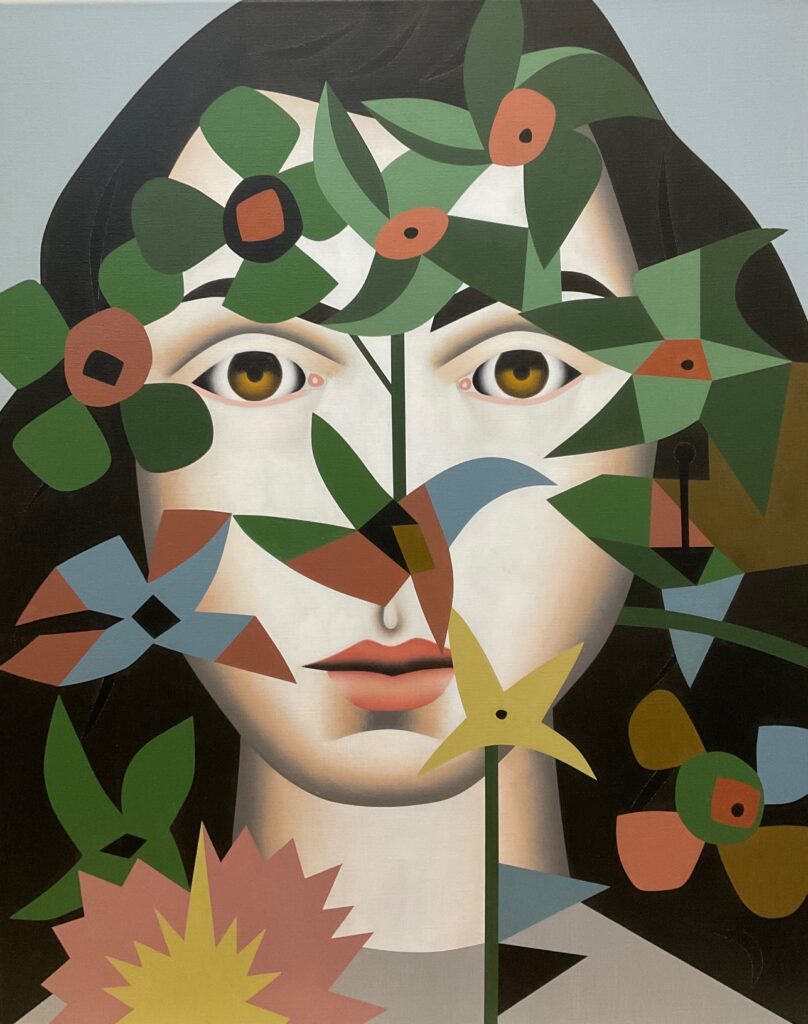
I have been asked a lot about why I paint more men than women. I think there is more of a balance than it may seem to viewers at first glance. That balance has shifted considerably over the last few years, with a series of Rita Angus paintings made for a solo exhibition at the New Zealand Portrait Gallery last year, and with the continuing use of flowers over faces.
For Other People’s Flowers, it was simply a decision to paint two larger pieces with female faces. There was originally a plan to have one male and one female figure, but I’m a slow painter, and in the end the decision came down to what I felt would sit best within the show. One of the works almost didn’t get finished.

Gavin Hurley, Big Sonia with Henderson’s Flowers, 2026. Courtesy of the artist and Melanie Roger Gallery.
How did working alongside Kirsten’s and Julia’s very different approaches to “borrowing” shape or shift your own thinking for this show?
Kirstin and I had an initial meeting with Melanie Roger, who curated the show. Julia is based in the South Island, so she wasn’t there in person.
I was very happy to be invited to show alongside them. Kirstin’s expressive approach to paint is very different from my hard edges. I especially like that, in this exhibition, she has made paintings that sit within a painting. Julia’s impressive, research-based ceramics are both painterly and sculptural.
Learn more about Other People’s Flowers here.
@gavin_hurley
@melanierogergallery