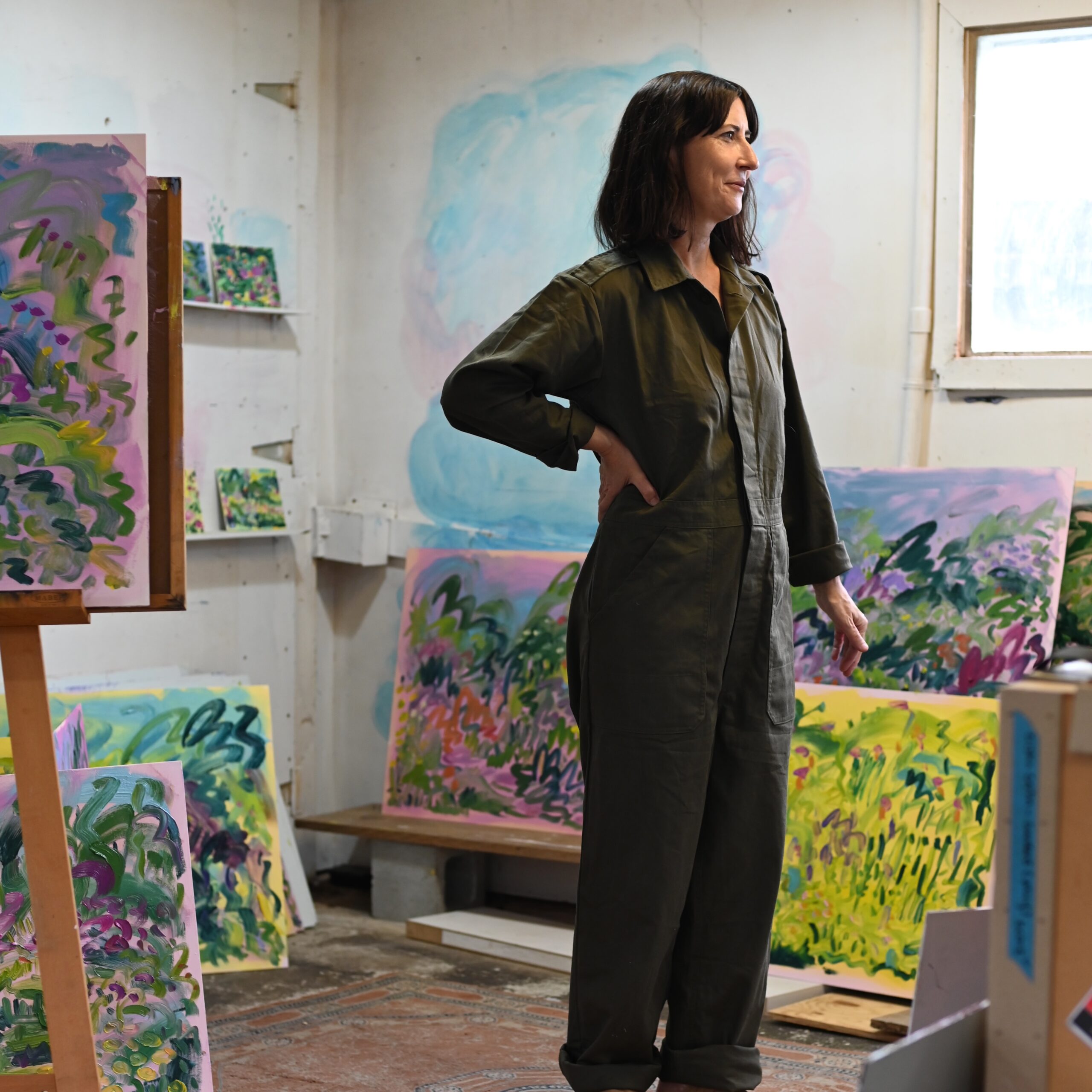
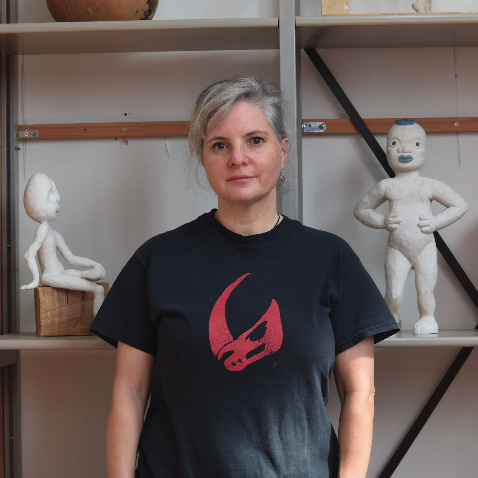
Kirstin Carlin paints other people’s gardens into her own, cutting and reassembling her canvases until the frame itself becomes part of the work. For Other People’s Flowers, a group exhibition with Gavin Hurley and Julia Holderness at Melanie Roger Gallery, we spoke with the artist about building an archive from borrowed imagery, water-jet-cut aluminium panels, and painting her way through Joan Mitchell’s garden.
Flowers and gardens have consistently recurred throughout your practice. For these works, where did your inspiration come from?
Flowers and gardens regularly feature in my work — still life, gardens, landscape. I’m interested in the ubiquity of these subjects and their connection to painting’s history. I borrow, collect and rework imagery from photographs, books, magazines, historical paintings and online collections, continually building an expansive archive from which my paintings emerge. For the works in this show, I worked in a similar vein — trawling, borrowing and repurposing both historical and contemporary imagery.
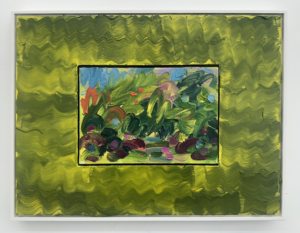
Kirstin Carlin, Green, 2026. Courtesy of the artist and Melanie Roger Gallery.
You are known for your unique style of mark making and the evocative interplay between abstraction and representation. At what point does an image stop being a reference and start becoming your own?
The imagery is always the very starting point of a painting — a springboard, a jumping-off point, a cue to “dive” into my own work. Sometimes I’m working from many different images: a path from here, trees from there, constantly pushing and pulling the image and thinking about process versus representation — marks for mark’s sake, and marks that aren’t for mark’s sake. I test how far an image can drift from its source while still carrying its trace.

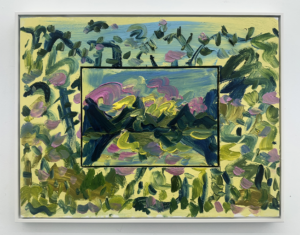
Kirstin Carlin, South, 2026. Courtesy of the artist and Melanie Roger Gallery.
The cut-out and reassembled elements complicate the idea of the frame in these new works. What drew you to physically cutting and moving paintings within paintings, rather than working within a single fixed surface?
Although I’ve been working with the idea of cut-outs in the studio for a while, the work in Other People’s Flowers is the first time I’ve shown works using this technique. It’s been fun heading out to industrial East Tāmaki to have my aluminium panels cut with a water jet.
I was asked at the opening of the exhibition how I came up with the idea of “cutting into” the paintings. It came from thinking about the edge of a painting — where it stops and the frame begins. I see the works as more than simply having an elaborate frame, though. They are paintings within a painting, an inside and outside, continuing my interest in pushing and pulling against figuration, mark making, imagery and process. By “remixing” my paintings, I break up the composition, and some of the formal decisions are forced out of my hands.
The title of the show is Other People’s Flowers. Whose flowers feel most present to you personally in this body of work?
I’m regularly painting “other people’s flowers” — a photograph of someone’s garden found online, reworking a still life by a favourite New Zealand modernist, or painting my grandmother’s roses. But the work I made for Other People’s Flowers fits into the show in a less literal way. My paintings are a stroll through Joan Mitchell’s garden in Vétheuil, “borrowing” her titles Weeds, Noon and South; channelling Frances Hodgkins — my constant companion — and her beautiful, wonky flowers; and appreciating the light touch of Joanna Margaret Paul’s blossoms and flowering plants.
Learn more about Other People’s Flowers here.
@kirstincarlin
@melanierogergallery