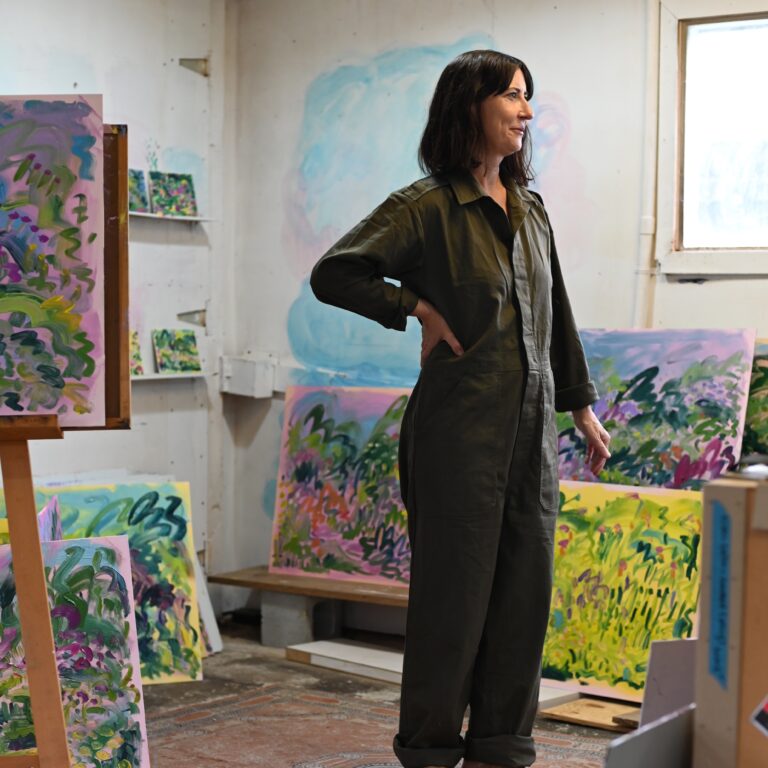
Ngaroma Riley carves ancestors and family stories into wood, working her way into a tradition that hasn’t always made room for wāhine. With her carvings now included in Te Papa’s five-year exhibition He Toi Whakairo, alongside 147 taonga spanning seven centuries, and a new joint show with Tawhai Rickard opening at Tim Melville, Riley is having a breakout year. We spoke with her about learning to carve Buddhist statues in Japan, her love of chainsaws alongside traditional hand tools, and what it means to be part of a growing wave of wāhine carvers reclaiming space in whakairo.
Your work is currently on show at Te Papa as part of He Toi Whakairo, which is set to run for five years and sits alongside 147 taonga spanning seven centuries. What does it mean to have your work in that kind of company, and on that kind of timeline?
To be honest, it’s pretty mind blowing to have my work shown in such prestigious company. Not only because of the exquisitely carved works in the exhibition, but because of the carvers that I’m showing alongside. Some of the taonga whakairo (carved treasures) I’ve seen in books before and many of the tohunga whakairo (expert carvers) I hold in high esteem. I was very excited to meet Riki Manuel whose work I first saw in Japan as a 17-year-old exchange student. Seeing his work back then was a pivotal moment in time for me. I often look at our ancient taonga as points of reference because the carving styles have changed over time, with the resources and tools available to us. I’m still at the beginning of my carving career so I was definitely feeling a bit of imposter syndrome on the day of the opening.
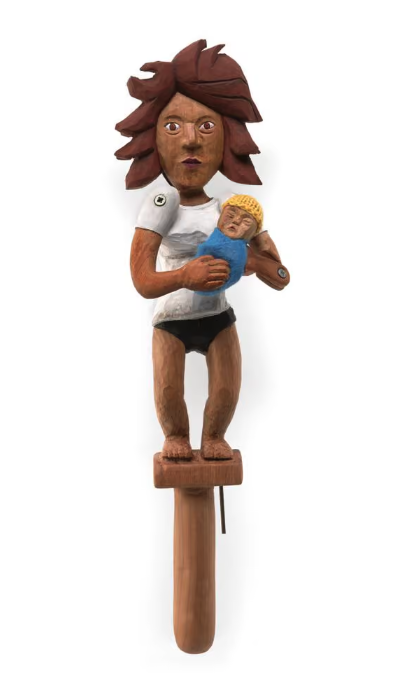
Ngaroma Riley, Māmā, 2024. Courtesy of the artist and Te Papa Museum.
Carving has historically had restrictions around who could carve what, particularly for wāhine. What did navigating those boundaries look like for you personally, and has that changed as more wāhine carvers come through?
There are currently some restrictions around carving but whether these were historical or not, we don’t really know. For example, most of the whakairo in the show at Te Papa are unprovenanced. That means that we don’t know who the makers were, but to assume that they were all carved by men helps perpetuate a narrative that women never carved. It’s not helpful and it doesn’t make sense.
We know that Māori society was a lot more fluid than Pākehā ethnographers would like us to believe. People had roles for sure and we certainly had our experts, but we all would have been skilled in material culture. We would have been able to make many items which are considered art forms now, but back then were necessary for survival. I can’t imagine any Māori woman sitting around waiting for someone to carve her something personal if she had the ability to do it herself. There are also well known stories of tupuna wāhine (female ancestors) who carved.
Sadly, because of colonisation, the art of carving and many aspects of Māori culture have been lost or gone to sleep. The revival of whakairo Māori has sought to exclude women but this is gradually changing. There are an increasing number of wāhine carvers and we have the first wahine carving shed at Te Tuhi in Pakuranga.
You started carving making Buddhist statues in Japan – how did that experience shape the way you approach wood and form today?
I really love carving in three-dimensional form. The brief tuition I had in carving Buddhist statues kickstarted this journey. Japan has a very long unbroken wood carving history, so there are many examples to draw inspiration from. They also use a range of tools in different ways to whakairo Māori (Māori carving) so I’m very fortunate to have acquired some basic skills that I can now apply to the work I’m doing.

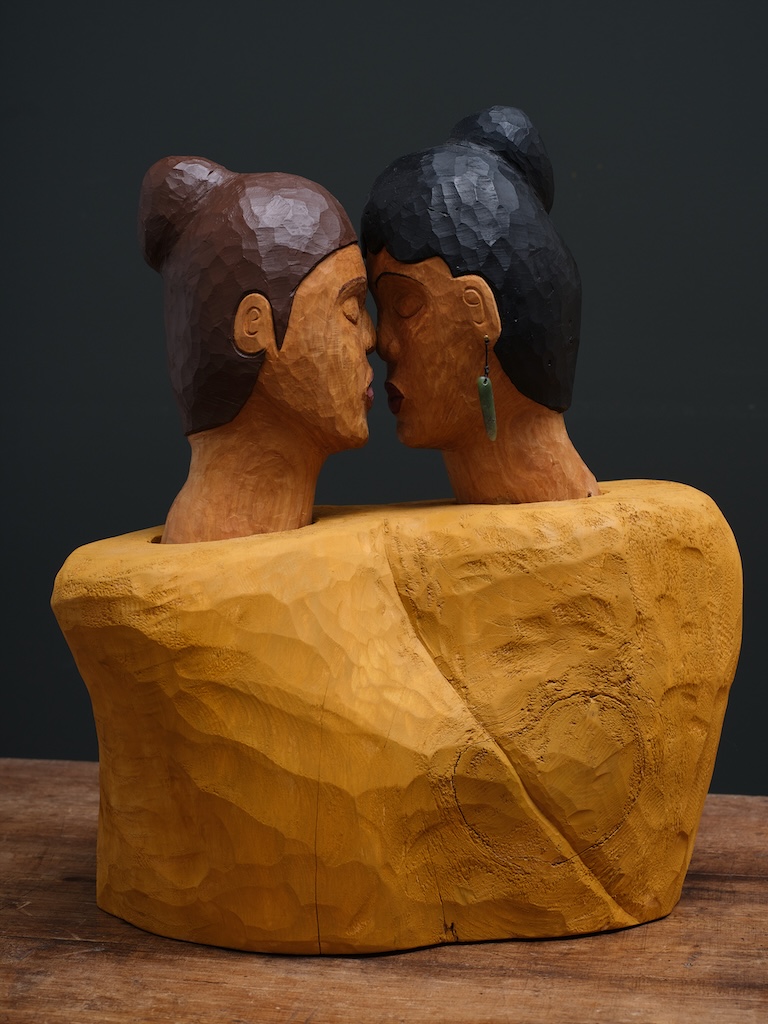
Ngaroma Riley, The Lovers, 2024. Courtesy of the artist and Tim Melville.
You’ve mentioned a love of chainsaws alongside more traditional carving tools – how do those different tools show up in your process?
I frequently use power tools to block out work and speed up the process in the initial stages of carving. I’m short with small limbs and an aging body. Carving is physical work and power tools allow me to conserve my energy. I use hand tools such as saws and chisels for carving and creating finer details in my work.
You recently won the Fair Trust Art Prize (presented by Eileen Fair Charitable Trust and Te Manawa), the Molly Morpeth Canaday Award 2025 and the Caselberg Trust Creative Connections residency in Dunedin. What impact has winning these awards and residencies had on your practice?
The Fair Trust Art Prize is huge for me as it will be my first solo show at a public gallery. I’m nervous but excited about the work I’m yet to make… (Did I mention that I have problems sleeping? Ha ha). The 2025 MMCA was my first major recognition as an artist and it was at that stage that I felt that I could start telling people I was an artist. It was great for my self-esteem. The Caselberg Trust Creative Connections residency was like a homecoming because I’ve spent a lot of time on the Otago Peninsula and in Dunedin. The residency gave me the space and time to research, create, connect, reflect and rest. It was very good for the soul and I hope all artists get this kind of opportunity at some stage in their career. The biggest impact on my arts practice so far has been the Papatunga residency at Te Tuhi in 2024. This grew into the establishment of the wāhine carvers studio: Te Ana o Hine at Te Tuhi. I am currently the ahi kaa at the studio and this has nurtured my practice beyond belief. It’s enabled me to focus on my career without fear, and to create works at a larger scale than before. Hiraani Himona and the team at Te Tuhi are staunch advocates for wāhine carvers and our movement.
Can you tell us about your upcoming exhibition at Tim Melville in September?
Pōnga Rā / when will you walk with me is a joint exhibition of work by Tawhai Rickard and myself. The title takes its name from a song written by Rob Ruha in 2014. My work features carved figures on a hikoi/protest. Among them are family members, tangata Tiriti and more. I remember going on hīkoi with my Māori mother and Pākehā father, because protesting injustice has always been a family affair. Held in the lead-up to Aotearoa New Zealand’s 2026 general election, this exhibition is my response to a government whose policies seek to diminish the role of Te Tiriti o Waitangi andundermine Māori representation. These policies form part of a wider political climate in which Māori rights and the place of Te Tiriti in our national life are increasingly contested.
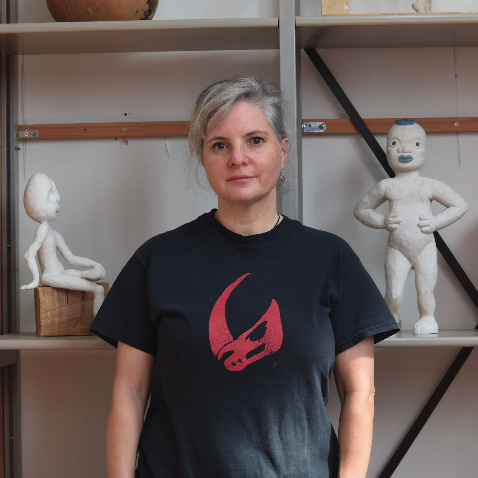
Photo of Ngaroma Riley by Tui Hirabayashi.
@ngaroma_riley
@timmelvillegallery
Te Papa – Ngaroma Riley
Tim Melville – Ngaroma Riley