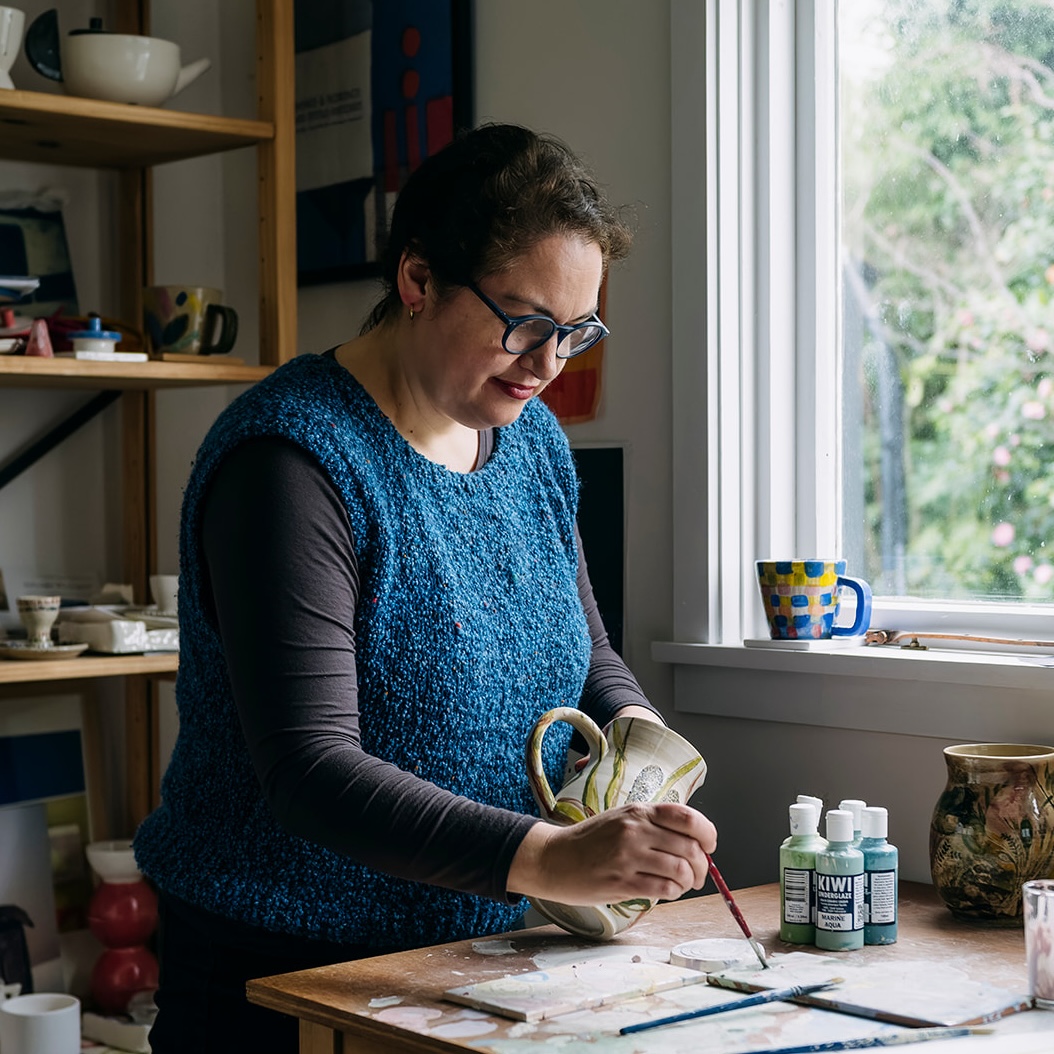
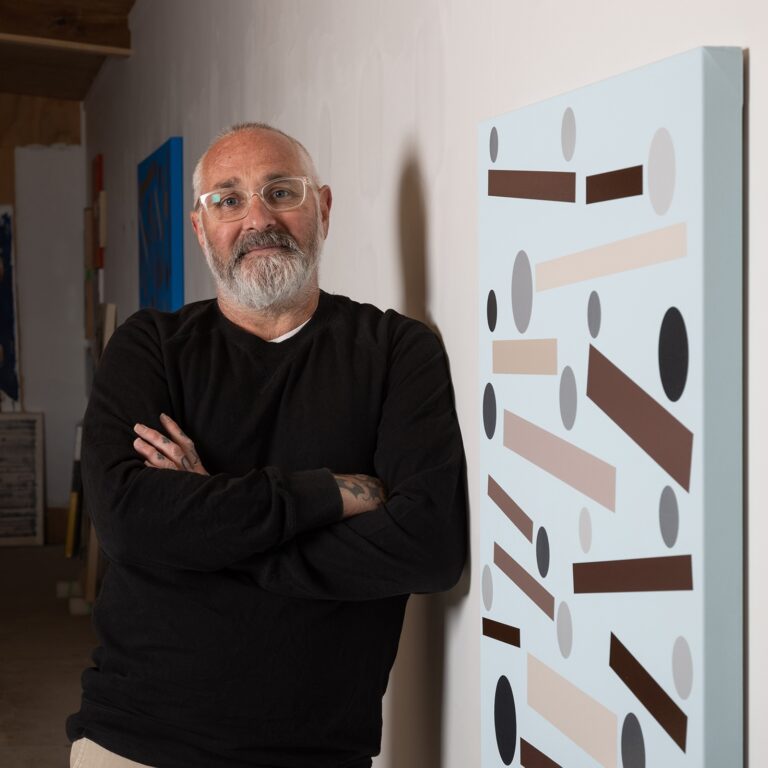
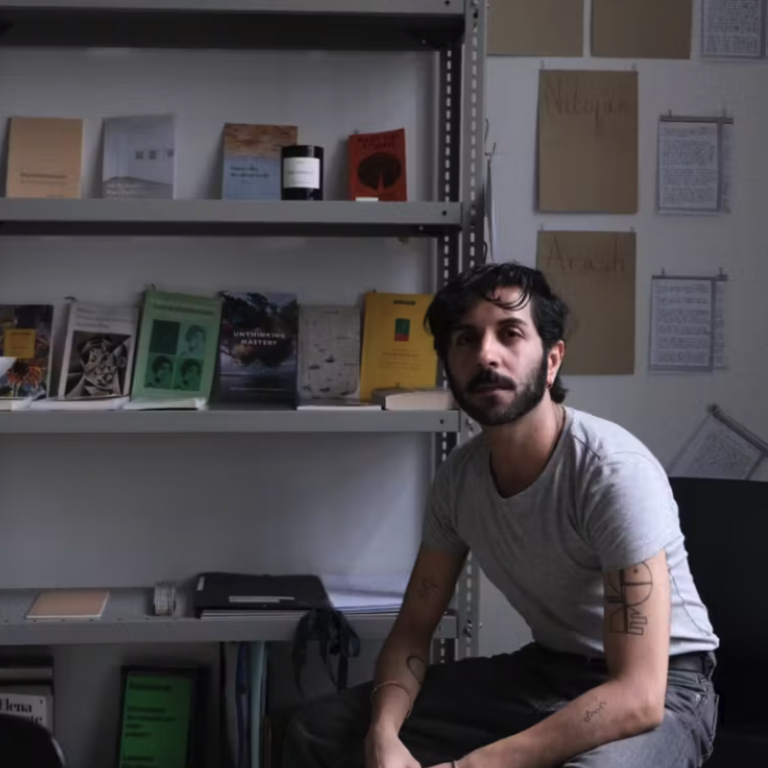
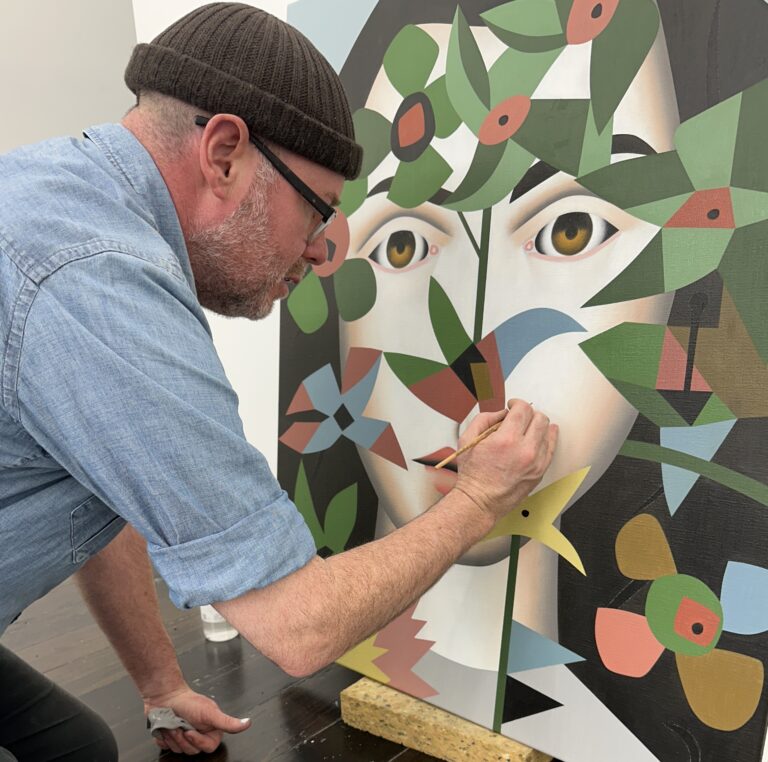
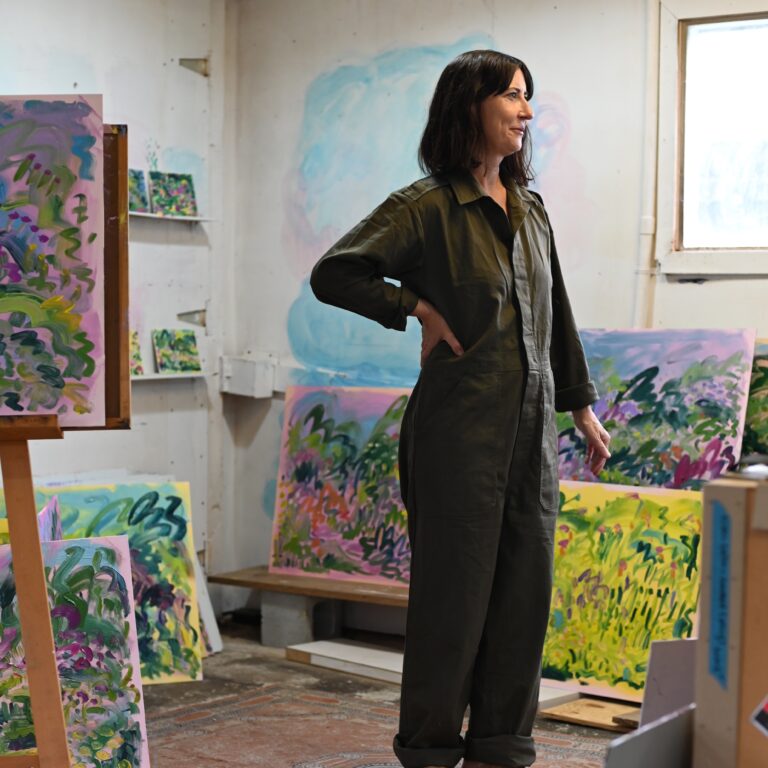
Julia Holderness works across ceramics, textiles, sound and text, always tracing how objects and ideas move between people. For Other People’s Flowers, a group exhibition with Gavin Hurley and Kirstin Carlin at Melanie Roger Gallery, we spoke with the artist about the shared studio of Doris Lusk, Anne Hamblett and Molly Lawn, flowers as carriers of friendship and influence, and why ceramic was the right form for this body of work.
You first developed this material for your exhibition The Studio, 2021 at Dunedin Public Art Gallery in 2021. That project explored the shared studio of three young New Zealand artists—Doris Lusk, Anne Hamblett and Molly Lawn—who rented a space and worked together in central Ōtepoti Dunedin in the years following art school, 1939–40. What drew you back to it for this exhibition — did you find you weren’t finished with the group studio , or did something new open up?
One of the things I discovered while looking closely at Lusk and Hamblett’s work from that period was that they had used the same vases as subjects in their paintings. I became really interested in that small detail — the way an object could move between them, appearing in different paintings and taking on slightly different lives through each artist’s interpretation.
I started thinking about my own experiences of gardening alongside friends. We exchange tubers, cuttings, seeds, we talk about varieties and growing conditions, and pass flowers between our homes. There’s a kind of informal conversation that happens through those exchanges, and I began to see a parallel with the way artists exchange ideas, objects and influences. I was thinking about Lusk, Lawn and Hamblett bringing flowers to their studio, arranging them together and chatting about them.
So I suppose I wasn’t finished with Lusk, Hamblett and Lawn, but I also wasn’t simply trying to revisit that earlier exhibition. The vases opened up another way of thinking about their relationships — through the objects they shared and looked at together, and through the quiet forms of influence that happen between people who work alongside one another.

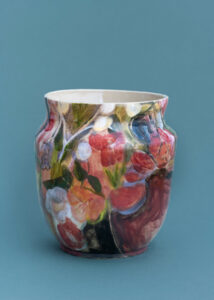
Julia Holderness, Flower Piece (Anne Hamblett 1939), 2026. Courtesy of the artist, SANDERSON and Melanie Roger Gallery.
Is there something particular about flowers — as opposed to any other still-life subject — that makes them suited to carrying influence and conversation across time and between artists?
I think flowers have a particular capacity to carry relationships because they are both incredibly specific and constantly changing. A flower can belong to a particular garden, person or season, but it can also be propagated, exchanged and carried somewhere else. Flowers also have such a long history within painting, so when you depict a flower you’re inevitably entering into a conversation with other artists and other images. I like that a flower can be both an ordinary, familiar thing and a vessel for quite complicated ideas about friendship, memory and time.

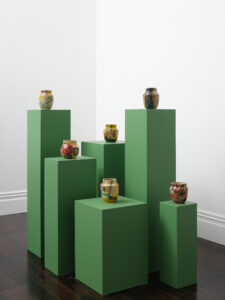
Julia Holderness, Installation View. Courtesy of the artist, SANDERSON and Melanie Roger Gallery.
You work across ceramics, textiles, sound and text. What made ceramic specifically the right material for this body of work, rather than paintings?
Melanie and I were interested in bringing an object-based element into Other People’s Flowers to complement Gavin and Kirstin’s wall works. Ceramic felt particularly appropriate because the vase is already at the centre of the story I was researching. It allowed me to take something that had existed as an image in Lusk and Hamblett’s paintings and return it to its three-dimensional form.
There’s also something interesting that happens when you make a painting on a vase. The work is still fundamentally concerned with painting — colour, composition, surface and the act of looking — but the image is wrapped around an object rather than contained by a rectangular frame. The surface curves, so the image changes as you move around it. You become aware of the vase as an object as well as an image.
I liked that tension between painting and sculpture, and between something functional and something purely visual.
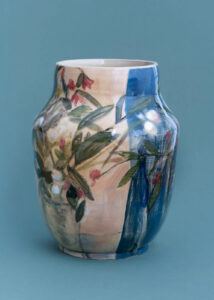
Julia Holderness, Spring Blossom (Anne Hamblett 1939), 2026. Courtesy of the artist, SANDERSON and Melanie Roger Gallery.
How do you want your vases to sit alongside the works by Gavin and Kirstin in Other People’s Flowers — as a quiet historical footnote, or as something that talks back to the contemporary paintings around it?
Definitely as something that talks back. They are paintings, but paintings on a three-dimensional surface, and that creates a different physical relationship to the works around them.
I also like the idea that they bring the historical material into the present rather than keeping it at a distance. The vases have moved through different hands and different contexts — from the artists I was researching, into my research, and now into this exhibition alongside Gavin and Kirstin’s paintings. They become another kind of conversation.
For me, that’s what connects the historical and contemporary work: not necessarily that the artists are making the same kind of work, but that ideas, images, objects and influences keep being passed between people and transformed along the way.
Julia Holderness exhibits courtesy of SANDERSON where her exhibition ‘Botanical Correspondents’ will run concurrently from 26 August – 14 September.
Learn more about Other People’s Flowers here.
@jholderness
@melanierogergallery
@SANDERSON